
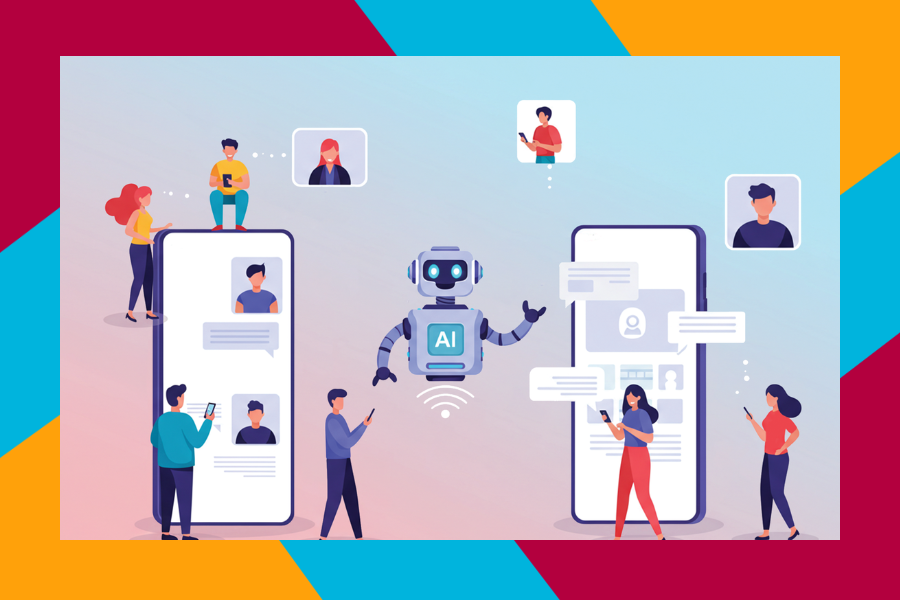
Kevin Fenning discusses his new report looking at the use of AI in local government.
Read the report – AI in Local Government: Adoption, Benefits and Challenges
Artificial intelligence (AI) will be one of the defining technologies of the 21st century, offering the potential to massively expand the capabilities of computers, and likely ushering in a new era of robotics – with potentially profound consequences for how we live and work.
And yet, as of right now, AI is a mixed bag. Capable of astounding feats in some contexts, and struggling with extremely basic tasks in others. As more people use AI, we also get more people using AI badly: copying text verbatim (prompts and all), clunky AI copywriting (‘it’s not X, it’s Y’), and bland AI art. And even when AI works well, there remains an anxiety that we might lose something precious from using it: our ability to think critically, perhaps, or the learning that comes from grappling with a subject.
What does AI mean for local government?
Like everyone else, local government is grappling with these challenges – and is doing so in the context of other, longstanding organisational struggles: financial strains, growing demand for critical services, and ensuring the delivery of high-quality support to vulnerable people in its care.
The promise for local government is that AI might help address the chronic resource challenges that the sector faces by creating efficiencies and additional capacity. Conversely, the risks for local government are that the weaknesses of AI – bias, inaccuracies, inconsistency – negatively affect service delivery, a risk amplified wherever staff lack knowledge on how to use AI effectively.
The task facing local government leaders is therefore a challenging one: knowing how and where to apply AI to create efficiencies, without leading to unacceptable outcomes, and doing so in a context of fast-moving technological change.
For this reason, the LPIP Hub has undertaken a review of how local government is utilising AI, the benefits that are being realised, and the challenges that are emerging. Drawing on 101 reports of AI usage and interviews with 35 people from 22 organisations spanning local government, central government, government agencies, universities, and the private sector, the review considers how AI is being used right now by councils across the country. As such, it provides a timely review that points towards how the sector, supported by Government, can make best use of AI in the future.
How is AI being used by councils?
The level of AI usage varies significantly across councils. Some local authorities have made substantial investments in rolling out AI, providing access to AI platforms to all or large cohorts of staff, with the aim of generating efficiencies. Other councils are taking a more cautious approach, investing in applications where there is a strong business case. This is safer, but it can mean the benefits of AI deployment are limited or unevenly spread across councils.
Perhaps unsurprisingly, given the significant advances and attention in this area, much AI usage is focussed on large language model (LLM) AI like Microsoft Copilot. However, we have also observed significant uptake in both text-based and voice-based chatbots, which are being deployed internally (to support quality control and sharing of expertise) and externally (to support better responses to resident queries).
We are also seeing the deployment of a ‘long tail’ of service-specific uses that involve a wider range of AI types, from predictive analytics to audio and visual sensors, to robotics. This includes uses such as predicting risks of homelessness, identifying fraudulent claims to the council, monitoring vulnerable residents in care settings, and assessing the impact on travel times due to changes in road layouts. These uses are typically found in small numbers of councils, but hint at a much larger potential for efficiencies through deploying AI at scale, where there are shared challenges.
Where AI is being used, some significant efficiencies are being claimed. This is most apparent where AI is being used for tasks such as note-taking, transcription, and translation – where LLMs can radically reduce the time taken to do tasks and where, in many cases, outputs can be easily checked to ensure accuracy.
In areas such as social care, these are creating significant benefits by reducing the time taken to produce notes of client meetings, and to undertake phone checks of key information. Moreover, residents appear to appreciate that social workers are more engaged in speaking with them, rather than having to spend the majority of precious face-to-face time filling in forms.
In theory, this can free up significant amounts of staff time. In practice, in heavily over-burdened services, the deployment of AI is helping to alleviate some of the burden on staff who are already working extremely hard to deliver services, enabling better staff satisfaction. The trade-off is that if AI outputs are not monitored correctly, inaccuracies and model bias can creep in, with the result that reviewing outputs remains critical to ensuring effective usage.
Councils are acutely aware of the ethical challenges of using AI, and many local authorities have responded to these issues by implementing guidelines and policies for usage, developing governance structures and processes, and engaging with residents and communities about how AI can and should be used. In this way, local authorities are playing a critical role in the conversation around AI usage in the public sector.
Where next for AI deployment in local authorities?
Our study represents a stocktake of the current position in the context of a rapidly-changing technological environment. Going forward, it will be important to:
- Improve the evidence base on the effectiveness of deployment, as rigorous evidence remains limited, which is making it harder for councils to invest.
- Share expertise on AI usage through relevant networks and training for council officers.
- Support the development and scale-up of solutions across the sector.
There are important roles in this for councils, sector representative organisations, and relevant central government teams, building on work that is already underway. If efficiencies can be identified and scaled up, this could play an important role in helping local authorities continue to adapt to the range of service delivery challenges and opportunities they face.
It is important to recognise that it is not only local authorities that are adapting to AI. Residents are increasingly using AI in their own lives, including in their dealings with the council. Sometimes this use is negative, where AI is used to draft complaints or planning objections. But AI can also play a role in helping people to understand the complexities of what councils do, and helping them to articulate their legitimate concerns. AI also offers the potential to enable local authorities to engage more widely and deeply with communities than is currently possible.
What is clear is that AI is not a ‘magic bullet’ for local authority challenges, nor is it a ‘once and for all’ solution. It requires skilful implementation by staff who understand its uses and limitations, with safeguards in place that prevent unacceptable outcomes. And it requires review over time as the technology matures. Nonetheless, AI is a powerful tool that is already creating significant benefits where it is being used. Helping councils to implement AI effectively and appropriately should therefore be a priority to maximise the benefits of their vital work across the country.
This blog was written by Kevin Fenning, Director of Evidence First and an LPIP Hub Place Fellow.
Find out more about the Local Policy Innovation Partnership Hub.
Disclaimer:
The views expressed in this post are those of the author and not necessarily those of City-REDI or the University of Birmingham.