
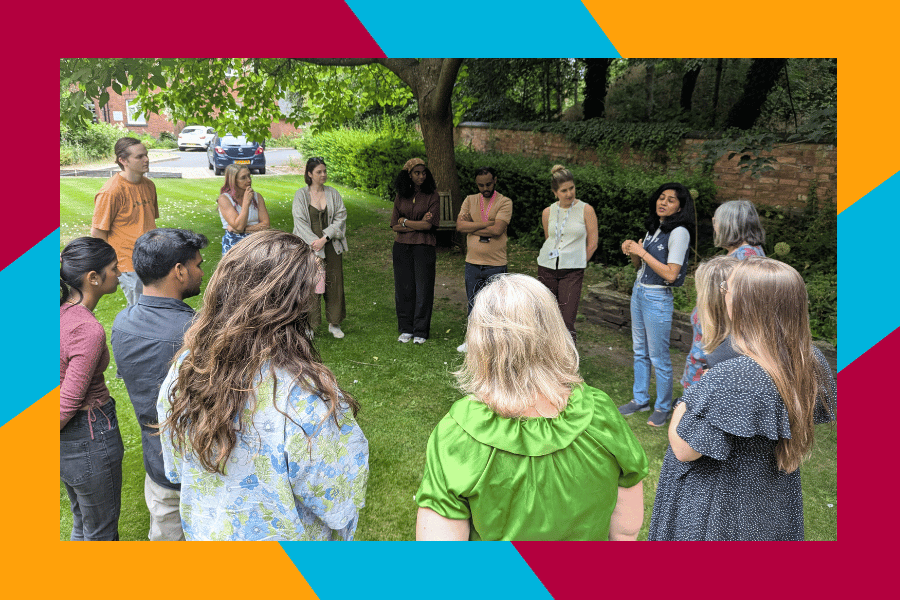
Dr Andrew Reeves highlights the key role that civic universities can play in their localities to support learning towards action on climate change through collaboration with a range of public, private and community sector bodies.
It has long been established that the societal transformation needed to address the climate emergency relies on commitment and changes in ways of working by businesses, public sector bodies, and voluntary sector organisations, and on engagement across society to secure political support, public participation, and fair and inclusive approaches.
In this context, place-based and relational approaches to education and engagement, delivered through informal and non-formal learning, have a crucial role to play.
What role can universities play in their locality to support or deliver this?
This blog post introduces a range of practices running since 2019 in the Leicester area responding to this challenge and details how they came about.
Over this period, De Montfort, Leicester and Loughborough Universities (DMU, UoL and LU) have worked together with partner organisations towards a vision of all key sectors and stakeholders having the knowledge, motivation and local support they need to enable action on climate change. I have played an active part in much of this work, through a mix of personal commitment and a role chairing the East Midlands Regional Centre of Expertise (RCE) in Education for Sustainable Development; RCEs form a global network with a clear shared purpose of catalysing regional action for sustainability through education.
During this time, we have trained and supported people from local schools, small businesses, voluntary groups, social enterprises, arts-based charities, business-support agencies, the regional economic development agency, along with local citizens, harnessing expertise within our local universities.
Our main approach has been adopting and adapting a pre-existing learning intervention (one-day ‘Carbon Literacy Training’), which addresses the causes of climate change, possible relevant actions and includes action planning for personal and collective initiatives. As well as engaging with all types of organisations locally, we have also developed specific Carbon Literacy courses for small and medium-sized businesses (the key employers in our locality) and textile-trade organisations (a key local industry).
Beyond Carbon Literacy, Leicester University has led on developing and delivering a wide range of tailored content for small businesses, whilst I have developed and delivered a half-day training introducing climate action to voluntary sector bodies. Most recently, we jointly delivered the first ‘Biodiversity Literacy Training’ course in Leicester, engaging a mixed group of university staff, students and voluntary/public sector partners with a one-day programme offering a foundation on how and why to take action to support nature recovery.
Despite having no core ongoing funding to achieve this mission, our delivery has progressively increased in scale by harnessing a blend of large-scale national funding alongside internal small-scale funds to continually develop new initiatives and provision.
Innovation and strength of model
Our work is innovative as it is relatively rare, both in the UK and globally, for a place-based partnership to work together over the long-term with a focus on engaging all local stakeholders on climate change action via a range of educational interventions. For example, within universities, Carbon Literacy training delivery usually focuses on staff and students as part of its work on sustainability or Education for Sustainable Development; a strategically driven approach seeking to reach key sectors and networks in a locality is unusual, as universities typically do not see this as part of their remit.
Our key strengths are the sustained involvement of relevant local partner organisations and the leadership role of local universities in pursuing this agenda.
With so many sectors and audiences to reach, a collaborative approach is essential to achieve widespread engagement and build momentum so that more and more people and organisations get on board. Working through a range of local and regional networks to bring partners together (predominantly the ‘Universities Partnership’ of the three local universities and local government partners), our provision is co-developed to address local needs. For example, this includes training for school students, staff and governors delivered by the city council and two universities in 2020, harnessing students as co-trainers. Our 2021 training for staff and leaders at our regional enterprise partnership led on to 2022 training for business advisors across our region, who were supported to embed these issues into their business support services.
Difference from traditional University Lifelong Learning (ULLL) approaches
Conventional ULLL methods would focus predominantly on the provision of taught courses to enrolled learners (‘formal learning’). This might involve a range of provision (undergraduate, masters, short courses, in-person or online), but would routinely be delivered to meet a market-based need for students to enrol.
The distinctive approach adopted here is an evolving offer of non-formal learning, harnessing research, innovation, consultancy and other routes to enable delivery. Through an action orientation, such as pledges made within carbon literacy courses or follow-on mentoring sessions to support action planning, our interventions also foster conditions for informal learning through actions and reflection.
To illustrate the scope of the work, headline details of some key specific projects are as follows:
| Year | Focus | Funding and Partnership |
| 2020 | Local Schools Carbon Literacy Training (CLT) | National NGO funded, led by City Council |
| 2020-2022 | Voluntary Sector Climate Action Toolkit | £5k internal funding, DMU-led working with City Council |
| 2021 | SME and Business Advisor CLT | £80k Regional Regeneration Funding, led by local chamber of commerce with DMU and UoL |
| 2023 | Leicester City Football Club Community Foundation CLT | Free, DMU-led |
| 2023 | Development of CLT courses for SMEs and Textiles businesses | £4k internal funding, DMU, UoL and local training consultancy |
| 2023-2025 | Annual Voluntary Sector CLT | £2k Universities Partnership funding |
| 2024-2025 | Multi-stakeholder engagement on governance (DMU) and business training (UoL) | Part of £2.5m innovation-funding project led by Leicestershire County Council |
| 2025-2028 | Community engagement on energy projects. | £120k, DMU, LU and local partners; regional doctoral research funding for projects responding to community needs. |
| 2025-2028 | Voluntary sector climate action training and support. | £1.5m, DMU-led, voluntary sector support funding |
| 2026 | Biodiversity Literacy Training for universities, public and voluntary sector partners | £2k Universities Partnership funding |
For both businesses and the voluntary sector, there was a progression over time, from small-scale pilot activity (in some cases, unfunded) establishing an effective approach to provision towards larger-scale externally funded projects, upscaling reach and impact.
On the latter point, DMU’s new ‘Leicester Environmental Action and Future’ (LEAF) project combines both these roles, with DMU facilitating quarterly action-learning reflective sessions with five voluntary sector project partners in Leicester, to consolidate the project partners’ informal learning from experience. This is combined with non-formal learning through training provision and convening knowledge-sharing events. This again offers a departure from traditional ULLL where universities are positioned as experts transmitting knowledge – in this case, we bring a core contribution around skills for reflection and learning from experience.
Impact on learners and community
For the hundreds of local learners receiving training and support, our evaluation indicates increased knowledge on the causes of climate change and commitment to personally and collectively take action.
Organisational actions will vary by sector, such as:
- charities creating climate-focussed arts initiatives
- our regional development agency is embedding net zero as a priority in decisions on major infrastructure
- business advisors embedding advice and signposting on climate-friendly operations within their support processes.
Beyond our locality, our course for SMEs has been shared with over 150 organisations in the first 18 months since its launch in 2024, with users including a roofing business, local councils and a training consultancy.
Long-term strategic integration
All three local universities and our upper-tier local authorities (Leicester, Leicestershire and Rutland) have co-created the ‘Universities Partnership’. This is a ‘civic university partnership’, committed to universities seeking to identify and address the needs of their locality. This is a long-term commitment, adopted at a high level by each university vice-chancellor and local council leader. A board with local council representatives steers the initiative; a manager and assistant are employed across the partnership to support delivery, and university staff convene stakeholder groups across five priority themes (including ‘Environmental Sustainability’) to design and deliver projects.
Strategic commitments are also reflected within universities. For example, at DMU ‘Partnerships with Purpose’ is one of four pillars of the University’s strategy and Sustainability is a cross-cutting theme. Sustainability is given high priority due to DMU hosting a global Sustainable Development Goal (SDG) hub for SDG 11, ‘Sustainable Cities and Communities’. Education for Sustainable Development (ESD) is one of three key priorities for the sustainability theme, and due to DMU’s role as an RCE chair, ESD is understood as extending beyond the university to include education for local people, places and organisations.
Transferability
The key transferable element of this work is the place-based or ‘civic’ commitment to education for local people and organisations on a matter of relevance to all (in our case, climate change). From this commitment, and a collaboration between universities and other key actors that can play a part in delivering this, priorities can be identified, funding opportunities explored and educational activities delivered.
In this case, our work has been embedded within two partnership initiatives: hosting the Regional Centre of Expertise (RCE) in Education for Sustainable Development and running a theme group focused on Environmental Sustainability within the Universities Partnership (UP) civic university collaboration for Leicester, Leicestershire and Rutland. The RCE (established since 2007) established the vision for regional collaboration for sustainability education; the UP (established in 2022) brought strong and refreshed commitment from all three local universities and local government.
In the UK context, as detailed above, we have found a range of rationales for providing resources to enable this work, ranging from large-scale grants for research/innovation (for the LCAN project), large-scale grants for voluntary sector projects (for LEAF), economic development funding to aid businesses (£80k via the ‘Community Renewal Fund’) and small-scale internal funds within universities.
In another setting, it could be plausible and desirable for place-based non-formal civic education to be delivered through partnership over the long term via sustained funding from regional/national government. In contexts where long-term resourcing is scarce, our case study offers a model for combining commitment, local networks (between individuals and formal partnerships between organisations), ongoing engagement with learners to identify needs/priorities and an ethos of pragmatically seeking resources to deliver on agreed priorities.
In this way, our experience in the Leicester area in the UK could be transferable to many contexts around the world.
Next Steps
The case study will be extended into an LPIP Hub policy briefing, outlining distinctive roles for universities supporting place-based climate action based upon the experience of a range of Leicester-area initiatives.
I am keen to connect with other people and institutions working in a similar way (or keen to do so) in their localities on climate education, whether in the UK or overseas – please get in touch to explore possible joint working.
This blog post was based upon a case study produced as part of the SAMUELE compendium of Lifelong learning Case Studies. The case study was recognised in 2026 as one of the top three submissions to SAMUELE through an award presented by EUCEN, the European network for lifelong learning in higher education.
The work described here informed the 2025 ‘Civic Universities and Climate Education’ report produced by the Institute for Community Studies.
This blog was written by Andrew Reeves, LPIP Hub Place Fellow. Andrew is an Associate Professor at De Montfort University Leicester.
Find out more about the Local Policy Innovation Partnership Hub.
Disclaimer:
The views expressed in this analysis post are those of the author and not necessarily those of City-REDI or the University of Birmingham.