
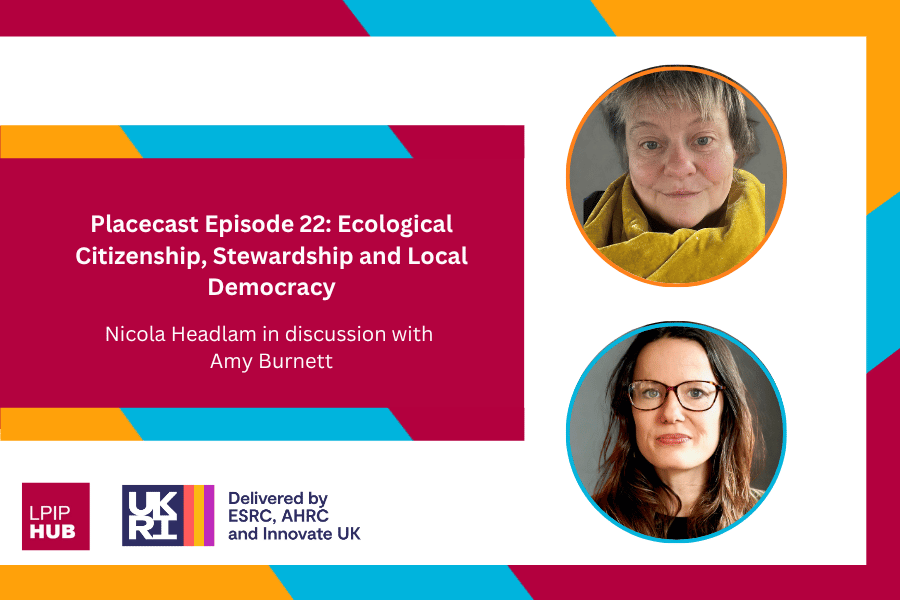
In this episode of Placecast, presenter Nicola Headlam is joined by Amy Burnett, LPIP Policy Fellow, researcher and practitioner in local governance, sustainability and community-led change. Amy reflects on her journey from working on decentralisation projects in Angola to researching town and parish councils in England, exploring how local democracy, stewardship and participation can create more resilient and sustainable places. Drawing on her work with neighbourhood planning, the Transition Town movement and governance reform, she discusses the often-overlooked role of local institutions and civic actors in shaping meaningful change.
The conversation centres on Amy’s concept of ecological citizenship, a framework that connects environmental responsibility, community stewardship and democratic participation. Nicola and Amy explore themes including devolution, valuing community action, place-based leadership, social innovation, language and power, and the importance of recognising the hidden contributions of volunteers and local changemakers. Looking from the hyper-local to the global, the episode offers a thoughtful and hopeful discussion about how communities can unlock new forms of value, creativity and collaboration to address the complex challenges facing places today.
Guest Speaker
Dr Amy Burnett
Amy Burnett is a Research Fellow at the Centre for Enterprise, Environment and Development Research (CEEDR) at Middlesex University’s (MDX) Business School and a Research Fellow at the Centre for the Understanding of Sustainable Prosperity (CUSP).
Her research and practitioner work focuses on civil society groups and government to promote and incentivise innovative and sustainable development in the context of sustainable finance, planning, policy, placemaking, and place-based identities. She has significant experience as a practitioner in the UK community, planning and international development sectors.
Host
Dr Nicola Headlam
Nicola Headlam has over 20 years of experience working across all aspects of the multi-helix innovation system, including central and local government, civil society and campaigning, academic research and knowledge mobilisation, and industry. Along the way, she has honed her expertise in urban and regional subnational economic development, the roles of government in shaping place, and in utilising data and evidence for transformation.
In 2024, she became a freelance economic advisor on the role of leadership and partnerships, urban and living lab forms for research, the future of cities and foresighting methods, urban transformations, place-branding and urban regeneration and the spatial consequences of public policy.
View Nicola’s LinkedIn Profile
Transcript
Show notes
Catherine Wilder – https://www.linkedin.com/in/catherine-wilder/
Amy’s Multi-Dimensional Value Typology – developed during a British Academy Policy Innovation Fellowship
The Valuing Community Mapper – developed during a British Academy Fellowship Activities Fund
Find out more about the Local Policy Innovation Partnership Hub.
Disclaimer:
The views expressed in this analysis post are those of the author and not necessarily those of City-REDI or the University of Birmingham.
Generative AI was used to generate parts of the blog using the transcript from the podcast.