
City-REDI, along with Birmingham Business School, hosted the 20th Regional Innovation Policies Conference 2026, funded by the LPIP Hub.
Under the theme of “Navigating Futures with Innovation: Resilient and Resurgent Regions”, over 110 participants from 18 countries had a lively two days on Edgbaston campus.
Dr Chloe Billing reports on the discussions from the conference over the two days in a series of blogs.
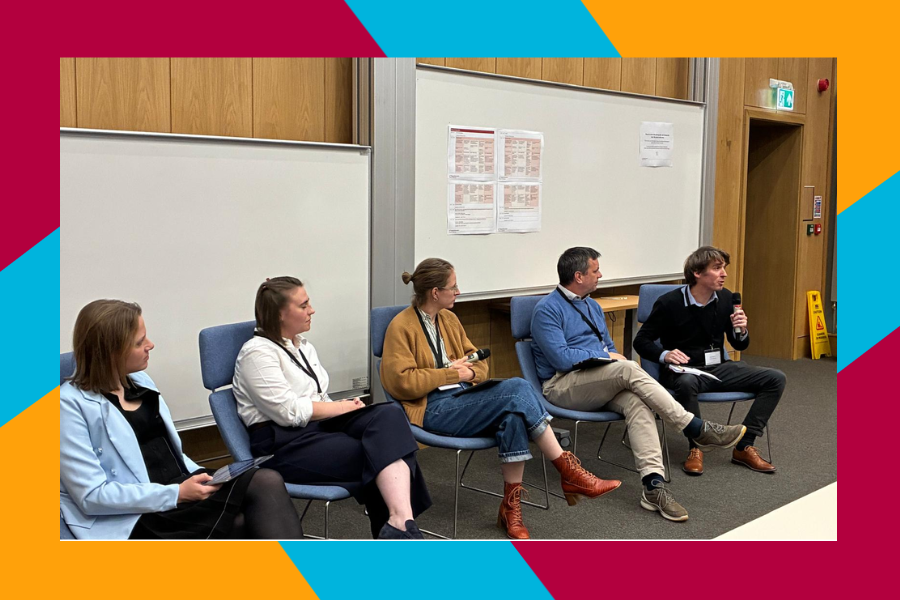
Day 2 Panel Session, Regional Innovation Policies Conference 2026, University of Birmingham, 18 September 2026
The panel
The final panel on Day 2 of the Regional Innovation Policies Conference 2026 asked how evidence makes its way into decision-making, what helps and hinders that process, and what this means for the future of regions. Chaired by Chloe Billing (City-REDI), the session brought together four speakers who work across the policy-research boundary from different positions.
James Wilson directs Orkestra, the Basque Institute of Competitiveness at the University of Deusto, which marks its 20th anniversary this year and has 43 staff working closely with regional and local government. David Waite (University of Glasgow) has traced policy in the Glasgow city region for around ten years. Carolin Ioramashvili (SPRU, University of Sussex) is a UKRI Policy Fellow at the Department for Culture, Media and Sport, following a British Academy Innovation Fellowship in the Cabinet Office with the Evaluation Task Force. Anna Humphreys leads on inclusive growth at the West Midlands Combined Authority (WMCA), maximising the social, environmental and economic impact of investment across the region.
What is missing between policy and research
Carolin opened with a distinction learned from working inside government. Policymakers are interested in evidence rather than in any single research project. Funding models that ask academics to disseminate individual studies get this the wrong way round, and more value comes from longer-standing relationships in which researchers understand what evidence officials already hold and how new work adds to it.
James agreed that relationship building is essential but can be frustrating, as political cycles and personnel change faster than research agendas. Orkestra reflects often on the line between consultancy and research. Consultancy offers a simpler relationship with defined outputs, while research brings different objectives on each side that have to be negotiated.
Anna picked up on this transactional quality. Activity can become fragmented and driven by the funding available, which limits understanding of long-term impact. The changes she works towards in people’s lives are intergenerational and will not be visible within a single funding cycle.
David set out several gaps. Capacity to interact is a fundamental constraint, and challenges can emerge where a local authority economic development team, for example, has shrunk. Incentives are misaligned, since few policymakers have time for an 8,000-word paper. Researchers must balance being trusted with retaining the independence to tell hard truths, and a new minister or mayor can overturn established priorities. He also called on academics to be less extractive and to give something back for the time policymakers invest.
Skills built at the boundary
Anna stressed the value of a specific question and a clear intended output. WMCA has worked with academic and policy colleagues to develop Areas of Research Interest linked to the West Midlands Growth Plan, which has helped prioritise timely research. She also valued spaces for in-depth discussion over formal presentations, citing a recent exchange with the University of Birmingham on social value in public procurement.
Carolin emphasised meeting people where they are. Officials in central departments move roles often and are not always subject experts, so researchers need to understand which levers are actually available to them. Small changes to policy count as impact.
James described designing the interaction from the outset, drawing on an Orkestra framework for action research for territorial development built around structured cycles of research and action. Further lessons were flexibility as priorities shift, positioning short projects within a longer-term agenda, and diplomacy. How findings are communicated often matters more than the findings themselves, and policymakers tend to object less to critical results in academic journals than to how and when they are shared with stakeholders.
David described this work as more art than science, with learning by doing important, and noted that a three-year grant with outputs due years later will not meet a decision-maker’s needs. Anna added that research and policy must both be able to explain the benefit to residents.
Capacities for the future
Looking ahead, David highlighted Areas of Research Interest as a promising way to connect government priorities with available evidence, noting their use by UK government and a current pilot in Manchester.
James saw a bridging role for research, as departments and tiers of government often work on complementary issues without talking to each other. He pointed to work with the Regional Studies Association on regional policy hubs internationally, which found very different institutional set-ups, and to Orkestra’s strategy of recruiting pre-doctoral researchers and training them in engaged research during their PhDs.
Carolin, who also researches innovation intermediaries, observed that academics rarely reflect on their own translation work. She argued for more sustainable and professionalised structures, noting the lack of long-term funding in the UK and City-REDI’s ability to adapt to shifting funding environments. Skills are needed on the policy side too, where researchers can still meet caution or ivory tower stereotypes.
Anna returned to shared space and trust between universities, government and business. She suggested an independent intermediary could help, and that mayoral strategic authorities may be well placed to support this as devolution brings greater responsibility for evidence-based decisions.
Questions from the floor
One participant highlighted policy fragmentation and weak institutional memory in the UK, and the role researchers play in connecting officials working on similar issues and bringing international perspectives. They asked how to secure the next generation of engaged scholars. David suggested active learning, such as asking students to engage with a city-region strategy, while James described Orkestra hosting student dissertations linked to live projects.
On local and combined authority capacity for analysis and evaluation, Anna agreed this needs strengthening across the wider ecosystem. Carolin added that this requires investment, and that policy fellowships offer a relatively low-cost route to build both capacity and relationships. A final question on residents prompted Anna to note that challenges such as skills, infrastructure and housing persist across administrations, and James to describe involving cluster organisations and citizen science in action research.
The session closed with a shared view that bridging policy and research depends on sustained relationships, trusted shared spaces and investment in capability on both sides.
Reflections from the LPIP Hub
The discussion connects closely with the LPIP Hub’s ongoing work with the Local Policy Innovation Partnerships. For these partnerships, innovation means new ways of designing, testing and learning from policy in response to local needs, as well as R&D and technology. A recurring lesson is that evidence has the most influence when it is co-produced, with researchers, local government, business and communities shaping the questions together from the outset. That relational work needs to be recognised and resourced rather than assumed. Being in the room is also not the same as being able to shape decisions. Evidence and community voice carry weight when there are clear routes into decision-making and delivery, and when partners can see how their contributions have been used. The panel’s emphasis on specific questions, Areas of Research Interest and outputs timed to decision-makers’ needs makes the same point.
The Hub’s work also points to the value of convening. Where activity is spread across many organisations, a body with the mandate and capacity to connect related work and retain institutional memory can matter as much as any single intervention. As devolution gives mayoral strategic authorities greater responsibility for innovation and growth, this convening role will become more important. So will analytical and evaluation capacity within local and combined authorities, and careful thought about which decisions are best made at which scale. Partnerships also benefit from experimentation and from regular, facilitated reflection on how they work, built into governance rather than added at the end. Funding models that reward quick outputs tend to under-invest in this slower capability building. Taken together, these lessons support the panel’s conclusion: building partnerships for innovation and building partnerships for evidence are two sides of the same task, and both depend on long-term investment in relationships, shared spaces and capability.
This blog was written by Dr Chloe Billing, Research Fellow, City-REDI, University of Birmingham.
Find out more about the Local Policy Innovation Partnership Hub.
Disclaimer:
The views expressed in this analysis post are those of the author and not necessarily those of City-REDI or the University of Birmingham.