
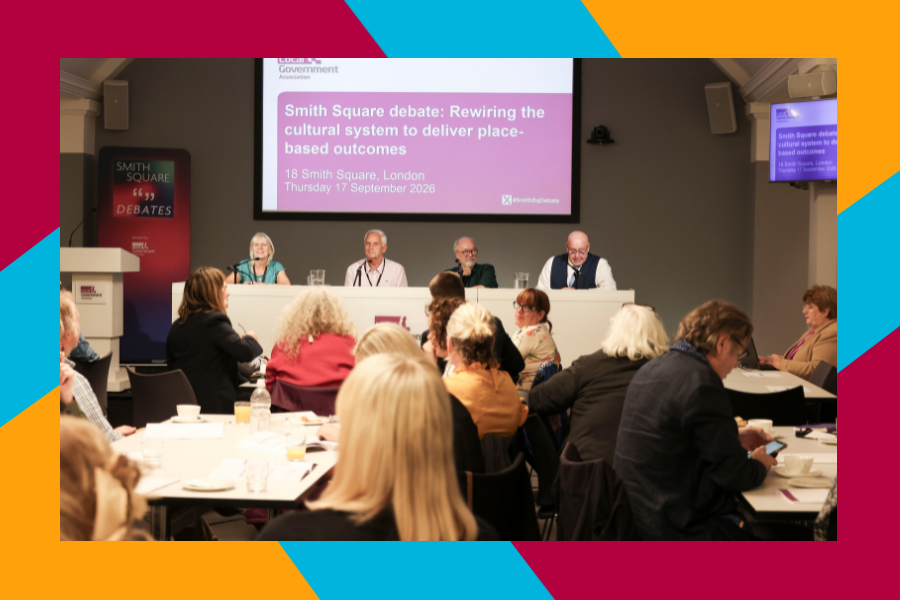
In this blog, Val Birchall reflects on the Local Government Association’s Smith Square Debate, Rewiring the Cultural System to Deliver Place-Based Outcomes. Drawing on the discussion, Val explores how culture, local leadership and place-based approaches can work together to tackle complex challenges and create better outcomes for communities across the UK.
Introduction
There has been frustratingly little progress since the commission set up by the Local Government Association (LGA) published the Cornerstones of Culture Report setting out the pre-conditions of a functional local system. At that time, I wrote A Moment for Change, making the case for a national rethink.
In Art without Architecture I analysed how the accidental system for supporting cultural development across the country fails to deliver for communities, stakeholders and politicians. That’s been the focus of my LPIP fellowship. The proposition for a new National Cultural Framework, jointly commissioned by the LGA, with the National Alliance for Cultural Services and Chief Cultural & Leisure Officers Association (CLOA), is now available to read here.
The reorganisation of local government, and the push for devolution to elected mayors in the regions, creates the opportunity for designing a new approach. So what are the principles we should work to, and how might we usefully progress from here?
What’s the current problem?
While cultural development in places is supported by a mixed economy of public funders, private sponsors, foundations, donors, the paying public and volunteers, artists, community workers and cultural producers and venues, rather than locking together to create an efficient whole, these parts operate largely independently in an accidental system.
Independent organisations and individuals need not be beholden to public policy, and insisting they operate within predefined lines militates against creativity and the very particular essence of cultural creativity. But for the public sector bodies spending public funds, I’d argue that there should be an articulated shared vision between those responsible for supporting cultural development. It should set out what they want to achieve (collectively) and why, and how they could measure their impact so that the results of their actions are clearly understood, and they are held to account. Instead, these bodies have rubbed along, at times uncomfortably and certainly less than effectively, creating their separate plans and priorities and different ways of recording their achievements.
Worse still, in an environment where cultural vitality depends on how well the needs of local people are met and how strongly the local voice is heard, where there are carefully crafted, evidence-based cultural strategies that are owned by the community through well-governed local stakeholder partnerships and informed by effective engagement with residents, these currently rely for delivery on a complex array of competitive funding schemes. The result is pieced together and can’t be more than just the sum of its parts.
It’s not a hierarchy
I’ve been working with colleagues across this accidental system, at all spatial levels and with different perspectives, as the focus of my LPIP fellowship. I’m trying to tease out how we might create and adopt a collective vision for culture, owned by the parties expected to resource and deliver it. It needs to recognise that cultural companies, artists and voluntary organisations create, develop and distribute content in a networked world, with interweaving purpose.
A confusing and frustrating environment in which cultural operators are pulled in different directions in order to attract the funding they need makes it difficult for any of the parties fully to achieve their aims.
How then should the roles and responsibilities sit – which part of the new system would lead on what and why? After twenty years in local government, place-based cultural policy is my starting point. It is how we best serve our communities and meet their needs. It is how we ensure we build from local assets, use local collections, strengthen local identity, and make use of the wider partners to interlock with other services on the ground.
Strategic Authorities, including those just starting out, are charged with planning for housing, skills, health and economic growth. They clearly need a role that properly considers culture in the context of these responsibilities. Likewise, there are genuine national flagships, issues of national reputation, critical mass, national standards, national distribution and touring and national collections to be considered.
It isn’t a hierarchy; it is an ecosystem. Much like the reintroduction of wolves into Yellowstone, we could, if we tweak the wrong component, inadvertently create some kind of cultural trophic cascade. Care is needed to consider the consequences of any change to ensure we are leaving it better than the status quo.
The principles
The National Cultural Framework proposition sets out the principles that we need to come back to at every stage of our thinking. It starts from the imperative of creating a structure that is both Nationally Coherent and Locally Differentiated (or, if you prefer, reflects the distinctiveness of place, while addressing the need for consistency across the country.
Six pre-conditions have been identified.
Firstly, Governance – a subsidiarity model that sets out whose role it is to do what, with decisions taken as close as possible to those affected. We should aim for sharing success rather than maintaining sovereignty of achievements; this is the cornerstone of collaboration.
Secondly, Data and Evidence – whatever we do, it needs to be underpinned by an understanding of the facts, set out transparently, and not by unsupported anecdote or political whim.
Thirdly, Strategy – aligned through the tiers, to enable a coherent and functional approach. I’d argue we really need a national cultural strategy because that process would enable the teasing out of the wider considerations, but we are not likely to get one it seems.
Fourth, Investment – a shift from fragmented competition between places to settlements that demonstrate trust in local arrangements and knowledge.
Fifth, Delivery- must happen as part of place-based local arrangements as part of cultural vitality in communities. This must acknowledge that culture is a part of core civic infrastructure, inherently linked to the delivery of key public services in localities. The Local Culture Scotland report, published earlier this month, sets out a strong argument for this approach.
Finally, Accountability – who holds whom to account in a fast-changing and increasingly varied set of boundaries and agendas from national government through elected mayors, local Councillors, Town & Parish Councils, and the public themselves?
The To Do List
There’s been a wide consensus about the need for a new approach. But there is a lot still to do to move on from here.
The process to this point has been more of a coalition of the interested than a coming together of those in a position to act. As a group, we have analysed, researched and tested the thinking with key stakeholders. We held a Cultural Policy Hackathon (designed by LPIP Fellow Helen O’Gara) with policy-makers, academics, funders, cultural and community organisations to refine the proposition, which raised many more questions and the need for wider engagement.
The next step is to use the proposition to convince policy-makers at a national level of the need for further work that builds on the principles above. At the launch of the document, there was “violent agreement” on the importance of the framework, so we should be optimistic that it can form the groundwork for a practical plan for implementation.
This blog was written by Val Birchall, Chair of the National Alliance for Cultural Services and a Fellow of the Royal Society of Arts, and a member of the Academy of Urbanism.
Find out more about the Local Policy Innovation Partnership Hub.
Disclaimer:
The views expressed in this post are those of the author and not necessarily those of City-REDI or the University of Birmingham.