
Senior Research Software Engineers James Tyrrell and Gavin Yearwood led the organisation of RSE Midlands 2025, and below James gives a summary of this successful event.
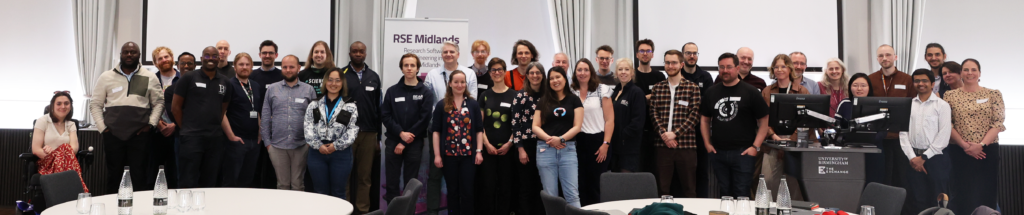
The Advanced Research Computing team hosted the Research Software Engineering (RSE) Midlands 2025 Annual Conference at The Exchange on Monday 7 April, 2025. Sponsored and supported by our partners in Lenovo, Intel, and the Society of Research Software Engineering (SocRSE), we were pleased to be able to bring together over 40 individuals from across the Midlands and beyond to share some recent successes and challenges in the world of research software engineering.
Our day began with a talk from Pip Grylls (University of Warwick) on behalf of the trustees of SocRSE. Pip’s talk covered the history of the Society as well as its ongoing initiatives. This includes the upcoming ninth annual conference for Research Software Engineering (RSECon25) for which Pip is the Programme Chair. With new attendees and a growing cohort of RSEs in the Midlands, Pip’s talk provided a great introduction and context for the subsequent talks and discussions.
In our next session, Gavin Yearwood (University of Birmingham) led a group discussion on ‘What can RSE Midlands do for you?’ This session got attendees to work collectively at their tables and discuss what they want from RSE Midlands. Common responses included a return of the coding club, which presented a more frequent gathering of the community, with possible new additions of blog posts and collaborative workshops. Outreach to RSEs and those in RSE adjacent fields was another common idea. The expansion of the RSE Midlands Committee and a formation of local representatives is an idea that many were passionate about. From this discussion it shows an enthusiastic community who will see RSE Midlands go from strength to strength.
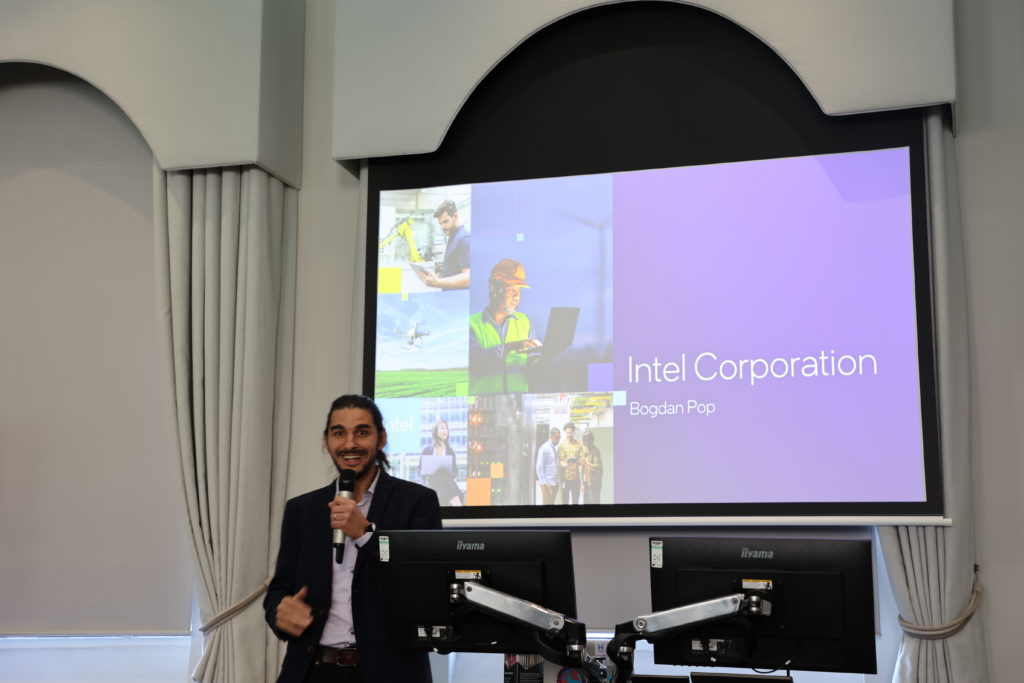
After the discussion, there were talks from Bogdan Pop (Intel) and Matthew Barton (University of Birmingham). Bogdan’s talk described Intel’s AI strategy and their emphasis on developing an open AI platform for enabling researchers and enterprise to build and deploy innovative AI solutions. Sticking with the ‘innovative’ theme Matthew then provided an overview of the work RSEs from the University of Birmingham’s Research Software Group have been doing with the Baskerville Tier 2 HPC facility, exploiting its multi-GPU architecture to conduct novel research in collaboration with academic partners from across the University.
Our final session before lunch consisted of a series of lightning talks submitted by our attendees. Boutheina Nedjai (University of Birmingham) spoke on ‘Software as a Research Output’ and her ongoing work to improve understanding of the issues surrounding the recognition of software as a research output. Jenny Wong (2i2c) talked about ‘Reproducible research software environments with Binder’, highlighting the potential for Binder to assist in overcoming the technical barriers that get in the way of researchers easily sharing code and reproducing results. Vincenzo Brachetta (University of Birmingham) described the formation of the new ‘Julia programming language Special Interest Group’ at the University, inviting the audience to get involved and give the Julia language a go. Jonathan Tedds (ELIXHIR Hub) introduced the EOSC-EVERSE Project, a European Virtual Institute for Research Software Excellence, with a call to join the EVERSE Network. Steph Thompson (University of Birmingham) detailed some of the work the University’s Researcher Engagement and Data Group do on ‘Researcher development and training’, including the BEAR Champions programme and annual BEAR Conference.
Following a Green Conference Lunch, we returned to the main room for a session led by the Software Sustainability Institute (SSI). Oscar Seip (SSI Community Officer and Fellowship Manager) kicked off the afternoon’s proceedings with a talk on the SSI’s Fellowship Programme and wider activity. We then heard from three SSI Fellows speaking about their projects: Godwin Yeboah (University of Warwick, 2025 Fellow) on ‘Building a community of Digital Arts and Humanities RSEs in the Midlands‘, Ella Kaye (University of Warwick, 2025 Fellow) on ‘rainbowR: a community for LGBTQ+ folk who code in R’, and Catherine Smith (University of Birmingham, 2019 Fellow) on ‘Exploring communities: the SSI Fellowship and beyond’.
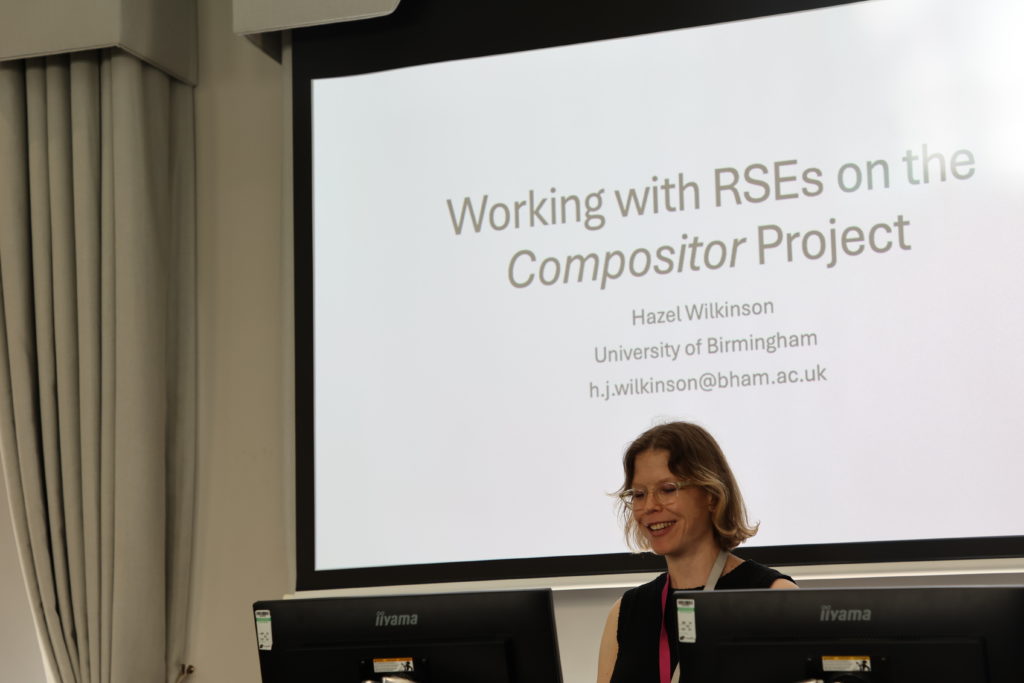
Nearing the end of the day, we next heard from a duo of invited academic speakers from the University of Birmingham. Hazel Wilkinson spoke on ‘Working with RSEs on the Compositor project’, a fascinating and highly visual project that is an excellent example of the impact RSEs can make to digital Arts and Humanities research. In addition to her role as a Senior Lecturer in the Department of English Literature, Hazel is a Deputy Director of the University’s Institute for Data and AI (IDAI) whose priorities include fostering interdisciplinary research in AI and data science. Grant Wilson spoke about the ‘DIATOMIC digital twin project’, an ambitious project to “create a virtual replica of Birmingham’s urban environment… [and] drive smarter decision-making”. Work conducted thus far (in collaboration with RSEs from the University of Birmingham’s Research Software Group) has produced pipelines for assimilating data from multiple sources, visualised on a map of the city. This project includes partners from industry and other institutions across Birmingham and demonstrates the potential for greater collaboration between RSEs, researchers and other stakeholders across the Midlands.
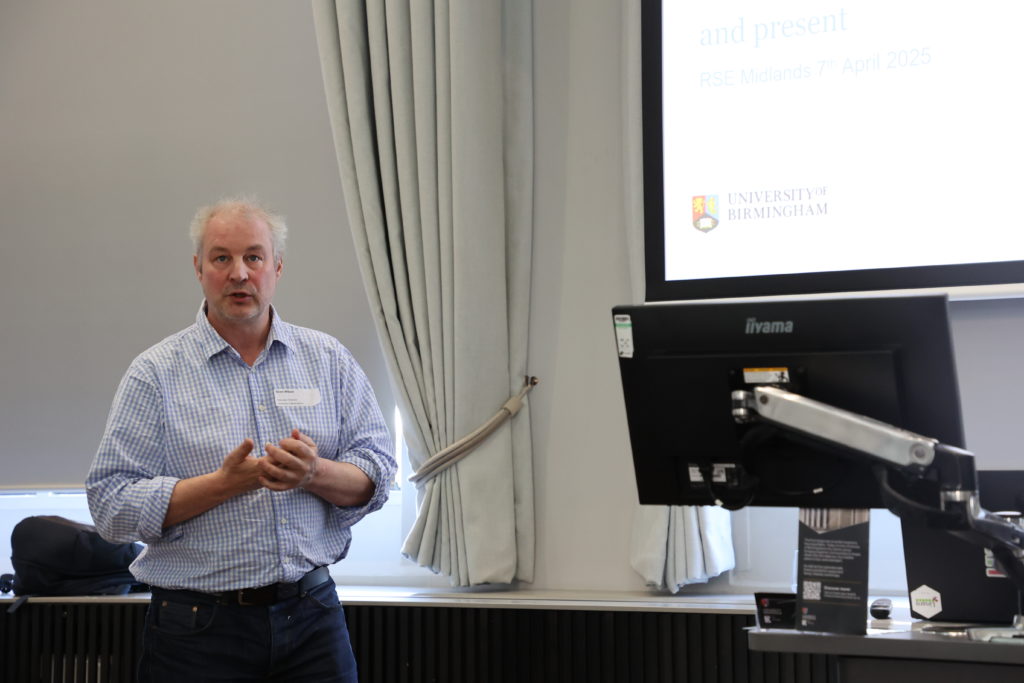
Our final talk of the day was delivered by Andrew Edmondson (a.k.a. ‘Ed’), Leader of the University of Birmingham’s Research Software Group. Ed’s talk covered ‘The story so far’ and described the history of the Research Software Group from its inception in 2016 to the present. Ed’s talk touched on many of the topics from earlier in the day, including hosting RSECon2019 at the University of Birmingham and the inaugural RSE Midlands conference (2022), the group’s ongoing collaboration with IDAI, and the recruitment of a variety of RSEs – many of whom were in the room!
It was great to see so many people – familiar faces and new – interested and engaged in the work of RSEs in the Midlands. We, the organising committee (James Tyrrell, Gavin Yearwood, Adrian Garcia, Matthew Barton), hope that the day was an enjoyable and informative experience for all. We would like to extend our thanks to all of our speakers, sponsors (Lenovo, Intel, and SocRSE), and attendees as well as the excellent team at The Exchange for their support on the day. We look forward to seeing everyone again at a future RSE Midlands event.