

In this case study, we hear from Fuad Alqrinawi, a PhD researcher in the School of Geography, Earth and Environmental Sciences at the University of Birmingham, who used BlueBEAR to simulate how microplastic particles travel through fully saturated porous media. Microplastic Particles (MPs) are now widely detected in soils, riverbeds, and groundwater, where they occur … Continue reading “Tracking microplastics transport through saturated porous media”
Category: PGR students
SeqProFT: Predict Protein Functions Using Less Computing Power
In this case study, we hear from Shuo Zhang, a PhD student in Computer Science, who is working on predicting protein properties using sequence information. Our work, SeqProFT, is a smart new way to predict protein properties using sequence information alone. Using BlueBEAR GPU resources, we trained and evaluated SeqProFT across a wide range of … Continue reading “SeqProFT: Predict Protein Functions Using Less Computing Power”
Exploring the dynamics of alien solar systems with BlueBEAR
In this case study, we hear from Alix Freckelton, a PhD student in Physics and Astronomy, who is exploring transit timing variations (TTVs). My research focuses on transit timing variations (TTVs): these are tiny irregularities in the times that we see exoplanets transiting their host stars. TTVs are caused in multi-planet systems by the planets … Continue reading “Exploring the dynamics of alien solar systems with BlueBEAR”
Reflections from the 15th BEAR Conference 2026
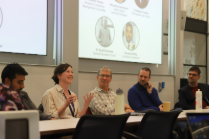
The following blog post has been written by Yaru Zhou, who is from the organising committee of the BEAR Conference 2026. The 15th Annual BEAR PGR Conference brought together postgraduate researchers from across the University of Birmingham for a day of interdisciplinary discussion centred around this year’s theme: AI x Integrity. Sponsored by Lenovo and NVIDIA, … Continue reading “Reflections from the 15th BEAR Conference 2026 “
Using AI to Bring Indigenous Storytelling Character Figures into Chemistry Education
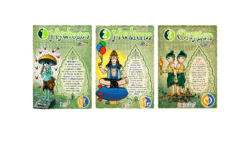
In this blog, we hear from Dina, a second-year Ph.D. student in Chemical Education, School of Chemistry, who won the best short talk at the BEAR conference 2026. Dina, conducted research that intersects chemistry education, technology, and ethnochemistry. Ethnochemistry is a multidisciplinary field that explores the relationship between chemistry and the traditional wisdom, practices, and … Continue reading “Using AI to Bring Indigenous Storytelling Character Figures into Chemistry Education”
Learning from Nature: Using HPC to Design Efficient Jet Propulsion
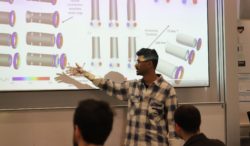
In this case study, we hear from Yukesh Karki, a doctoral student from Aerospace Engineering in the School of Metallurgy and Materials, who used BlueBEAR to identify the optimal three-dimensional nozzle geometry for hydrodynamic jet propulsion. He is also the winner of ‘best talk’ at the BEAR Conference 2026. Nature has already evolved highly efficient methods … Continue reading “Learning from Nature: Using HPC to Design Efficient Jet Propulsion “
Understanding multi-agent learning through large-scale simulations
In this case study we hear from Tuo Zhang, a researcher working in Machine Learning, who has been using BlueBEAR to run large-scale simulations of multi-agent reinforcement learning (MARL) algorithms. His research focuses on understanding how learning agents behave when interacting with each other in complex and changing environments. In many real-world systems, decision-making is not performed … Continue reading “Understanding multi-agent learning through large-scale simulations”
Modelling Birmingham’s Cultural Ecology and Urban Oral History Using BlueBEAR
In this case study, we hear from Jack (Wei-Chieh Tsai), a doctoral student from History of Art and Geography who used BlueBEAR to examine how cultural intermediaries, including artists, curators, and cultural organisations, have contributed to urban development. My PhD research examines the role of artistic interventions in transforming post-industrial Birmingham between 1986 and 2016. The project … Continue reading “Modelling Birmingham’s Cultural Ecology and Urban Oral History Using BlueBEAR”
Binary classification of lung tissue immunofluorescence images by deep learning
In this case study we hear from Ellen Jenkins, a postdoctoral student from the Institute of Inflammation and Ageing. Ellen is looking into developing a deep learning model to automatically differentiate the tissue from the air space. There is an ongoing project in the respiratory research group (CMH, IIA) which utilises samples of human lung … Continue reading “Binary classification of lung tissue immunofluorescence images by deep learning”
Bayesian Modelling of Rising Decision Thresholds in DDMs using BlueBEAR

In this case study we hear from Sophie Wetz, a Masters student in Psychology, who has been using BlueBEAR to investigate whether a dynamic, rising boundary improved the fit of the full Drift Diffusion Model (DDM) to Random Dot Kinematogram (RDK) task data. I’m a Master’s student on the Computational Neuroscience stream in the School … Continue reading “Bayesian Modelling of Rising Decision Thresholds in DDMs using BlueBEAR”