
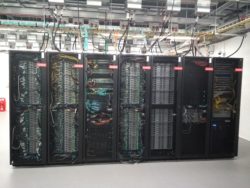
As we head into the summer after a successful BEAR Challenge (see below), July is a quieter month for events, and there will be no BEAR newsletter in August. This month we have updates on BEAR services, including the doubling in capacity of our supercomputer, BlueBEAR, and an excellent job opportunity for finishing PhD students … Continue reading “July BEAR Newsletter”
Tag: bear
Reflections on the BEAR Challenge 2024
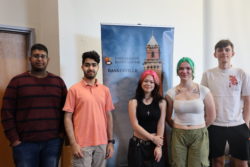
In this blog post, we hear from Ivan Korniichuk, a member of the third-placed team in BEAR Challenge 2024, who gives his perspective on the recent event. I am delighted to announce that our team “return -1” achieved 3rd place in the BEAR Challenge 2024! Participating in this intensive three-day event at the University of … Continue reading “Reflections on the BEAR Challenge 2024”
Investigating the brain with BEAR
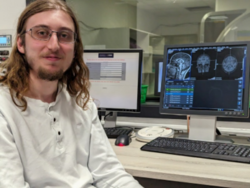
In this case study, we hear from Brandon Ingram (based at the School of Psychology), who has been utilising BEAR to deepen their understanding of the mechanisms our brains employ to interpret visual stimuli. My research focuses on integrating electroencephalography (EEG) and functional magnetic resonance imaging (fMRI) to gain a more comprehensive understanding of how … Continue reading “Investigating the brain with BEAR”
June BEAR Newsletter
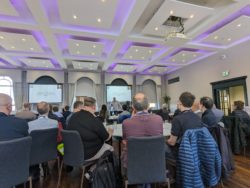
This month we cover lots of past and future events, with blog posts on the BEAR Conference and Baskerville Showcase, together with details on a session at the Postgraduate Research Festival and the BioFAIR Roadshow. We also have some articles on life within the Advanced Research Computing team, to give you an insight into our … Continue reading “June BEAR Newsletter”
Studying stars across the Milky Way with BEAR
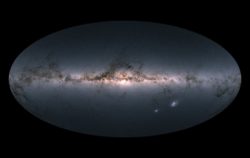
In this case study, we hear from Amalie Stokholm (based at the School of Physics and Astronomy), who has been using stars to gain insights into the history of our Galaxy using the high-performance cluster BlueBEAR and the Research Data Storage, both housed at the University of Birmingham. My name is Amalie Stokholm. I am … Continue reading “Studying stars across the Milky Way with BEAR”
Studying phase-field fracture mechanics using the high-performance cluster BlueBEAR
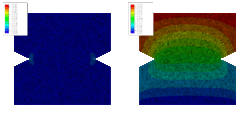
In this case study, we hear from Vincenzo Brachetta (School of Metallurgy and Materials), who has been working on fracture mechanics in materials science using the high-performance cluster BlueBEAR and the Research Data Storage, both housed at the University of Birmingham. He is also a member of the Birmingham Environment for Academic Research (BEAR) Champions … Continue reading “Studying phase-field fracture mechanics using the high-performance cluster BlueBEAR”
Predicting residual stresses in additive manufacturing using the high-performance cluster BlueBEAR
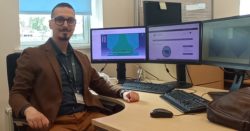
In this case study, we hear from Vincenzo Brachetta (School of Metallurgy and Materials), who has been working on prediction of residual stresses in materials science using the high-performance cluster BlueBEAR and the Research Data Storage, both housed at the University of Birmingham. He is also a member of the Birmingham Environment for Academic Research … Continue reading “Predicting residual stresses in additive manufacturing using the high-performance cluster BlueBEAR”
Using BlueBEAR to predict the wind characteristics around high-rise buildings

In this case study we hear from Jose Romero, a PhD student in Civil Engineering, who has been using BlueBEAR to predict wind characteristics around high-rise buildings. You probably don’t realise it, but wind is probably influencing your actions on a daily basis! It may be that you choose to grab a coat before leaving … Continue reading “Using BlueBEAR to predict the wind characteristics around high-rise buildings”
Reflecting on the 13th Annual BEAR Conference 2024
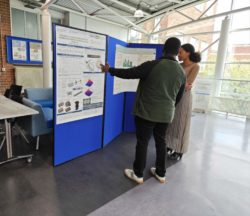
The following blog post has been written by Dr. Josephine Bates, who shares her thoughts on the BEAR Conference 2024. From the 23 to 24 April, 2024, the 13th annual BEAR (Birmingham Environment for Academic Research) Conference took place in the Chemical Engineering building at the University of Birmingham. The conference revolved around High-Performance Computing … Continue reading “Reflecting on the 13th Annual BEAR Conference 2024”
Just about “and managing” in the RSE world, within ARC
The field of research software engineering has grown steadily since the term “Research Software Engineer” (RSE) was coined in 2012. Many research-intensive universities now have central teams of RSEs who, like the Research Software Group (RSG) in Advanced Research Computing (ARC) here in Birmingham, are available to support researchers across the university with their bespoke … Continue reading “Just about “and managing” in the RSE world, within ARC”