
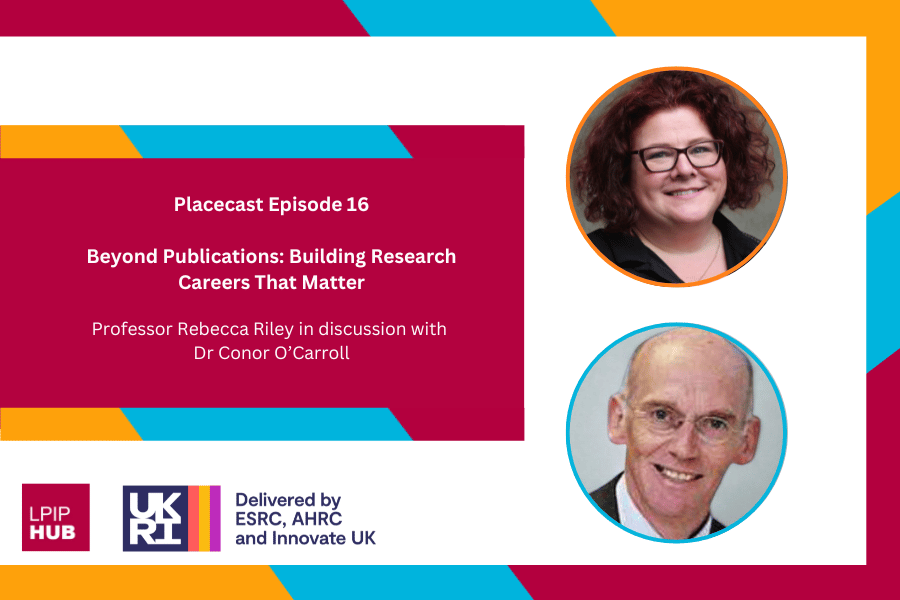
In this episode of PlaceCast, Rebecca Riley talks to Dr Conor O’Carroll about how research careers need to evolve to better support place-based policy and real-world impact.
Dr O’Carroll argues that traditional academic pathways, particularly the PhD as a route into academia, are no longer fit for purpose, with most researchers working beyond universities. The conversation highlights the need to move away from narrow publication-based assessment toward recognising skills, collaboration, and societal impact.
The episode emphasises stronger partnerships, placements, and cross-sector mobility as key to connecting research with local economies.
Overall, it calls for a more flexible, skills-focused research system that delivers greater value for people and places.
Guest Speaker
Dr Conor O’Carroll
Dr Conor O’Carroll is Director of SciPol Services Limited. As an independent consultant on research and higher education policy and funding, he focuses on researchers’ career development with special attention to doctoral education and career assessment. He began his career as a physicist, graduating from University College Dublin with a BSc and MSc, and later pursued a PhD in Italy at the University of Pavia and the European Joint Research Centre, IPSRA.
He’s a lead assessor for the EC Human Resource Excellence in Research Award and has worked on revising the European Researchers’ Charter and Code. He’s led European policy initiatives on open science and doctoral training, such as the development of the European Innovative Doctoral Training Principles and the European Framework for Research Careers.
Dr O’Carroll is an active researcher on national and European research policy, R&D, higher education, and researcher mobility policy, and is an accomplished commentator on R&D and higher education policy and funding. Recently, he led a year-long study on implementing the new European Charter for Researchers with 16 countries.
View Dr O’Carroll’s LinkedIn profile.
Host
Rebecca Riley
Professor Rebecca (Bec) Riley is Co-Director of City-REDI, Deputy Pro-Vice-Chancellor for Regional Engagement, Director of the Local Policy Innovation Partnership (LPIP) Hub, and Professor of Enterprise, Engagement, and Impact at the University of Birmingham’s Business School.
Bec joined the University of Birmingham nine years ago to set up City-REDI, to build a distinctive local, regional, national and international research platform through the development of a Birmingham approach to understanding and facilitating growth in city regions. This systemic approach in identifying and conceptualising the inter-dependencies within and between regional economies has provided new opportunities for understanding, conceptualising, modelling, evaluating and comparing economic activity and business trends at the city-region level.
As the newly announced Deputy Pro-Vice-Chancellor for Regional Engagement, Bec will lead on setting the civic and regional vision for the University, while building on the work she has been doing with the University’s Regional Engagement Group. Alongside her new role, Bec remains the Principal Investigator (PI) and Director of the LPIP Hub, addressing nationwide issues through local partnership and place.
Bec’s research interests focus on regional economic development, including research to develop policy and regional strategies, monitoring frameworks, economic forecasting, skills and labour market analysis, and strategic business cases and project evaluation. She applies a mixed methods approach in her research, with a strong focus and record of impactful policy-relevant applied research and stakeholder engagement. She is an experienced lead on research projects, with over 200 research projects carried out across academia, policy, and consultancy roles.
Transcript
Find out more about the Local Policy Innovation Partnership Hub.
Disclaimer:
The views expressed in this analysis post are those of the author and not necessarily those of City-REDI or the University of Birmingham.
Generative AI was used to generate parts of the blog using the transcript from the podcast.