As part of her Place Fellowship, Helen O’Gara presents a series of blogs exploring the felt experiences of community development professionals. Helen has spent time interviewing four community development practitioners across different parts of the UK who have been in the same place for between 19 and 50 years. The resulting series explores some of the themes, attributes, perspectives and memories brought up in these interviews.
‘the more I know the policies, the more I know the health inequalities and stuff, I feel like I want to be an instrument for those people who don’t know.’
‘I suppose I care about the communities I’m part of. I care deeply about people. I feel injustice. I feel it. It blows through me and it’s off.’
Why is it you? This is a question I asked in my interviews. Why is it you are doing this?
So I ask the same of myself. Why am I investigating this? As a community development professional myself, it would be very difficult to remove my own reflections from these stories. I am someone who has been in a place in different roles for a long period of time. I am motivated to understand others and also to share this understanding with policy makers because I also work within the institutional system in local authority.
I’m interested in how it feels to stay in places long-term.
I felt very motivated to create some outputs that would resonate with people I wanted to talk to, so that they could share with others to demonstrate some of what they were feeling.
As such, the articles you read in this series will pose more questions, they will be curious, they may be provocative, and they will hopefully be… hopeful.
Who wants to know?
When I tell policy makers that this is my area of interest, they want to know what I’m hearing. It feels pivotal because community engagement is such a large part of policy making. Policy makers are interested in ‘residents’, often seeing community development workers as the bridge to residents. Often, the policy maker is a resident, as is the community development professional. How much are all of us considering our emotional work, timeline and relationship to place?
The questions I heard from those involved in LPIP work, and what I started questioning when I started scoping, were:
What are the feelings of the community development workforce? What is their opinion of this particular policy and how it will work? What do practitioners envision for their place?
What emotional work are they being asked to do as they code switch, as they think about the relational politics of place and how to make something land, or help to devise a conversation that finds a way through conflict?
Do they stay neutral? Do they try? Has this changed over time? Do they see themselves as a community, or do they find themselves aside and separate as they create a neutral position?
Finding ways to understand the felt experience
To help me frame these interviews, conducted as part of my LPIP Hub Place Fellowship, I looked back on a previous LPIP blog by Elizabeth Goodyear reflecting on the bridges between community and academia, the value they have and the glue that they are. So much was resonant of the bridges between policy and action.
Elizabeth draws on a knowledge brokering framework from Victoria Ward (2017) that I used to frame the questions I asked in my interviews, so as to understand the motivations, methods and resilience that might exist for these individuals.
I further developed more ‘feeling’ questions using the ‘felt experience of place resource kit’ (Madgin, R, Howcroft, M and McCandish, A. 2025) that forms part of the AHRC Place programme. The toolkit encourages questions that can get to the felt experience of place for the workers themselves. How they interact with their place and with the policy landscape as distinct from residents. How their sense of self is wound up in it. Rebecca Madgin and Michael Howcroft’s work on ‘Advancing People Centred, Place Based Approaches’(2024) is a report that gets closer to my experience of the relational infrastructure and helped me pull apart the areas of enquiry for my interviews.
Start points
‘like all these things initially, I thought would be really good and I’m sure given with the best intentions’
‘I felt incredibly optimistic that things were going to change. And then…’
Nearly every time a new policy cycle arises, or a report is published on a policy area, it talks of engagement.
As the recent evidence review on communities in their places (Taylor et al, 2026) highlighted, there is some variance, but most guidance on enacting policy is to make it locally resonant, co-produce and communicate with communities, left to place-based institutions to figure out.
This is excellent practice; it is what community development professionals know is the secret to making policy work. If it weren’t in there, we would be disappointed. The rhetoric is not missing, but does it follow through? Does it even start in the right place?
It often feels like briefings and policy documents are created without engagement, or the engagement is limited to voices that are heard most often.
When the ‘ask’ comes to those trusted voices in places to act, there is a wealth of emotions and reactions that occur. At the heart of it, the community development workforce are people with experience, there are other calls on their time, and they have often been here, many times before. The reality of it can sometimes feel empty, tokenistic, or just ineffective as they reflect.
”I went; ‘but it’s not going to work.’ and she goes, “well I know it’s not going to work…”
and she goes, ‘well, I know it’s not going to work, but this is what they want’. And we spent probably nearly a year arguing with [them] over how we were going to engage with the community.”
Timelines
‘I know we’re in it for a long journey’
‘I’m a mum, so it’s like having a child…. It’s like maybe, if you’re a garden, you have a tree, you’re seeing it growing and growing and you don’t want it to die or dry’
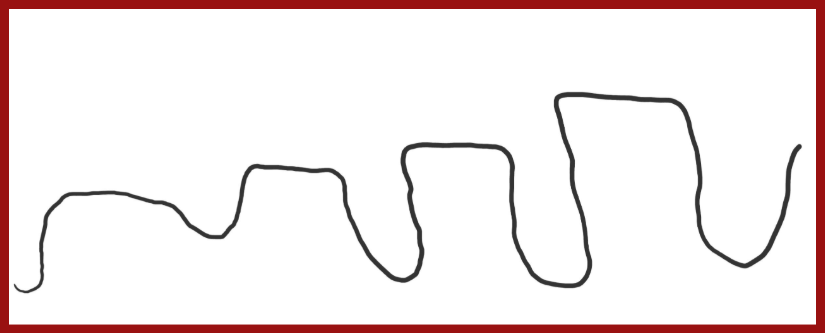
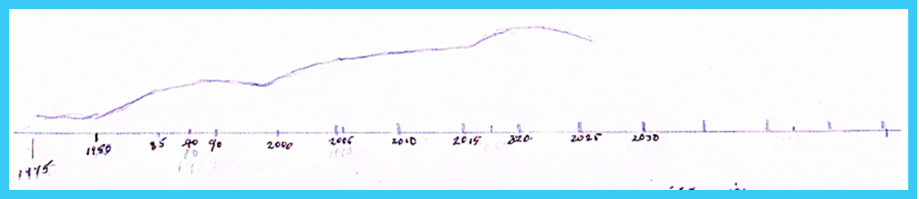
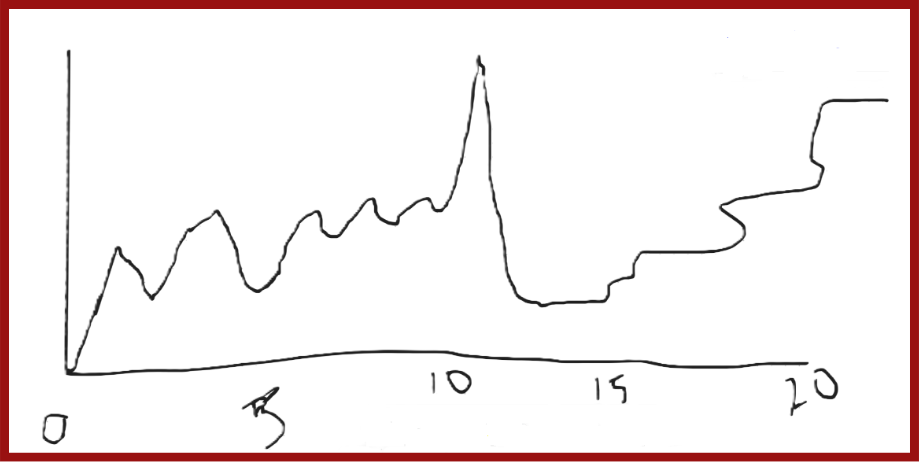
We ended each interview by completing a line drawing depicting something of their long-term journey in place. A very simple creative task that took all of the verbal reflections into a visual representation. Each reflecting throughout the interviews on their perspective of being in place for long periods.
A key theme that came through in every interview, which each of the following blogs will explore, was change over time and the need for time to see change. The feeling that their sense of time was different to policy and funding cycles.
Each of their lines spanned decades. Each of them had stories of change that had taken time. Each interviewee pointed out some of the ups and downs of their line, attributing seasons to the peaks and troughs. Detailing the juxtaposition of some of the emotions they felt with the activity taking place, how trials often spurred them on. Each line shows longevity and tenacity. Each line is a person’s link to their place, how their identity is wound up in that place. It may be a simple line, but it shared a story.
When we are approaching those trusted voices in our communities to start a new process, we could remember that their timeline started before ours; we are a point in their story, a guest. How does that change how we approach a situation?
These are the 4 images created. A line from one side of a page to another. Some with annotation, some explained to me a little.
‘Every time we do something we get better at understanding, we go up and up’
“ I think it will be a zig-zag, right now, I’m down here, I’m scared for the voluntary sector…but here, Covid, we were high because we got lots of money and people are supporting each other, although it is a scary time, for community development, engagement was high”
Through the next four blogs, we will unpack some of the themes emerging from these interviewees’ felt experience; working through ideas of policy, infrastructure, emotional labour and what the ideal looks like.
This blog was written by Helen O’Gara, LPIP Hub Place Fellow. Helen is a Public Health Principal.