
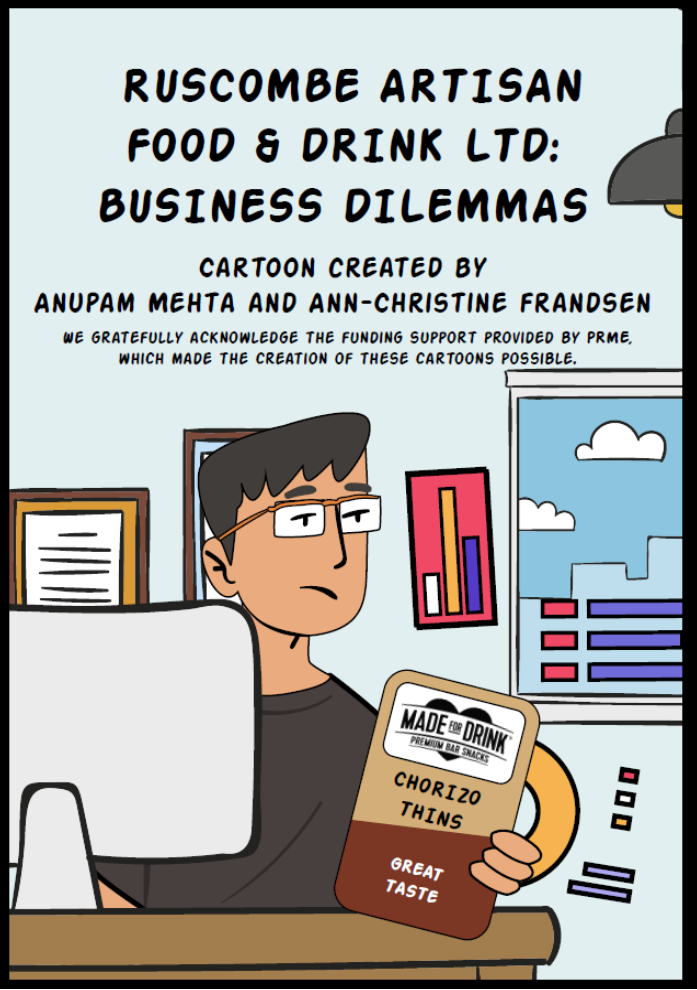
By Dr Anupam Mehta and Dr Ann-Christine Frandsen
Birmingham Business School, University of Birmingham
PRME funded research
Innovative Pedagogic tools for learning and teaching Sustainability and Responsible Business
Sustainability education in business schools is crucial for preparing future leaders and entrepreneurs to address the urgent global challenge of climate change and its impact on communities and ecosystems across land, air, and water.
One critical question is how can we attract and retain students’ attention and collaborative engagement into complex issues and prepare them for their professional career where sustainability and responsible business is a key guide to their thinking and acting.
Want to try something different in your teaching? Our framework helps you turn real case studies into cartoon-based business cases, boosting student engagement while delivering key knowledge.
Our cartoon-based framework offers support for translating business case studies into sustainable real-life business cases that work across cultures and diverse student backgrounds and experiences.
Our research shows how this innovative pedagogy is a creative and fun way to engage the students into complex matters. The medium of cartoon is a cross-cultural way of encouraging working collaboratively, promoting imagination, and encourages critical and alternative thinking.
There are several steps to think about which the framework report we have created describes and exemplify. For instance, what kind of real sustainability business cases to use, and what key elements from the case study, when translated into an image narrative, you must keep in making sense. We also present key pedagogic guidance in making these translations.
Students’ reactions using the cartoon-based real-life case study in class
“when I first saw the cartoon based case study. It’s very interesting it. It attracted me immediately and shift my attention to the case.”
“…also, like seeing the owner discussing the challenges which makes it more like a real world business problem, instead of just like studying the theories.”
“Normally, my colleagues, they are like really bored doing case study. But once they see this like cartoon, they started to like, get engaging and like I help them out.”
“the comic is like, really easy for students to like understand the concept and theory of the studies.”
“it makes like accounting finance and sustainably come alive in a way that I like test book never could”
“It helps me realize that business decisions are not like very straightforward.”
So what?
The future sustainable economy will depend on how the next generation of managers, future leaders and SME entrepreneurs’ knowledge in dealing with climate change issues in practice. How we educate our future leaders and decision makers is therefore of concerns for all of us on this planet.
In developing sustainability competence, and sustainability-related decision-making, not least by SMEs, an energising environment where learning is fun, and collaborative is key to students active learning. The text-based real business cases have advantages but can be overwhelming for many students when the topic is complex and challenging such as voluntary environmental capital investment project. However, as a cartoon-based case study it draws their immediate attention and encourages students collaboratively bringing different perspectives and interpretations of the story depicted in the cartoon.
While numerous teaching cases exist on sustainability issues within large enterprises, more cases need to address the dilemmas and challenges SMEs face in making sustainability decisions. The case study discussed in this paper focuses on an SME scenario, providing a unique perspective on the complexities inherent in such contexts.
For those wondering whether this method works in practice, we can now confirm that the case study was successfully implemented in a management accounting module in Singapore. It was delivered to a cohort of 80 second-year BSc Accounting and Finance students. The case study integrates both financial and environmental factors into the strategic investment evaluation process and is based on primary data gathered through interviews with the company’s CEO. Students received the case study in advance, enabling them to prepare thoroughly and engage meaningfully in class discussions. Although our findings are preliminary, we observed a positive impact on student learning. Why not try it yourself?
- If you would like to find out more about this work, please contact Dr Ann-Christine Frandsen and Dr Anupam Mehta.
- Back to Social Sciences Birmingham
The views and opinions expressed in this article are those of the author and do not necessarily reflect the official policy or position of the University of Birmingham.