
Written by: Dr Caroline Gillett, Assistant Professor in Patient and Public Involvement and Engagement
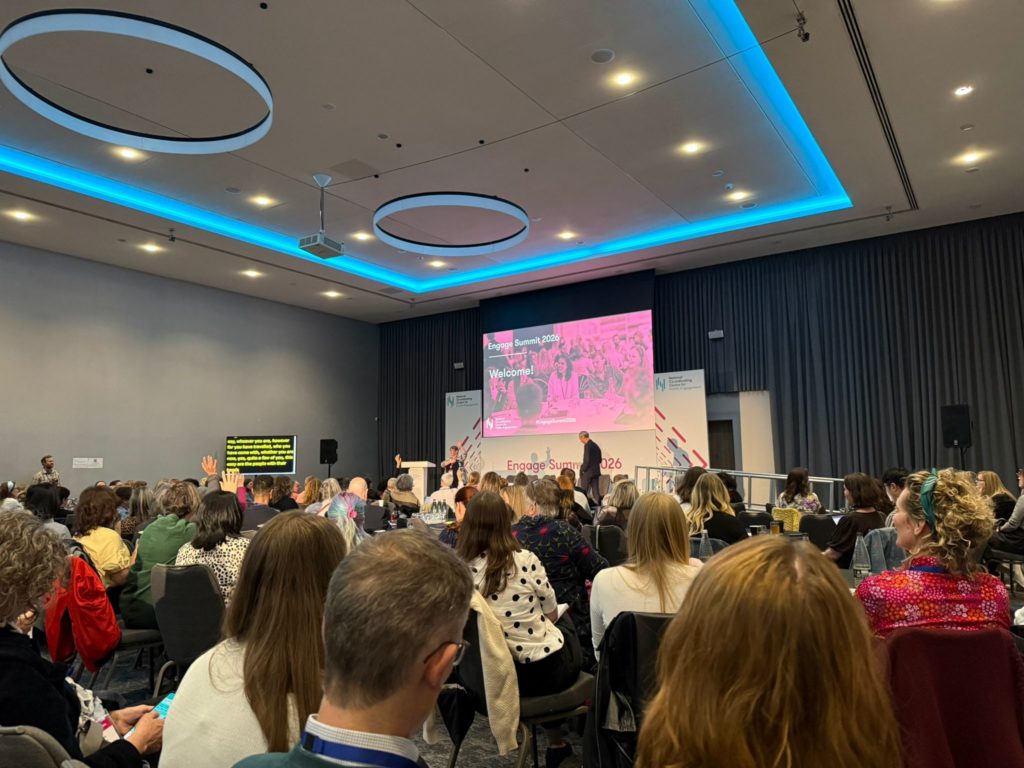
Over the 29–30 April, I had the opportunity to attend the 2026 Engage Summit hosted by National Co-ordinating Centre for Public Engagement at The Eastside Rooms in Birmingham.
The Summit brought together people from across higher education, community organisations, research, policy and public engagement practice to reflect on the future of universities and their relationship with society. More than simply a conference, it felt like a genuine community of practice — a space for honesty, challenge, solidarity and imagination.
Building on the NCCPE’s “Engaged Futures” programme, the event focused on some significant questions: what kind of university sector do we want to build, and how do we create systems that genuinely value engagement, inclusion and collaboration? Across the two days there was a strong sense that while progress is being made, the sector is also facing real pressures and uncertainty. The recurring message was that meaningful change will require collective action, long-term commitment and stronger partnerships between universities and communities.
Workshops and Learning
Alongside the plenary sessions and poster sessions, I attended several workshops which provided useful ideas and opportunities for reflection.

Emotional Touchpoints: Dealing with Emotionally Challenging Situations in Public Engagement Practice
Delivered by Edinburgh Napier University
This was one of the most practically useful sessions I attended. The workshop introduced “Emotional Touchpoints” as a structured reflective tool for navigating emotionally challenging situations within public engagement work.
Participants explored how storytelling and active listening can help surface emotional experiences in a safe and constructive way. A series of cards displaying positive and negative emotions are used during conversations, allowing facilitators to identify and reflect back the emotions being expressed. Participants can also add emotions not already represented. The importance of establishing psychological safety and clear ground rules before beginning the exercise was emphasised.
Given the emotionally complex nature of patient and public involvement and engagement (PPIE) work, I could see this approach being particularly valuable as a debriefing and reflection tool within projects and teams. You can find out more about the resource on the team’s blog here. The workshop also referenced the University College London resource “Disagreeing Well”, which I plan to explore further.
Young People Reshaping Research
Delivered by Queen Mary University of London and Staffordshire Council for Voluntary Youth Services
This session focused on youth participatory research and the importance of embedding young people’s leadership within research projects and decision-making.
A particularly memorable part of the workshop involved two young people performing a conversational reflection on their experiences within the projects. It was an engaging and effective way of communicating both the value and the realities of participation from a young person’s perspective.
I also took part in a discussion around “body mapping” as a reflective tool. This encouraged participants to think about how young people may feel physically and emotionally at different stages of a project. The exercise highlighted the importance of recognising participation as something relational and emotional, not simply procedural.


University 2.045: A Community Approach to Co-designing the Engaged University
Delivered by Technological University Dublin and St John of God Community Services
This was a welcoming and thoughtfully facilitated workshop which strongly centred accessibility and inclusion, including the representation of people with differing abilities within the discussions.
Our group explored a scenario focused on social media and considered how universities and communities could work together on research, advocacy and policy influence to make online spaces safer. The workshop reinforced the value of co-design methodologies and highlighted how communities should not simply be participants in research, but active partners in shaping agendas and solutions.
Themes from the Plenary Sessions
Several contributions from the plenary sessions stayed with me long after the conference ended.
Knowledge Exists Beyond the Academy
One of the most powerful short talks from the floor came from Sado Jirde from Black South West Network, who delivered a passionate and inspiring provocation around activism, power and engagement.
A key message was that knowledge, expertise and solutions do not (of course) sit exclusively within universities. Communities already hold deep insight and lived experience, and academia must move away from extractive approaches towards more reciprocal and equitable ways of working.
This linked strongly to broader discussions throughout the Summit about trust, relationships and the limitations of traditional institutional structures.
“Coalitions of Flotillas”
Another metaphor that resonated strongly described universities as “large tankers” — institutions that can take a very long time to change direction. While this may sometimes feel frustrating, the point was not to lose hope. Instead, engagement practitioners, facilitators and activists can come together as “coalitions of flotillas”: smaller, agile groups working collectively to influence larger systems.
The message was clear: systemic change rarely comes from a single intervention. It comes from many aligned efforts, relationships and movements building momentum together.
Risk, Trust and Hidden Systems
On the second day, Shomari Lewis-Wilson from Wellcome Trust spoke about their anti-racism work, the greater emphasis on relational engagement and the unequal ways organisations experience risk.
One particularly striking observation was around the ability of larger organisations to “absorb risk” in ways that smaller community organisations often cannot. I completely concur. This also prompted my own reflection on the “hidden curriculum” of research and funding systems — the often unspoken knowledge needed to navigate funding structures, institutional expectations and processes. Even for those working within academia, these systems can feel opaque and difficult; for those outside them, the barriers can be even greater.
He also commented on the argument for shifting away from prioritising speed and efficiency alone, and instead valuing trust, relationships and long-term impact.
Inclusion, Systems Change and Collective Action
The closing plenary, Acting Together for Change, brought together several speakers reflecting on how change happens across the sector.
Steven Hill from Digital Science identified four major developments helping move research culture forward:
- Engaged Research
- Embedding Research Impact
- Open Access
- Research Culture
His argument was not that any one of these alone would transform the system, but that meaningful progress comes through multiple initiatives working together. Grassroots activism and top-down policy change both matter, and real impact often comes when the two align. He also referenced the “Overton Window” — the range of ideas society sees as politically acceptable — and challenged us to think about how our work helps shift that window over time.
He also acknowledged that machine-augmented research and AI are realities that are not going to disappear. However, he argued that this makes the human dimensions of research even more important: ensuring that people continue to shape the questions, values and purposes behind the work.
Hamied Haroon from National Association of Disabled Staff Networks spoke powerfully about the social model of disability and how systems and environments create disabling barriers.
One example was particularly affecting: although his workplace technically had disabled access, the accessible entrance was through a separate route near the bins at the back of the building. The building was accessible, but not inclusive. It was a powerful reminder that inclusion is not simply about compliance or minimum standards — it is about dignity, belonging and equality of experience.
Asli Tatliadim, who has recently joined the NCCPE team, also who spoke about the power of reframing public conversations. In her example, she spoke about an initiative she had been involved with focused on migration and housing. Rather than focusing discussions solely “about refugees”, she highlighted the importance of examining the systems and actors that profit from inequality — particularly landlords and housing providers benefiting financially accommodation arrangements. She shared examples of work aimed at shifting towards community-owned and socially beneficial housing models, where investment creates long-term value for local communities as well as providing support for refugees. I found this a thought-provoking example of how changing the framing of an issue can open up different possibilities for policy, engagement and collective action.

Recognition and Community
It was also wonderful to see Paul Manners and Sophie Duncan receive recognition from UNESCO for their longstanding contributions to the public engagement sector. From the early days of the Beacons for Public Engagement through to the present, their leadership has helped shape and sustain this field over many years.
Sophie closed the conference with a metaphor that captured the atmosphere of the Summit perfectly: she described engagement practitioners as being like a penguin huddle — staying close together to keep warm, supporting those on the edges by bringing them into the centre, and creating a self-sustaining system of care and solidarity.
That image stayed with me because it reflected much of what the Summit itself represented: a community navigating uncertainty together, while continuing to push for a more inclusive, relational and socially engaged future for research and higher education.
The conference reinforced that while stories are important, storytelling alone is not enough. Real change requires collective action — “pressing the same button at the same time” — and building alliances that can shift systems over the long term.
I left the Summit feeling challenged, encouraged and reminded that although progress can sometimes feel slow, there is real value in bringing people together to imagine and work towards something better.
Finally, I would like to thank the Public and Cultural Engagement (PACE) at the University of Birmingham for supporting me to attend and network with other peers the event through covering the registration fees through my application to their public engagement fund.