
For the third year running (see previous awards), we are pleased to announce that a research group who use our advanced computing facilities has been recognised as award-winning in the HPCwire 2025 awards! Advanced Research Computing is very proud to provide Birmingham Environment for Academic Research (BEAR) to support high-impact research at the University, which has been internationally recognised in these highly competitive, global awards. You can find out more details about the award and the research involved in the press release below:
St. Louis, MO — November 17, 2025 — The University of Birmingham has been recognized in the 22nd edition of the HPCwire Readers’ Choice Awards, presented at the 2025 International Conference for High Performance Computing, Networking, Storage, and Analysis (SC25), in St. Louis, Missouri. The list of winners was revealed at the SC25 HPCwire booth, as well as on the HPCwire website: https://www.hpcwire.com/2025-hpcwire-awards- readers-editors-choice.
The University of Birmingham was recognized with the following honor:
Editors’ Choice: Best Use Of AI Methods for Augmenting HPC Applications
AI-driven insights into biodiversity decline
University of Birmingham researchers have developed a high-throughput biodiversity screening kit, now being adapted for in-field use, that enables real-time, high-resolution monitoring of community biodiversity. The effort leverages the University’s BlueBEAR cluster (Lenovo, with Intel CPUs and IBM Storage Scale), including NVIDIA A100 GPUs and HPC, to process terabytes of biodiversity and environmental data.
Professor Luisa Orsini and Dr Jiarui Zhou from the School of Biosciences led the high-impact research at the University of Birmingham, based in the College of Life and Environmental Sciences.

“We are thrilled that our work has been recognised with the HPCwire Editor’s Choice Award for Best Use of AI Methods for Augmenting HPC Applications. This achievement underlines the cutting-edge nature of our research at the University of Birmingham, where we harness advanced computing and AI to tackle real-world challenges in biodiversity loss and pollution. None of this would have been possible without the University’s Advanced Research Computing facilities, whose collaboration enables us to turn scientific innovation into meaningful impact.” Professor Luisa Orsini, Dr Jiarui Zhou, University of Birmingham
The coveted annual HPCwire Readers’ Choice Awards are determined through a nomination and voting process with the global HPCwire community, as well as selections from the HPCwire editors. The awards are an annual feature of the publication and constitute prestigious recognition from the HPC community. They are revealed each year to kick off the annual supercomputing conference, which showcases high performance computing, networking, storage, and data analysis.
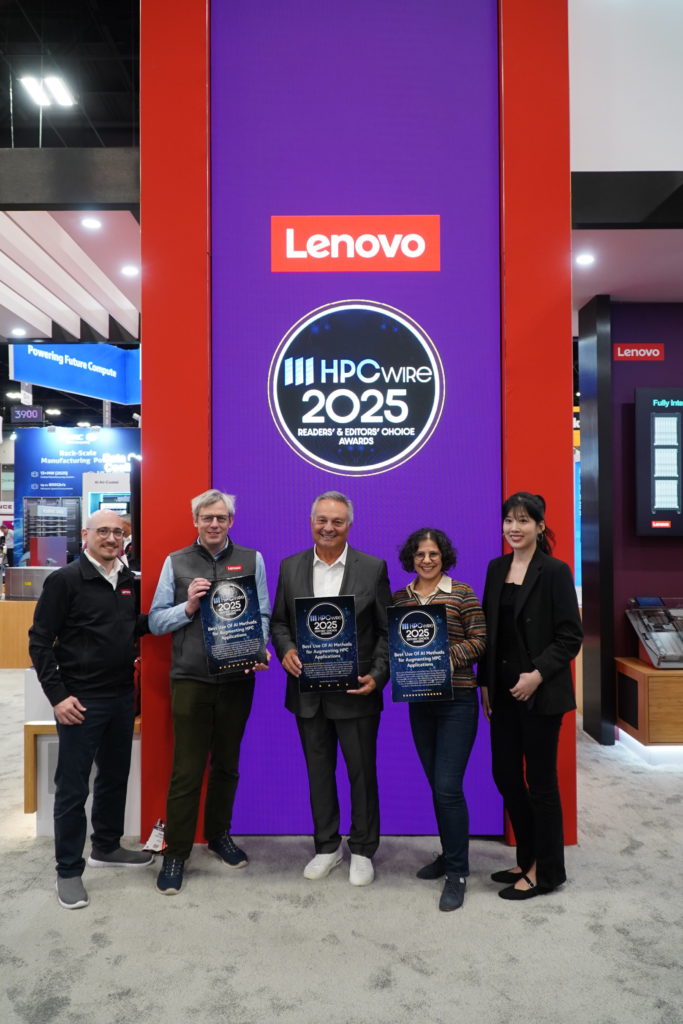
“While the early advances in applying AI to science and engineering are producing exciting and impressive results, traditional HPC continues to drive breakthrough discoveries for mission-critical workloads and applications,” said Tom Tabor, CEO of TCI Media, publishers of HPCwire. “The 2025 Readers’ and Editors’ Choice Awards truly capture this dynamic era of innovation.
“Across the globe, grand challenge problems are being tackled — and often solved — thanks to HPC, now amplified and accelerated by AI. Yet, many of these remarkable achievements rarely receive the recognition they deserve for their impact on society. With input from our worldwide community of HPC experts and the industry’s most respected editorial panel, the Readers’ and Editors’ Choice Awards stand as a powerful acknowledgment of the depth and diversity of HPC accomplishments worldwide. We extend our sincere gratitude and warmest congratulations to all of this year’s winners,” added Tabor.
More information on these awards can be found at the HPCwire website (www.HPCwire.com) or on X through the following hashtag: #HPCwireRCA25.
Two other research groups at the University were shortlisted for HPCwire awards
Two other research groups at the University of Birmingham were shortlisted for HPCwire awards but unfortunately did not win in their categories:
- Best Use of HPC in Physical Sciences – David Themens’s research group, together with contributors from around the world, can homogenize and assimilate multiple observations into both empirical and dynamical models of the near-Earth space environment in real time, in order to develop new methods of mitigating the impacts of Space Weather on communications, navigation, remote sensing, spacecraft operations, and the sustainable management of near-Earth Space.
- Best Use of High Performance Data Analytics & AI – Chandan Bose’s research group leveraged multi-objective Bayesian optimization and GPU-accelerated (OpenMP offload with MPI) high-fidelity fluid-structure simulations to unravel and optimize the vortex-dominated unsteady wake dynamics of butterfly swarm flight. The work showcases how cutting-edge AI and high-performance data analytics can drive breakthroughs in bio-inspired flight design and control.
About HPCwire
HPCwire is a news site and weekly newsletter covering the fastest computers in the world and the people who run them. As the trusted source for HPC news since 1987, HPCwire serves as the publication of record on the issues, opportunities, challenges, and community developments relevant to the global High Performance Computing space. Its reporting covers the vendors, technologies, users, and the uses of high performance, AI- and data-intensive computing within academia, government, science, and industry. Subscribe now at www.hpcwire.com.