
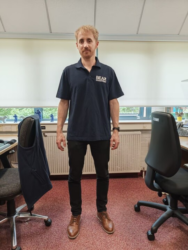
Birmingham Environment for Academic Research (BEAR) Newsletter Whilst June has seen several of the team head out to conferences and events, including ISC High Performance 2025, we are busy preparing for our own event next week to welcome 15 teams of taught students to the heavily oversubscribed BEAR Challenge 2025, part of the UoB Xtra series of events. … Continue reading “June 2025 BEAR Newsletter”
Reflections from the BEAR Conference 2025
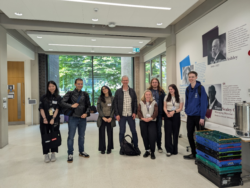
The 14th annual BEAR Conference, a vibrant event organised by postgraduates for postgraduates, took place on 22 May 2025 at the Alan Walters Building—and what a fantastic day it was! With 55 attendees, the conference was packed with insightful talks, lively discussions, and a strong sense of community. Dietmar Heinke, Chair of the BEAR User … Continue reading “Reflections from the BEAR Conference 2025”
Modelling defects in inorganic phosphor crystals
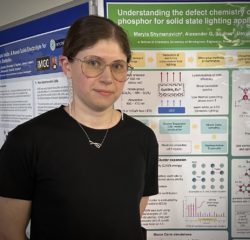
In this case study we talk to Maryia Shymanovich, a PhD student in Chemistry, whose project focuses on the computational analysis of the defects in inorganic phosphor materials for solid-state lighting applications. I am a second-year PhD student in Professor David Scanlon’s (School of Chemistry) group, and my research project focuses on the computational analysis of … Continue reading “Modelling defects in inorganic phosphor crystals”
What makes things go BOOM! – from vibrations to detonation

In this case study we talk to Jakob Hein-Paar, a PhD student in the Michalchuk Group, Chemistry, who looked into the effects of phonons on the reactivity of energetic materials. My research deals with vibrational metallization of metal azides, a group of energetic materials or explosives, investigating energy transfer within their crystal structures. As “vibrational” implies, … Continue reading “What makes things go BOOM! – from vibrations to detonation”
Shaking up mixing: optimising mixing using BlueBEAR

In this case study we talk to Emily Allman, MEng Chemical Engineering undergraduate student, who looked into the efficiency of Resonant Acoustic Mixers (RAM) using BlueBEAR, for her final-year research project. Emily presented her paper at the recent BEAR PGR Conference 2025. I am a final-year MEng Chemical Engineering student at the University of Birmingham. For … Continue reading “Shaking up mixing: optimising mixing using BlueBEAR”
Extracting tender information with BlueBEAR: tackling complex documents with NLP and image processing

In this case study we talk to Asim Abbas, PhD Researcher in Artificial Intelligence (School of Computer Science), who is using BlueBEAR to extract structured information from unstructured and ambiguous tender documents. My research focuses on extracting structured information from unstructured and ambiguous tender documents, whereas these documents present distinctive processing challenges due to their … Continue reading “Extracting tender information with BlueBEAR: tackling complex documents with NLP and image processing”
May 2025 BEAR Newsletter
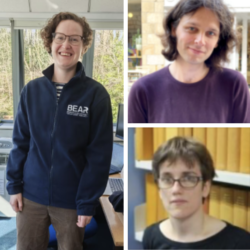
Birmingham Environment for Academic Research (BEAR) Newsletter As we head into summer, we have a busy events season starting this week with the HPC-SIG in Cambridge, the Thesis Submission event for PGRs, and the BEAR Conference. Hopefully you will have seen that our summer programme of BEAR training workshops (being held online) has now been released, and you can … Continue reading “May 2025 BEAR Newsletter”
RSE Midlands 2025
Senior Research Software Engineers James Tyrrell and Gavin Yearwood led the organisation of RSE Midlands 2025, and below James gives a summary of this successful event. The Advanced Research Computing team hosted the Research Software Engineering (RSE) Midlands 2025 Annual Conference at The Exchange on Monday 7 April, 2025. Sponsored and supported by our partners … Continue reading “RSE Midlands 2025”
RNA sequencing analysis made easy with BEAR
In this case study we talk to Jonny Lewis (researcher in Inflammation and Ageing) about how BEAR helps in understanding changes in the cells lining blood vessels when blood flow is not linear and smooth – altering what they release and communicate with. The sound of a computer, working at its limit, the fan desperately … Continue reading “RNA sequencing analysis made easy with BEAR”
Extraction and Analysis of Hydrological Spatial Data

In this case study, we hear from Chenlu Yang, a PhD student in the School of Geography, who has been leveraging BEAR (Birmingham Environment for Academic Research) to study flood behavior and hydrological extremes My research focuses on analyzing trends in flood behavior and hydrological extremes across the UK using high-resolution gridded datasets and long-term … Continue reading “Extraction and Analysis of Hydrological Spatial Data”