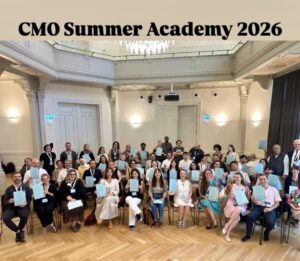
Taking part in the Corpus Musicae Ottomanicae (CMO) Summer Academy was one of the most valuable experiences of my academic career. Held at the Orient-Institut Istanbul from 7 to 11 September 2026, the academy brought together researchers, lecturers, musicians and students with a shared interest in Ottoman music and cultural heritage.
From the very first sessions, it became clear that the CMO Summer Academy was much more than a traditional academic event. It was a welcoming space where knowledge was generously shared and questions were encouraged. Participants were invited to learn both from experts and from one another. The programme successfully combined historical sources with contemporary methods, demonstrating how technology and interdisciplinary collaboration can foster a dialogue between the past and the present.
I took part in the Digital Humanities, Cataloguing and Research Data Management modules. Each offered its own perspective while complementing the others.
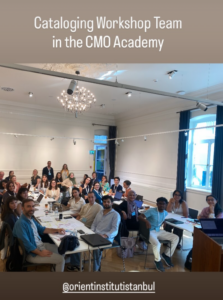
The Cataloguing workshop introduced me to the painstaking work involved in identifying, describing and organising Ottoman music sources. Through discussions on the CMO Source Catalogue, conceptual models, data ontology and catalogue-based research, I gained a much deeper appreciation of the importance of cataloguing. It is not simply a matter of creating records; it is about making cultural materials accessible and useful for future generations.
The Research Data Management module highlighted the importance of organising, documenting and preserving research data throughout a project. The combination of key concepts and practical work made the topic accessible and relevant. I left with a clearer understanding of how responsible data management supports academic collaboration and the long-term reuse of scholarly work.
Equally fascinating was the Digital Humanities workshop, “From Beats to Bytes”. It explored how digital approaches can support scholarly music and text editions, including the conversion of research materials into machine-readable formats. I was particularly interested in the challenge of using digital technologies while taking into account the distinctive characteristics of Ottoman sources. The module demonstrated how digital tools can broaden access to cultural heritage without losing sight of its complexity.
One of the academy’s main strengths was the quality of its academic community. The speakers and coordinators possessed considerable experience and engaged with participants with genuine care. Complex ideas were presented in a way thaistanbult encouraged participation and fostered collaborative learning. The programme’s careful organisation also enabled connections to be made between different topics, providing a deeper understanding of how research and technology can support the preservation and performance of Ottoman music.
I would like to express my sincere gratitude to the entire CMO team, the workshop coordinators and all the staff at the Orient-Institut Istanbul who contributed to the academy. Thank you for your generosity and support. I am particularly grateful for the help you gave me and for always being there when I needed advice. Your kindness helped me feel welcome and confident throughout the experience.
The CMO Summer Academy is an excellent example of what can be achieved through academic collaboration. It preserves and promotes an important musical heritage while creating opportunities for new researchers to learn and develop. I wholeheartedly recommend the academy to anyone interested in musicology, cultural heritage, digital humanities, cataloguing or research data.
I am proud to have taken part in this event and am delighted to share my positive experience. What I learned, along with the sense of community I experienced, will stay with me throughout my future studies. To everyone associated with CMO: thank you for an unforgettable week.