
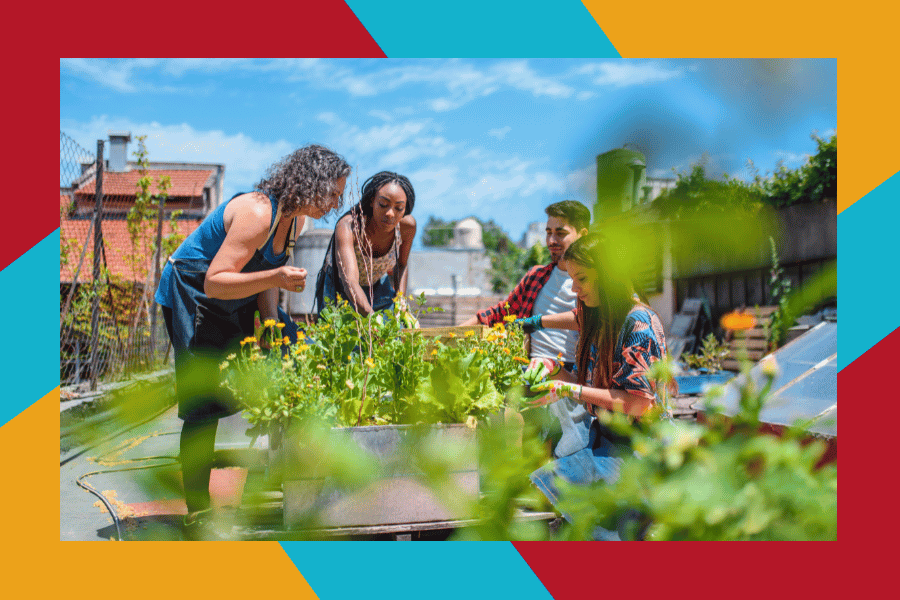
LPIP Hub Place Fellow Helen O’Gara’s series ‘We Are Guests’ continues with a third blog exploring the community infrastructure and experiences of funding felt by the community development workforce.
View the other blogs in the series.
“I think what you need is a common something that you can work together on”
“This is a whole invisible ecosystem of support.”
“They’re almost a village in a urban area. Yeah. It’s got that village mentality to it and you can guarantee that if something happens, within about a couple of hours, you’ll know. It doesn’t matter where it is on the estate, you will know”
Community Infrastructure
My introductory blog hinted that I was especially interested in how these community development practitioners were the ‘knowledge mobilisers’ and ‘hidden glue’ discussed in previous LPIP blogs. I wanted to understand how it felt to be in that role as a boundary spanner, whether paid or unpaid, where the ‘mission’, as one called it, is to activate their communities not just to thrive, but to engage. The practitioners desired to see change in their community, and they also desired their communities to have more say, to make decisions for themselves and to speak to power. To activate the essence of civil society that they themselves found so rewarding. It is no surprise that every one of the origin stories my interviewees shared discussed how they came to start as a volunteer. At some stage, they stepped into professionalism, or their professional identity became more aligned with the work; it was less a civic side quest, and more a moral ambition, and yet it interchanged on a regular basis. They are, at once, part of and enabling the infrastructure.
“I quit the work I was doing. It wasn’t right for me, and started to volunteer and it was volunteering that largely got me back on my feet and I became really passionate and interested because I’d lived the experience of being supported through my community, this idea of community becoming healing space and nourishing spaces where we can support and build each other.”
“I said to them, I think we need to do something because I don’t think anybody else is going to do it.”
Ethical over-extension
I’ve always said… it wouldn’t matter whether I got paid or I didn’t get paid, I’d still have to do the job I’m doing.
“I know some organisations, CEOs or directors, they serve the community without getting paid. Because they’re waiting for other funding and then they don’t want to say to people who come to the service, that’s it, it’s cut off.”
All the interviewees have moved in and out of paid and unpaid spaces, sometimes operating both at once. All roles serving that same ‘mission’. The choice is both individual and imposed. If funding is not there, do they do this for free? Do they have the financial and emotional resilience to continue for free?
This is the tension the community development workforce sits with. Each of them described this tension, the precarity, and the reasons they think that it is not worse than it is on the ground, because people stand in gaps. There is a growing professionalism for some, where paying people fairly becomes part of their ethical practice, but the sector is still reliant on and upholds volunteering and citizenship. It’s a very complex space to find a consistent threshold for professionalism.
“I’m all about wellbeing, if I was paying my staff substandard wages. It would be a contradiction in terms and I think we owe that responsibility to each other as system players that actually we need to lift each other up and support and learn and grow collectively”
“The sector is still holding everything together, but there’s less funding.”
I had a discussion with two of the interviewees about how it felt like the country is in a bad place in terms of community infrastructure given the extent we rely on the voluntary, community, faith and social enterprise sector, whilst it is simultaneously under-valued and persistently under-funded, There is realistic fear that it is damaging the resilience of our communities, their ability to thrive and their ability to be the citizens the whole sector needs to survive. If community-building organisations don’t exist, the safe mechanisms for citizenship are also limited.
“There’s very few people working in the area now. It’s basically just us.”
“Some organisations are one‑person bands.”
The sense of precarity was strong. Community development practitioners are skilled and progressive in their ambition to make things ‘better’, but are experiencing low sustainability in income generation, leading to frustration, anger and affecting material and psychological welfare. Does the funding structure of this workforce either feed a lower-paid workforce or establish that it can only be held by those with the financial resilience to sustain it without remuneration? Does that reinforce inequalities?
Speed
Sometimes speed or crisis leads to action – a convening factor that drew a community together.
One interviewee used their line drawing to share how the pandemic released a spike in support, in the value of the community infrastructures and funding. It felt positive and adaptable; both the communities themselves and the infrastructure support led to huge growth. Much of the community raced ahead of the policy sphere, leading the way to support people who were marginalised, so community infrastructure and citizenship were revealed.
But the other side of that period has felt like a long drop. An expectation that the same levels of spare time and volunteering exist, that the exhaustion experienced by many in the sector during that time has recovered. For some, there is a sadness as the workforce has dwindled, funding has been removed, and people have returned to previous rhythms of life. I wondered if there are feelings of loss, for the potential we may have seen during that time to sustain levels of citizenship that could support the everyday crises that are experienced without a pandemic, when housing, mental health, welfare, and employment are the chronic conditions requiring support
“… and then they end up going back to where they were, going back to isolation. They were going back to the mental health problem.’
“They’re going back to, you know, where we start from because we didn’t end up finishing the work we’re doing, not sustaining it because of funding.”
When there is a ‘thing’ to gather around, communities are often there. Sometimes that is something that is not wanted in their space, a planning issue, crime, perceptions of their place changing, or a pandemic. All interviewees discussed the things that do garner interest and engagement, and their need to be responsive to these issues as well as use their own marketing skills to gain interest in the work they are progressing.
Urgency is an underlying narrative that leaves our professionals in a constant state of vigilance. They are aware, always, of the community feelings and of the politics and the opportunities arising. With funding cycles arranged as they are, this adds to the need for urgency and vigilance with little time to think. They are being kept in a state of movement.
“It’s often really exciting when we get the opportunity to start, but it’s not like the old days, you know, where there was time.
“Three months worth of funding is dropped on your lap and expectation it will start tomorrow. And it’s funny because the system moves at a snail’s pace, but expects people like me to run 100 miles an hour at it, often for very limited resources.”
The Local Government Association discuss the complex landscape of funding for just the cultural sector, crucially pointing out that only 25% of initiatives will still be in existence in 3 years. This is replicated and often compounded in community development, where a three-year agreement may actually be the more long-term opportunity. More recently, policy supporting SME’s and VCSE stability and economic growth exists within procurement spend targets in the National Procurement Policy Statement (NPPS); however, longevity isn’t addressed here.
Community development professionals need to be alive to policy and opportunity in many overlapping areas, from culture to health, to housing, to climate, all with particular nuanced outcomes desired that our interviewees need to be across.
Often this is overwhelming, and opportunities are missed in favour of doing the work consistently.
“Sometimes I miss the funding, you’re so busy and you actually miss it. Then somebody goes, did you apply?
No, because I’m about a month behind everybody else and too busy and actually no, I missed that one completely.”
Stability in time
The clear message is that community development work takes time, and for time to have the impact, infrastructure needs to be supported, nurtured and valued.
The practitioners shared stories of impacts coming decades down the line, with mixtures of joy and frustration.
“It’s taken me 25 years to get there. You know, it’s not a thing that happens overnight.”
This blog was written by Helen O’Gara, LPIP Hub Place Fellow. Helen is a Public Health Principal.
Find out more about the Local Policy Innovation Partnership Hub.
Disclaimer:
The views expressed in this analysis post are those of the author and not necessarily those of City-REDI or the University of Birmingham.