
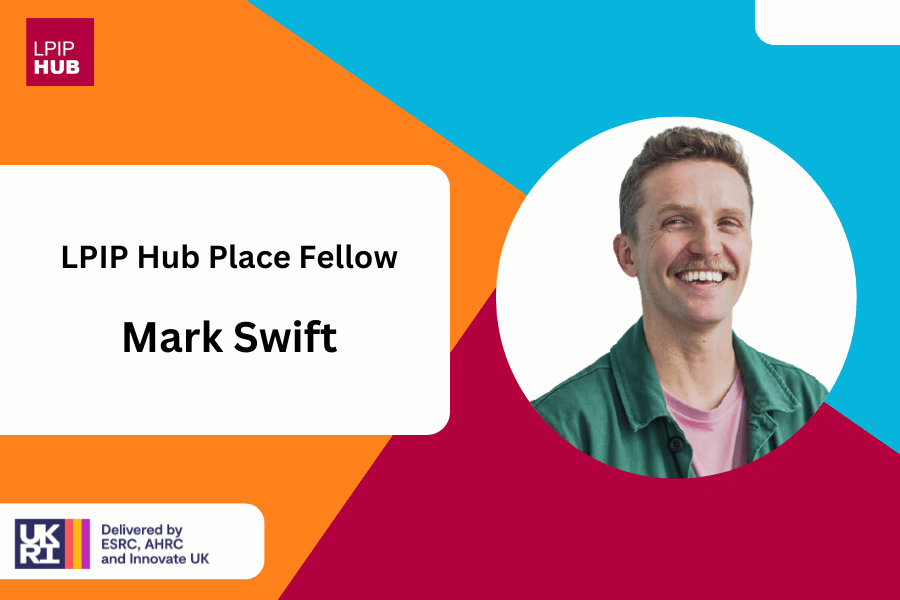
In this reflective blog, Mark Swift explores how his LPIP Fellowship reinforced the importance of community knowledge, participation and productive challenge in helping institutions remain open to learning, innovation and transformation.
A fellowship and a moment of reflection
When I joined the Local Policy Innovation Partnership (LPIP) Fellowship programme, I expected to learn more about innovation, policy and systems change. What I did not expect was how much it would prompt me to reflect on my own journey as a social entrepreneur.
For more than twenty years, I have led Wellbeing Enterprises CIC, working alongside people and communities experiencing some of the deepest inequalities in society. Throughout that time, I have often found myself operating at the boundary between communities and institutions. On one side are people navigating the realities of everyday life. On the other are organisations striving to respond to increasingly complex social challenges. Both bring valuable knowledge and expertise. Yet bringing those perspectives together is rarely straightforward.
The fellowship allowed me to step back from the day-to-day pressures of running an organisation and reflect on some of the tensions I had encountered throughout my career. Through conversations with researchers, policymakers, practitioners and fellow innovators, I found myself returning to a simple question: how do institutions remain open to learning from the people they exist to serve?
Defining success before understanding communities
One experience from earlier in my career illustrates this tension.
We had been commissioned to deliver a community-based project and had explicitly agreed that there would be space to learn alongside local people before determining what success would look like. Yet within weeks of starting, I found myself being asked to commit to a fixed set of performance indicators. We had barely begun engaging with residents. We did not yet understand their priorities, aspirations or the realities shaping their lives. Nevertheless, there was understandable pressure to provide certainty, targets and reassurance.
I remember leaving the meeting frustrated. Not because anyone was acting unreasonably. The people involved were committed, thoughtful and working within genuine constraints. Rather, I felt we were being asked to define success before we had fully understood the people and communities the project was intended to serve.
That experience highlighted a tension that exists across many systems: the need to balance accountability and certainty with listening, learning and adaptation.
The fellowship helped me see that this tension extends far beyond individual projects. At its heart is a question about what kinds of knowledge systems value and whose voices shape decisions.
Valuing what matters
This theme became a thread running through much of my fellowship work. In Rebalancing Health Innovation for Health Equity, I argued that communities should be seen not simply as recipients of innovation but as a source of innovation themselves. In Valuing What Matters: Reclaiming Social Value for Systems Change, I explored how some of the outcomes that matter most to people and communities are often the hardest to measure.
Trust. Belonging. Confidence. Relationships. Hope. Agency.
These are not peripheral concerns. They are often the foundations upon which lasting change is built. Through my work at Wellbeing Enterprises, I have repeatedly seen how relationships, trust and people’s sense of control over their own lives shape outcomes in ways that conventional measures struggle to capture. If systems focus only on what can be easily counted, they risk overlooking the conditions that enable wellbeing, resilience and innovation to flourish.
Participation, democracy and being the grit in the system
Similar questions informed Dialling Up Democracy in the 21st Century and Building Civic Capability: A Life Course Framework for Place. Both explore how participation is not simply a democratic ideal but a practical necessity. If institutions are to remain responsive in an increasingly complex world, they need meaningful ways of hearing and learning from the people whose lives they affect.
This brings me back to the idea of being the grit in the system.
The phrase is not intended to suggest opposition or antagonism. Rather, it describes the productive challenge that helps systems learn. Innovation rarely emerges from agreement alone. It often emerges when different perspectives encounter one another and assumptions are tested. Communities see things institutions cannot always see. Practitioners notice realities that may not appear in formal reports. Researchers bring evidence that challenges established practice. Progress depends on creating opportunities for these perspectives to meet, challenge and inform one another.
Social entrepreneurship, learning and transformation
These questions also informed my paper Outside-In: The Role of Social Entrepreneurs in Public Sector Transformation. Social entrepreneurs often occupy a unique position at the edges of systems, translating between different worlds and helping institutions learn from practice and lived experience.
Yet there is a challenge here. Social entrepreneurs are often called upon to help systems respond to immediate pressures, and that work is important. But there is always a risk that innovation becomes focused on helping systems cope rather than helping them change. The question is not simply how we respond more effectively today, but how we create the conditions for learning and transformation over time.
Perhaps that is what the fellowship helped me understand most clearly.
Innovation is not simply about new ideas, technologies or services. It is about creating the conditions in which different forms of knowledge can come together, challenge one another and shape decisions. It is about remaining open to learning.
Increasingly, I believe that is what being the grit in the system really means. Not obstruction. Not opposition. But a commitment to ensuring that our institutions remain open to learning, challenge and renewal. Without that friction, systems may become more efficient. With it, they may become capable of transformation.
This blog was written by Mark Swift, Founder and CEO of Wellbeing Enterprises CIC. Mark is a LPIP Hub Place Fellow.
Find out more about the Local Policy Innovation Partnership Hub.
Disclaimer:
The views expressed in this post are those of the author and not necessarily those of City-REDI or the University of Birmingham.