
Val Birchall reflects on how fragmented cultural funding and governance are undermining place-based cultural development, and argues that local government reorganisation and devolution present a rare opportunity to create a more coherent cultural ecosystem.
While Local Government tackles another reorganisation, the promise of devolution and the increasing challenge of funding discretionary services, the government has created a new catchphrase – “arts everywhere” and has set about introducing a fresh set of competitive schemes, top-down priorities and structures which don’t lock easily into the developing fabric of governance in places. It put me in mind of Malcolm Forbes’ observation that it is easier to suggest a solution if you don’t know too much about the problem.
The accidental system at work
While cultural development in places is supported by a mixed economy of public funders, private sponsors, foundations, donors, the paying public and volunteers, rather than locking together to create an efficient whole, these parts operate largely independently in an accidental system.
The independent organisations and individuals need not be beholden to public policy, of course, but there is no articulated shared vision between the public sector bodies that should be responsible for supporting the cultural sector, that sets out what they want to achieve or why, and how to measure their impact. Instead, these bodies have rubbed along, at times uncomfortably and certainly less than effectively, creating their separate plans and priorities and different ways of recording their achievements.
Worse still, in an environment where the emphasis is on local need and local voice, where there are carefully crafted, evidence-based cultural strategies that are owned by well-governed local stakeholder partnerships and informed by effective engagement with residents, these rely on a complex array of competitive funding schemes, pieced together into a package that can’t adequately create a sum greater than its parts. This is represented in diagram form by the Local Government Association Complex Landscape of Fragmented Funding for Culture
Unsurprisingly, this creates a confusing and frustrating environment in which cultural operators are pulled in different directions in order to attract the funding they need, and where it is difficult for any of the parties fully to achieve their aims.
Someone should do something about that
Becoming an LPIP Fellow allowed me to think about why this is a problem and, more importantly, how the seismic shifts in local government could be turned into an opportunity to do something about it.
So I’ve been working with colleagues across this accidental system, at all spatial levels and with different perspectives. I’m trying to tease out how we might create and adopt a collective vision for culture, owned by the parties expected to resource and deliver it. It needs to recognise that cultural companies, artists and voluntary organisations create, develop and distribute content in a networked world, with interweaving purpose.
Then how would the roles and responsibilities sit – which part of the new system would lead on what and why? After twenty years in local government, place-based cultural policy is my starting point. It is how we best serve our communities and meet their needs. It is how we ensure we build from local assets, use local collections, strengthen local identity, and make use of the wider partners to interlock with other services on the ground; these are the Cornerstones of Culture.
Strategic Authorities, including those just starting out, are charged with planning for housing, skills, health and economic growth. They clearly need a role that properly considers culture in the context of these responsibilities. These competencies are set out in the Devolution Framework Explainer. Likewise, there are genuine national flagships, issues of national reputation, critical mass, national standards and national collections to be considered.
It isn’t a hierarchy; it is an ecosystem and, much like the reintroduction of wolves into Yellowstone, we could inadvertently create a trophic cascade. Care is needed to consider the consequences of any change to ensure we are leaving it better than the status quo.
The how and the when
In the next blog, I will be writing about the proposition that has emerged. The principles underpinning the framework and how the new approach could be implemented in practice. Things are already in a state of flux, and it won’t be possible to create a new approach all at once. In any case, the more expertise and the greater the number of perspectives in the room, the more dimensions there are to explore. In the meantime, new national initiatives are announced and new structures created that seem oblivious to the problem, miss the opportunities to deliver truly place-based solutions, and exacerbate the challenge for us all.
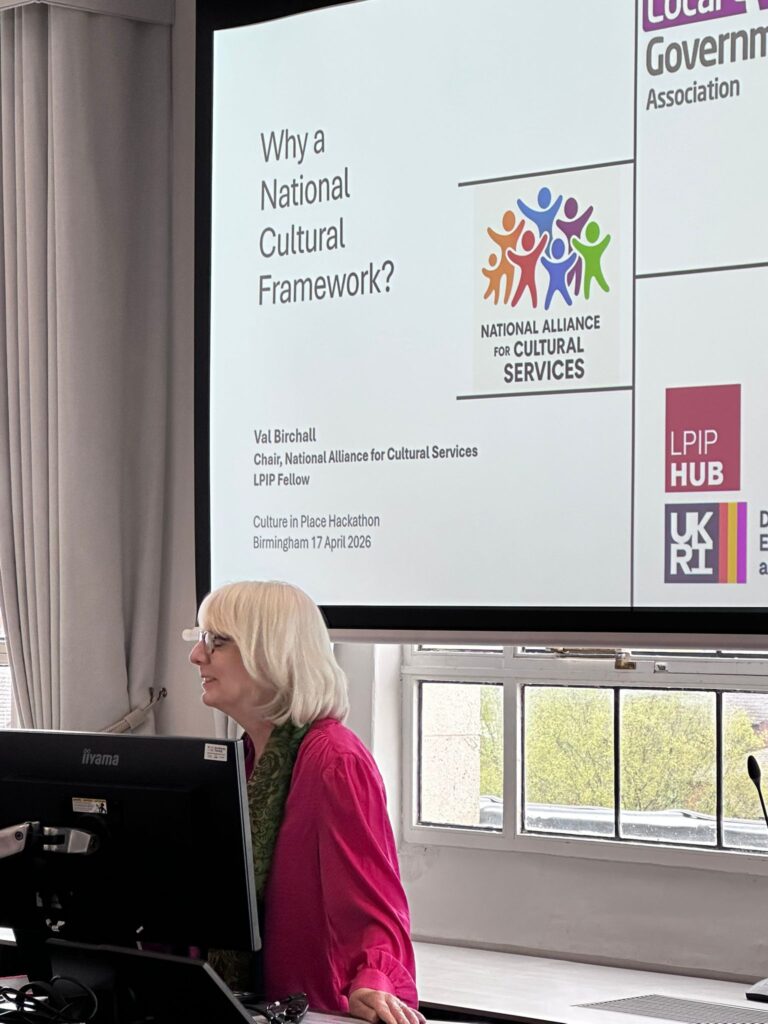
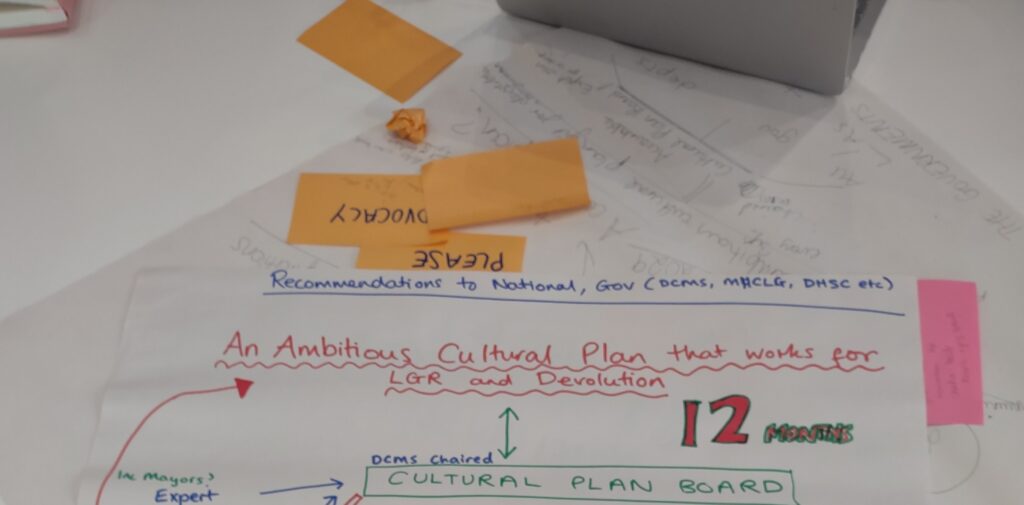
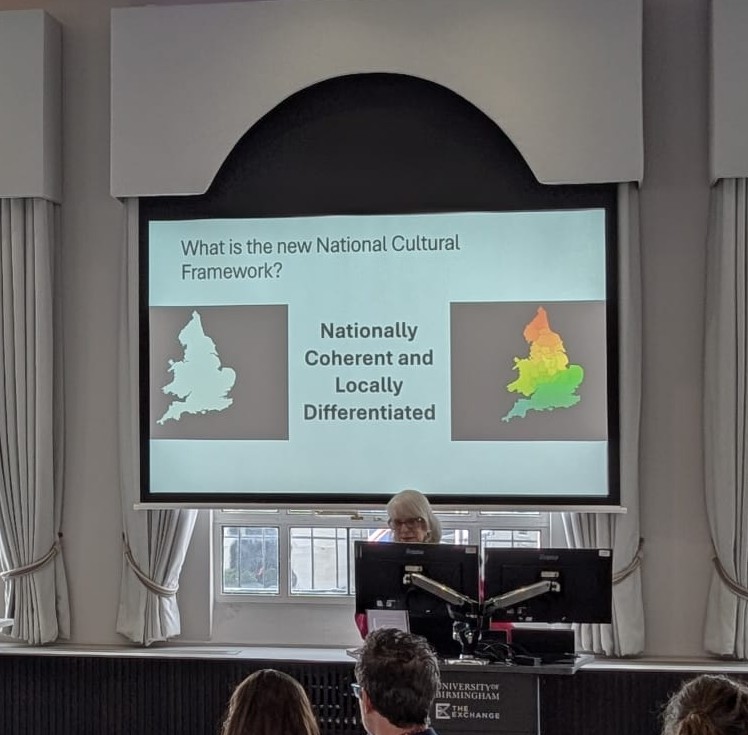
Val Birchall presenting.
This blog was written by Val Birchall, Chair of the National Alliance for Cultural Services and a Fellow of the Royal Society of Arts, and a member of the Academy of Urbanism.
Find out more about the Local Policy Innovation Partnership Hub.
Disclaimer:
The views expressed in this post are those of the author and not necessarily those of City-REDI or the University of Birmingham.