
In this case study, we hear from Chenlu Yang, a PhD student in the School of Geography, who has been leveraging BEAR (Birmingham Environment for Academic Research) to study flood behavior and hydrological extremes
My research focuses on analyzing trends in flood behavior and hydrological extremes across the UK using high-resolution gridded datasets and long-term catchment-scale observations.

I work extensively with large NetCDF files, TIFF rasters, shapefiles, and time series data to detect changes in flood, intensity, and spatial distribution over the past decades. A key part of my workflow involves extracting hydrological variables from NetCDF and TIFF files using spatial boundaries (catchments).
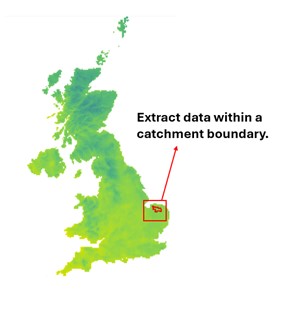
BlueBEAR has played a vital role in supporting my work. As a high-performance computing platform, it has significantly reduced the time needed for large-scale data extraction and preprocessing, which is often the bottleneck when working with multi-decade climate datasets. The ability to run intensive R and Python scripts in parallel allows me to automate data retrieval efficiently.
By leveraging up to 72 cores on BlueBEAR, I can process datasets that would take several days on a personal computer in just a few hours. This not only accelerates my workflow, but also frees up my local laptop for other data analysis tasks at the same time. BEAR’s secure and scalable research data storage ensures that my datasets remain accessible and well-managed.
We were so pleased to hear of how Chenlu was able to make use of what is on offer from Advanced Research Computing, particularly to hear of how they have made use of BlueBEAR HPC – if you have any examples of how it has helped your research then do get in contact with us at bearinfo@contacts.bham.ac.uk.
We are always looking for good examples of use of High Performance Computing to nominate for HPC Wire Awards – see our recent winner for more details.