
In this case study we talk to Jakob Hein-Paar, a PhD student in the Michalchuk Group, Chemistry, who looked into the effects of phonons on the reactivity of energetic materials.
My research deals with vibrational metallization of metal azides, a group of energetic materials or explosives, investigating energy transfer within their crystal structures.

As “vibrational” implies, something is moving within the crystals, namely the atoms. These atomic movements can be described as phonons, quantized wave packets in crystals.
When phonons interact with electrons, the energy level of the electronic states within the crystal can change. In some cases this interaction can close the electronic bandgap (as in metals, ergo metallization), enabling possible chemical reactions – in this case, explosions!
BlueBEAR’s high-performance computing resources not only provide enough RAM to handle all these atoms but reduces calculation times through powerful cores with great parallelization
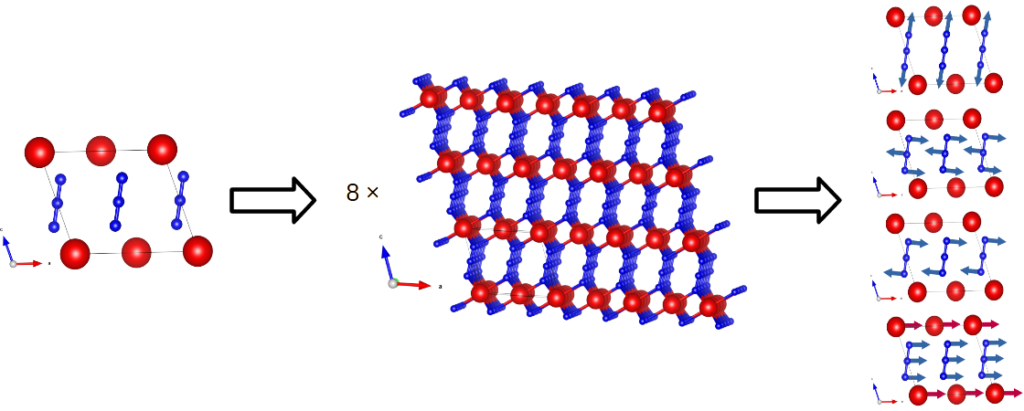
Phonons can be represented mathematically as eigenvectors, which describe how atoms move within a crystal. They can be obtained from the dynamical matrix which is constructed from calculated interatomic forces within supercells with a few displaced atoms using the finite difference method. Depending on the symmetry, it takes a few to several dozen calculations of supercells with several hundred of atoms – when also considering phonon-phonon interactions, the number of calculations goes up to a few thousand.
Given the sheer amount of demanding calculations required, any conventional computing setup would either be prohibitively slow or too limited in scope. BlueBEAR’s high-performance computing resources not only provide enough RAM to handle all these atoms but reduces calculation times through powerful cores with great parallelization, as well as offering a solid framework to process all these calculations.
By leveraging this computing power, we aim to understand the mechanisms of energy transfers within explosives and refine the existing models. This knowledge will help to design safer, more environmentally friendly materials—in silico—without the need to test hundreds of compounds by hand.
We were so pleased to hear of how Jakob was able to make use of what is on offer from Advanced Research Computing, particularly to hear of how they have made use of the BEAR compute – if you have any examples of how it has helped your research then do get in contact with us at bearinfo@contacts.bham.ac.uk.
We are always looking for good examples of use of High Performance Computing to nominate for HPC Wire Awards – see our recent winner for more details.