
In this case study we talk to Zhuangchen Wu, a final year PhD student in Economics, he is also the winner of the best presentation at the BEAR Conference 2025. Zhuangchen is investigating customer anger and consumer ratings.
Consumer anger or fair pricing theory (Rotemberg 2005, 2011) proposes that firms have stable prices because they fear consumer anger. Consumers will be disappointed when facing unfair price increases. This assumption explains why prices are more responsive to changes in factors rather than in demand. For example, prices are rigid after natural disasters that cause exogenous demand shocks. However, due to data limitations, little is known about the actual magnitude of the effects of consumer anger. To this end, this paper constructs a unique dataset to measure “consumer anger” directly and further investigates how it impacts price-setting behavior

I collect weekly data from the menus of restaurants in the United Kingdom, including information on online ratings, the number of reviews, and prices. Online ratings are the average rating consumers give and can be used to measure the level of “consumer anger”. High ratings indicate that consumers believe the price is fair, while low ratings mean consumers are unsatisfied with the price and service. Specifically, I document that restaurants in London have the highest average ratings, whereas those in Belfast have the lowest. At the same time, sellers in London, Birmingham, and Manchester typically received more reviews than those in the other cities. Chain restaurants receive lower ratings but more reviews than independent restaurants.
The extra computational power [from BlueBEAR] allows me to estimate the ratings-frequency relationship using high-frequency weekly panels with 20 million observations.
The relationship between the frequency of price changes and ratings is then investigated. I find that the coefficients of ratings are significantly negative, indicating that restaurants with higher ratings have fewer price changes. This evidence is consistent with the consumer anger theory. However, the results of the interaction between ratings and the number of reviews tell us a different story. The significantly positive coefficients suggest that the number of reviews has a moderating effect on the relationship between “consumer anger” and price-setting behavior. Popular restaurants have more bargaining powers that allow them to change prices more frequently. Furthermore, the “consumer anger” story is more pronounced for positive price changes, independent restaurants, and restaurants near tourist places.
the high-performance multi-core processors improve the efficiency of conducting various heterogeneity analyses
The BlueBEAR High-Performance Computing (HPC) service plays an important role in revealing this consumer anger story. The extra computational power allows me to estimate the ratings-frequency relationship using high-frequency weekly panels with 20 million observations. Also, the high-performance multi-core processors improve the efficiency of conducting various heterogeneity analyses.
Finally, it was great to have this opportunity to participate in the 14th annual BEAR conference, where we had so many interesting talks and lovely discussions. It is insightful to hear various studies utilizing HPCs from researchers across the university.
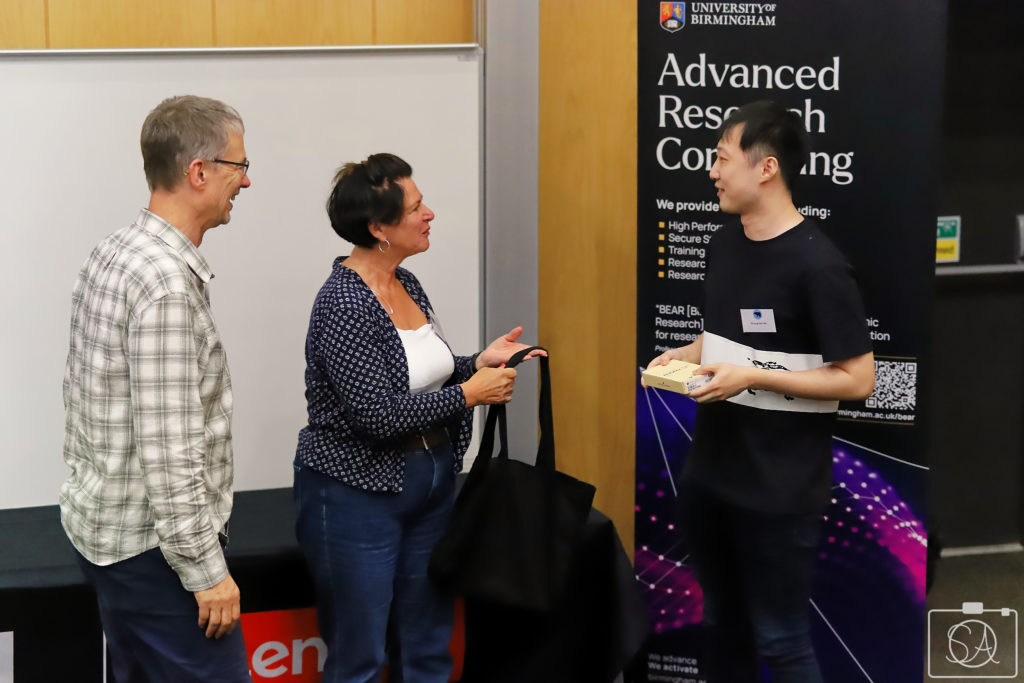
We were so pleased to hear of how Zhuangchen was able to make use of what is on offer from Advanced Research Computing, particularly to hear of how they have made use of the BEAR compute – if you have any examples of how it has helped your research then do get in contact with us at bearinfo@contacts.bham.ac.uk.
We are always looking for good examples of use of High Performance Computing to nominate for HPC Wire Awards – see our recent winner for more details.
References
Rotemberg, J. J. (2005). Customer anger at price increases, changes in the frequency of price adjustment and monetary policy. Journal of Monetary Economics, 52(4), 829-852
Rotemberg, J. J. (2011). Fair pricing. Journal of the European Economic Association, 9(5), 952-981