
We previously heard from several participants of BEAR Challenge 2025 how they had enjoyed attending the event and the skills they developed (see blog post here), with one team going onto win the national CIUK challenge. In this blog post, we hear from undergraduate student David Adesoye-Amoo on how the challenge helped him navigate a subsequent research project.
High-performance computing and data centre architecture
Author: David Adesoye-Amoo
I directed Team ‘Bit by Bit,’ a group of six from different course backgrounds both postgraduate and undergraduate, in the 2025 BEAR Challenge on the Tier-2 Baskerville supercomputer in June. It was an incredibly intense and rewarding sprint. Over three days, I managed distributed systems and helped our team place 6th out of 16 competing groups and 32 registered.
As any systems engineer knows, building high-performance infrastructure requires balancing computing power with network limits. I am incredibly proud that, during the data centre design phase, the Advanced Research Computing (ARC) team recognised us for having the “best understanding of networking design” among all teams in the final challenge. To achieve this, we improved InfiniBand switch layouts and rack cabling to increase job throughput across CPU and GPU clusters, although we could have used more GPU nodes to boost overall performance.
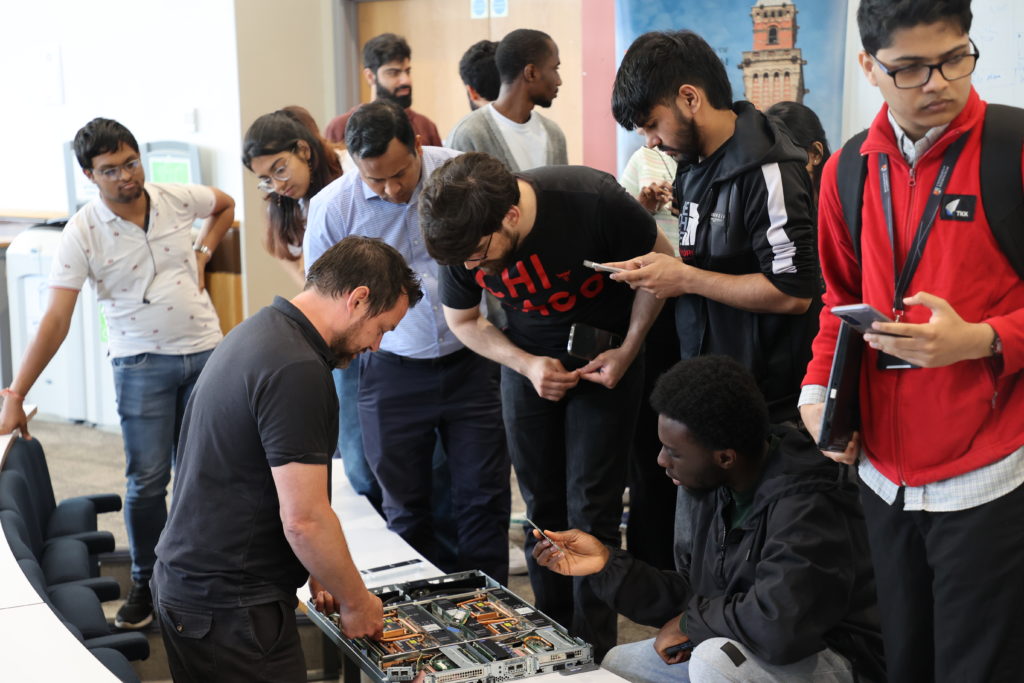
Here is a look at what we accomplished on the technical side:
🔹 We managed workloads with Slurm and built custom bash and CUDA pipelines to sort 1GB files and run MD5 decryption in parallel.
🔹 In the Galactic Astronomy challenge, we achieved 86.0% inference accuracy on a new test set for galactic image classification.
🔹 Careful VRAM management and tuning neural network settings helped us work within limited GPU resources.
As an incredible bonus to the experience, I was lucky enough to be able to go on a tour the university’s data centre, Baskerville! During the walkthrough, we were able to see individual components and the insides of servers up close, which perfectly complemented the theoretical side of the challenge. And to top it all off, I got a nice free shirt afterwards! 👕
Beyond the competition
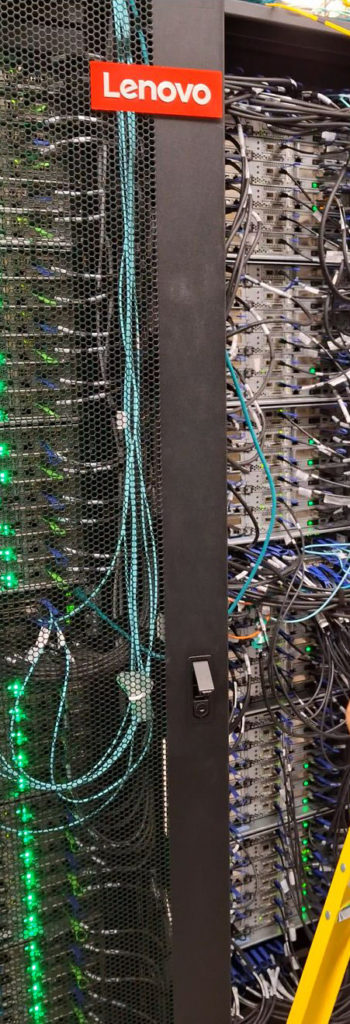
The BEAR Challenge really opened my eyes to the importance of resource optimisation as during the competition, and later during the tour of the Baskerville data centre, learning exactly how task delegation and scheduling work under the hood shifted my entire perspective on machine learning.
A large part of my initial conception was when fine-tuning or training AI models, consumer hardware is dismissed as insufficient. However, the challenge made me realise that without proper optimisation, even a massive supercomputer will bottleneck. It inspired me to change my approach. I decided to start with the goal of doing as much as I could locally, using optimisation techniques to build a proof-of-concept. My original plan was to use this initial work to approach the University and request access to Baskerville or BlueBEAR for the heavier research. However, as I applied the resource-management strategies I learned from the challenge, I realised I could actually push my local compute much further than I thought, allowing me to have usable prototypes for the African Language Ecosystem right from my own machine. [Editor: You can read more about David’s research project on LinkedIn here].
A huge thank you to my team and the ARC organisers!
Register to join BEAR Challenge 2026!
Thanks to David for providing an insight into his experience of the BEAR Challenge 2025. If you would like to get involved, we are pleased to announce that booking is now open for BEAR Challenge 2026 to train up a new cohort of students with skills in HPC in preparation for future careers in the area, and to tackle future challenges at CIUK 2026! If you’re a taught student (undergraduate or masters) and interested in taking part in BEAR Challenge, find out more and register your team with us via Eventbrite.