
In this case study, we hear from Shuo Zhang, a PhD student in Computer Science, who is working on predicting protein properties using sequence information.
Our work, SeqProFT, is a smart new way to predict protein properties using sequence information alone. Using BlueBEAR GPU resources, we trained and evaluated SeqProFT across a wide range of tasks, such as enzyme function, Gene Ontology annotation, and fold classification.

These experiments involved several protein language models, different model sizes, and multiple prediction heads, making access to GPU computing essential for running the study efficiently.
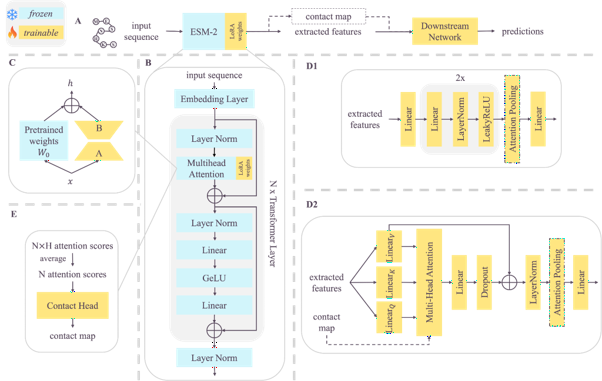
Instead of fully fine-tuning huge models, which takes a lot of time and computing power, it uses a shortcut called LoRA. This lets the model learn new tasks using only a small fraction of the original resources, making it faster and cheaper.
The method works especially well because it adds a special attention mechanism that helps the model understand how different parts of a protein may interact, even without knowing its 3D structure. In tests, smaller models using this approach performed just as well as, or even better than, much larger ones.
These experiments involved several protein language models, different model sizes, and multiple prediction heads, making access to [BlueBEAR] GPU computing essential for running the study efficiently.
Our work makes protein research more accessible and efficient, which could speed up discoveries in medicine and biology. By combining efficient fine-tuning with sequence-only prediction, SeqProFT provides a practical tool for studying proteins when experimental structures are unavailable, expensive, or time-consuming to obtain.
We were so pleased to hear how Shou was able to make use of what is on offer from Advanced Research Computing. If you have any examples of how it has helped your research, then do get in contact with us at bearinfo@contacts.bham.ac.uk.
We are always looking for good examples of the use of High Performance Computing to nominate for HPC Wire Awards – see our recent winner for more details.