
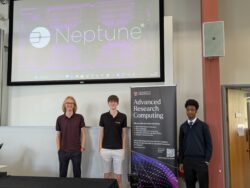
Update 29/09/26 Please note – due to popular demand, we have had to close applications for work experience for the 2026-27 school year. We will review availability again in 2027. Over the last few years, Advanced Research Computing (ARC) has hosted more than ten work experience students, ranging from year 10 pupils to undergraduate students. … Continue reading “Work experience in Advanced Research Computing – 2026 students”
Month: July 2026
Understanding recent BlueBEAR service disruptions – July 2026

Over the past few months, BlueBEAR users may have experienced periods of reduced service availability, planned maintenance, and interruptions to normal operations. We recognise that these disruptions can be frustrating, particularly when research projects depend on reliable access to High Performance Computing (HPC) resources. This blog post explains the factors behind recent outages and outlines … Continue reading “Understanding recent BlueBEAR service disruptions – July 2026”
Beyond the head: tail-aware sperm segmentation using fine-tuned AI computer vision models

In this case study, we hear from Sina Shafiezadeh, a postdoc in the Department of Metabolism and System Sciences, who is working to track and analyse the details of sperm motility from video microscopy. Accurate and informative assessment of sperm motility is essential for diagnosing male infertility and optimising Assisted Reproductive Technologies (ART) such as in vitro fertilisation (IVF). While Computer-Aided Sperm Analysis … Continue reading “Beyond the head: tail-aware sperm segmentation using fine-tuned AI computer vision models”
Early access: Baskerville National Compute Resource

Baskerville Supercomputing Centre and the Institute for Data and AI (IDAI) are giving University of Birmingham users early access to the Baskerville National Compute Resource (NCR), from October 2026, as alpha and beta testers, before the machine is fully running from April 2027. The service is likely to be interrupted until final testing is complete. The technical specification of … Continue reading “Early access: Baskerville National Compute Resource”
Tracking microplastics transport through saturated porous media

In this case study, we hear from Fuad Alqrinawi, a PhD researcher in the School of Geography, Earth and Environmental Sciences at the University of Birmingham, who used BlueBEAR to simulate how microplastic particles travel through fully saturated porous media. Microplastic Particles (MPs) are now widely detected in soils, riverbeds, and groundwater, where they occur … Continue reading “Tracking microplastics transport through saturated porous media”
Join us for TidyTuesday: The next R User Group meetup — July 21, 15:00, Elm House

On Tuesday 21 July, the R User Group will be hosting its monthly meetup at Elm House — this time featuring an interactive TidyTuesday session focused on practising and improving your skills in the R programming language. We’ll explore a fun, real‑world dataset from TidyTuesday, an international community project designed to help you practise data … Continue reading “Join us for TidyTuesday: The next R User Group meetup — July 21, 15:00, Elm House”
SeqProFT: Predict Protein Functions Using Less Computing Power

In this case study, we hear from Shuo Zhang, a PhD student in Computer Science, who is working on predicting protein properties using sequence information. Our work, SeqProFT, is a smart new way to predict protein properties using sequence information alone. Using BlueBEAR GPU resources, we trained and evaluated SeqProFT across a wide range of … Continue reading “SeqProFT: Predict Protein Functions Using Less Computing Power”
June 2026 BEAR Newsletter
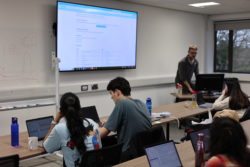
Birmingham Environment for Academic Research (BEAR) Newsletter This month’s Editor: Debbie Carter Last week we were excited to welcome 60 undergraduate and taught postgraduate students to BEAR Challenge 2026! Supported by many members of the ARC team, they experienced High Performance Computing (HPC) for the first time and heard about career opportunities in this field. The … Continue reading “June 2026 BEAR Newsletter”
Exploring the dynamics of alien solar systems with BlueBEAR
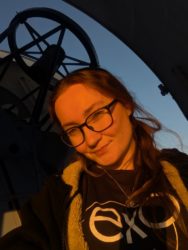
In this case study, we hear from Alix Freckelton, a PhD student in Physics and Astronomy, who is exploring transit timing variations (TTVs). My research focuses on transit timing variations (TTVs): these are tiny irregularities in the times that we see exoplanets transiting their host stars. TTVs are caused in multi-planet systems by the planets … Continue reading “Exploring the dynamics of alien solar systems with BlueBEAR”