
In this case study, we hear from Fuad Alqrinawi, a PhD researcher in the School of Geography, Earth and Environmental Sciences at the University of Birmingham, who used BlueBEAR to simulate how microplastic particles travel through fully saturated porous media.

Microplastic Particles (MPs) are now widely detected in soils, riverbeds, and groundwater, where they occur across a broad range of sizes and densities. However, the mechanisms controlling whether individual particles are transported through pore spaces or retained within the sediment matrix remain poorly understood.
Continuum models treat microplastics as bulk concentrations, making it difficult to capture the particle-scale processes that control transport and retention. To resolve these processes directly, I use MultiFlow3D, an in-house finite-difference, multiphase Eulerian-Lagrangian model. It simulates water flow through the pore spaces between individual grains while tracking thousands of MPs, each responding to the local flow conditions as well as its own size and density.
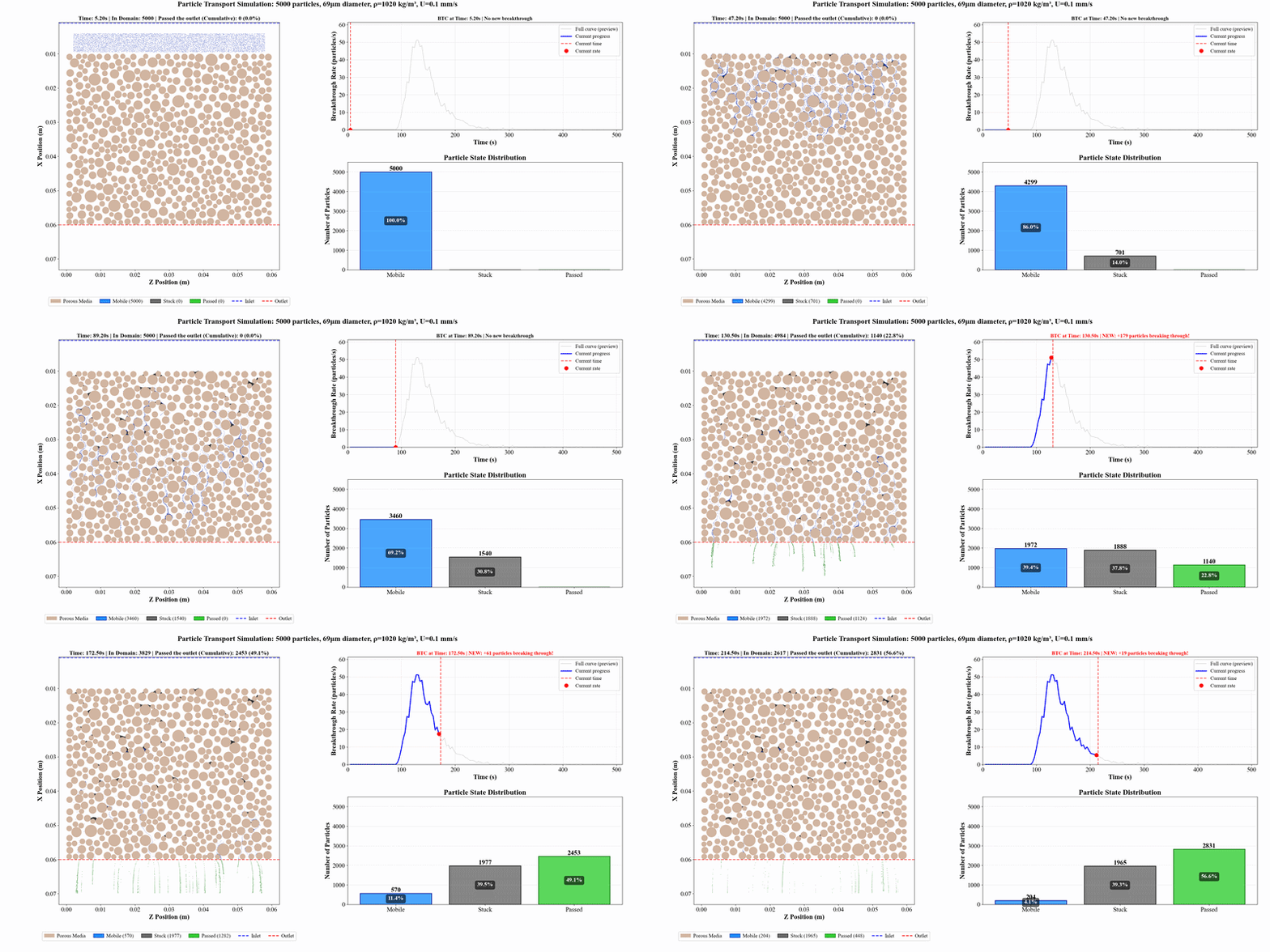
I ran 27 simulations covering three particle sizes, three densities and three flow speeds, each releasing a pulse of 5,000 particles. The key result: MPs mobility depends on the combined effects of flow, buoyancy, settling, size and pore geometry. Larger particles were retained more easily, while density effects were strongest at low flow and became much less important as advection increased. By tracking individual particles, the Eulerian-Lagrangian model shows how breakthrough, retention and delayed release emerge directly from pore-scale interactions.
These simulations are computationally demanding. BlueBEAR’s parallel computing capacity and support for long, multi-day jobs allowed me to run many cases simultaneously and complete the study within a practical timeframe; something that would not have been possible on a single computer.
We were so pleased to hear how Fuad was able to make use of what is on offer from Advanced Research Computing. If you have any examples of how it has helped your research, then do get in contact with us at bearinfo@contacts.bham.ac.uk.
We are always looking for good examples of the use of High Performance Computing to nominate for HPC Wire Awards – see our recent winner for more details.