
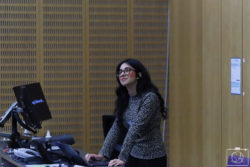
In this case study we hear from Hibah Saddal, a PhD student in Aerospace Engineering, who is using BlueBEAR to optimise aerodynamic performance. At the 14th BEAR Conference 2025, I had the opportunity to present my research carried out with my PhD advisor, Dr Chandan Bose, on bio-inspired fluid-structure interaction (FSI) problems, where we leveraged … Continue reading “Bio-inspired FSI and HPC-driven aerodynamic optimisation”
Category: Case study
High-resolution soil hydrology analysis enabled by BlueBEAR

In this case study, we hear from Guilin Luo, a PhD student in the School of Geography, who has been harnessing BEAR’s advanced computing resources to investigate how temperate forest soils respond to climatic change. By integrating high-resolution environmental monitoring data from the Birmingham Institute of Forest Research (BIFoR) site, and using workflows in R … Continue reading “High-resolution soil hydrology analysis enabled by BlueBEAR”
BEAR helps delve into the infant gut and malnutrition

In this case study we talk to Leon, a PhD student in the Department of Microbes, Infection and Microbiomes, who is using bioinformatics of microbes that encompass the human gut microbiome. The human gut is inhabited by trillions of microbial cells and most of those cells have very important roles in human health. My work … Continue reading “BEAR helps delve into the infant gut and malnutrition”
Using BEAR to peel back the layers on potato genetics

In this case study we talk to Jack, a PhD student in Biosciences, who is using bioinformatics to understand plant genetics. I am a PhD student working in plant sciences supervised by Dr Lindsey Compton. My research focuses on using bioinformatics to understand plant genetics. Canopy architecture traits, like height and area, impact photosynthesis, drought … Continue reading “Using BEAR to peel back the layers on potato genetics”
Do restaurants care about consumers’ ratings?
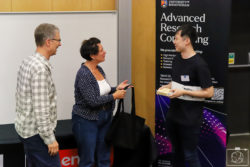
In this case study we talk to Zhuangchen Wu, a final year PhD student in Economics, he is also the winner of the best presentation at the BEAR Conference 2025. Zhuangchen is investigating customer anger and consumer ratings. Consumer anger or fair pricing theory (Rotemberg 2005, 2011) proposes that firms have stable prices because they … Continue reading “Do restaurants care about consumers’ ratings?”
How I used BEAR to understand investor behaviour in FinTech markets

In this case study we talk to Mohammad B M A J Aldoub, a PhD student in Economics, who is investigating how investors react to negative shocks in peer-to-peer (P2P) lending platforms. My research examines how investors react to negative shocks in peer-to-peer (P2P) lending platforms, with a particular focus on belief dispersion during uncertain times. P2P lending refers … Continue reading “How I used BEAR to understand investor behaviour in FinTech markets”
Modelling defects in inorganic phosphor crystals
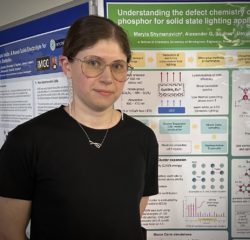
In this case study we talk to Maryia Shymanovich, a PhD student in Chemistry, whose project focuses on the computational analysis of the defects in inorganic phosphor materials for solid-state lighting applications. I am a second-year PhD student in Professor David Scanlon’s (School of Chemistry) group, and my research project focuses on the computational analysis of … Continue reading “Modelling defects in inorganic phosphor crystals”
What makes things go BOOM! – from vibrations to detonation

In this case study we talk to Jakob Hein-Paar, a PhD student in the Michalchuk Group, Chemistry, who looked into the effects of phonons on the reactivity of energetic materials. My research deals with vibrational metallization of metal azides, a group of energetic materials or explosives, investigating energy transfer within their crystal structures. As “vibrational” implies, … Continue reading “What makes things go BOOM! – from vibrations to detonation”
Shaking up mixing: optimising mixing using BlueBEAR

In this case study we talk to Emily Allman, MEng Chemical Engineering undergraduate student, who looked into the efficiency of Resonant Acoustic Mixers (RAM) using BlueBEAR, for her final-year research project. Emily presented her paper at the recent BEAR PGR Conference 2025. I am a final-year MEng Chemical Engineering student at the University of Birmingham. For … Continue reading “Shaking up mixing: optimising mixing using BlueBEAR”
Extracting tender information with BlueBEAR: tackling complex documents with NLP and image processing

In this case study we talk to Asim Abbas, PhD Researcher in Artificial Intelligence (School of Computer Science), who is using BlueBEAR to extract structured information from unstructured and ambiguous tender documents. My research focuses on extracting structured information from unstructured and ambiguous tender documents, whereas these documents present distinctive processing challenges due to their … Continue reading “Extracting tender information with BlueBEAR: tackling complex documents with NLP and image processing”