

In this case study, we hear from Jack (Wei-Chieh Tsai), a doctoral student from History of Art and Geography who examines how cultural intermediaries, including artists, curators, and cultural organisations, have contributed to urban development. My PhD research examines the role of artistic interventions in transforming post-industrial Birmingham between 1986 and 2016. The project examines how cultural … Continue reading “Modelling Birmingham’s Cultural Ecology and Urban Oral History Using BlueBEAR”
Category: PGR students
Binary classification of lung tissue immunofluorescence images by deep learning
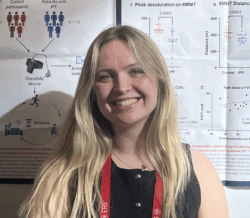
In this case study we hear from Ellen Jenkins, a postdoctoral student from the Institute of Inflammation and Ageing. Ellen is looking into developing a deep learning model to automatically differentiate the tissue from the air space. There is an ongoing project in the respiratory research group (CMH, IIA) which utilises samples of human lung … Continue reading “Binary classification of lung tissue immunofluorescence images by deep learning”
Bayesian Modelling of Rising Decision Thresholds in DDMs using BlueBEAR

In this case study we hear from Sophie Wetz, a Masters student in Psychology, who has been using BlueBEAR to investigate whether a dynamic, rising boundary improved the fit of the full Drift Diffusion Model (DDM) to Random Dot Kinematogram (RDK) task data. I’m a Master’s student on the Computational Neuroscience stream in the School … Continue reading “Bayesian Modelling of Rising Decision Thresholds in DDMs using BlueBEAR”
Atomic Simulation to Build Better Batteries

In this case study we hear from Oskar Soulas, a PhD student in Chemistry, who has been using BlueBEAR to investigate lithium–sulphur–nitrogen solid electrolytes for next-generation battery technologies. I am a second year PhD student in the Scanlon Materials Theory Group (SMTG) based at the University of Birmingham. The group uses powerful computational tools to understand … Continue reading “Atomic Simulation to Build Better Batteries”
Bio-inspired FSI and HPC-driven aerodynamic optimisation
In this case study we hear from Hibah Saddal, a PhD student in Aerospace Engineering, who is using BlueBEAR to optimise aerodynamic performance. At the 14th BEAR Conference 2025, I had the opportunity to present my research carried out with my PhD advisor, Dr Chandan Bose, on bio-inspired fluid-structure interaction (FSI) problems, where we leveraged … Continue reading “Bio-inspired FSI and HPC-driven aerodynamic optimisation”
High-resolution soil hydrology analysis enabled by BlueBEAR

In this case study, we hear from Guilin Luo, a PhD student in the School of Geography, who has been harnessing BEAR’s advanced computing resources to investigate how temperate forest soils respond to climatic change. By integrating high-resolution environmental monitoring data from the Birmingham Institute of Forest Research (BIFoR) site, and using workflows in R … Continue reading “High-resolution soil hydrology analysis enabled by BlueBEAR”
BEAR helps delve into the infant gut and malnutrition

In this case study we talk to Leon, a PhD student in the Department of Microbes, Infection and Microbiomes, who is using bioinformatics of microbes that encompass the human gut microbiome. The human gut is inhabited by trillions of microbial cells and most of those cells have very important roles in human health. My work … Continue reading “BEAR helps delve into the infant gut and malnutrition”
Using BEAR to peel back the layers on potato genetics

In this case study we talk to Jack, a PhD student in Biosciences, who is using bioinformatics to understand plant genetics. I am a PhD student working in plant sciences supervised by Dr Lindsey Compton. My research focuses on using bioinformatics to understand plant genetics. Canopy architecture traits, like height and area, impact photosynthesis, drought … Continue reading “Using BEAR to peel back the layers on potato genetics”
Do restaurants care about consumers’ ratings?
In this case study we talk to Zhuangchen Wu, a final year PhD student in Economics, he is also the winner of the best presentation at the BEAR Conference 2025. Zhuangchen is investigating customer anger and consumer ratings. Consumer anger or fair pricing theory (Rotemberg 2005, 2011) proposes that firms have stable prices because they … Continue reading “Do restaurants care about consumers’ ratings?”
How I used BEAR to understand investor behaviour in FinTech markets

In this case study we talk to Mohammad B M A J Aldoub, a PhD student in Economics, who is investigating how investors react to negative shocks in peer-to-peer (P2P) lending platforms. My research examines how investors react to negative shocks in peer-to-peer (P2P) lending platforms, with a particular focus on belief dispersion during uncertain times. P2P lending refers … Continue reading “How I used BEAR to understand investor behaviour in FinTech markets”