
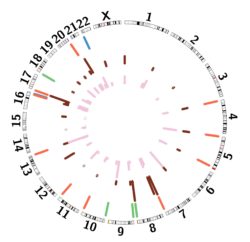
In this case study we hear from Ronan and Anubrata, both research staff in Cancer and Genomic Sciences, who have been using BlueBEAR to find therapeutic targets and biomarkers for the diagnosis of ALT-reliant cancers such as high-grade glioma. Our lab is investigating the Alternative Lengthening of Telomeres (ALT) process; a molecular mechanism used by … Continue reading “Investigating the Alternative Lengthening of Telomeres (ALT)”
HPCwire Award 2025 winners!

For the third year running (see previous awards), we are pleased to announce that a research group who use our advanced computing facilities has been recognised as award-winning in the HPCwire 2025 awards! Advanced Research Computing is very proud to provide Birmingham Environment for Academic Research (BEAR) to support high-impact research at the University, which … Continue reading “HPCwire Award 2025 winners!”
Molecular simulations of small peptides as a means to interpreting mass spectra
In this case study we hear from Edwin, a PhD student in Biochemistry,who has been using BlueBEAR to evaluate the effectiveness of different Molecular Dynamics (MD) simulation protocols at assigning structural information to Ion Mobility data Ion Mobility Spectrometry (IMS), Traveling Wave Ion Mobility Spectrometry (TWIMS) and High-Field Asymmetric Wave Ion Mobility Spectrometry (FAIMS) are … Continue reading “Molecular simulations of small peptides as a means to interpreting mass spectra”
October 2025 BEAR Newsletter
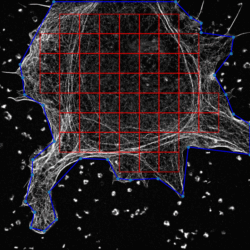
Birmingham Environment for Academic Research (BEAR) Newsletter It’s been great to meet so many new PhD students at various college and school inductions over the last few weeks, and to see so much interest in the new training workshops that we are providing. To help spread the word about the many ways that BEAR services can help … Continue reading “October 2025 BEAR Newsletter”
JuliaSIG repository

Dr Vincenzo Brachetta, Chair of the Julia Special Interest Group (SIG), describes below the creation of a repository to share educational resources related to the Julia programming language. Following the establishment of the Julia Programming Language Special Interest Group, which was created with the aim of supporting the growing community of Julia users and enabling … Continue reading “JuliaSIG repository”
Energy Data Landscape – Challenges and Opportunities
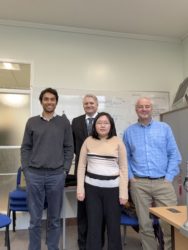
Edward Barbour and Grant Wilson, Associate Professors in Chemical Engineering, explored detailed domestic heat pump demand data and became interested in their operational costs under different energy tariffs. They quickly discovered that tariff data was difficult to obtain and compare across different suppliers. With help from Mingxue (Jean) Du, a Research Software Engineer, they identified … Continue reading “Energy Data Landscape – Challenges and Opportunities”
SMLM Data Exploration with Nano-org and BlueBEAR
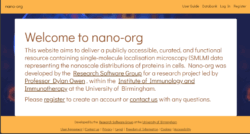
This case study highlights the ongoing collaboration between the Research Software Group, Professor Dylan Owen, and Dr Sandeep Shirgill in the development of Nano-org. Nano-org has recently been published in Nature Communications. Nano-org uses ultra-precise coordinate data to represent the nanoscale distributions of individual proteins within cells. The unique functionality provided by Nano-org supports a … Continue reading “SMLM Data Exploration with Nano-org and BlueBEAR”
Undergraduate student work experience in Advanced Research Computing
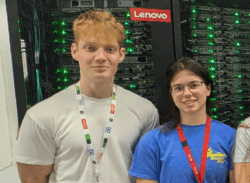
In September, two undergraduate students came to spend a week experiencing work in the Advanced Research Computing team. You can find out how their week went below, as they describe their first-hand experience. Our names are Sereya and Harry; we are Theoretical Physics undergraduates who had the opportunity of experiencing a week working in the … Continue reading “Undergraduate student work experience in Advanced Research Computing”
September 2025 BEAR Newsletter
Birmingham Environment for Academic Research (BEAR) Newsletter We kicked off September with a BEAR Champion meetup, celebrating all the help that our expanding team of volunteers have given over the past academic year and going on a data centre tour to meet our supercomputer, BlueBEAR. As we head into the new academic year, we have updated our training homepage to accommodate … Continue reading “September 2025 BEAR Newsletter”
How green is the BEAR? 2025 updates

In 2022, we took part in the University’s Sustainability Town Hall and published a blog post highlighting Advanced Research Computing’s efforts in sustainable computing over the previous decade. Since then, we’ve continued to explore and develop initiatives in this space. With growing concerns around the energy demands of data centres – such as a recent … Continue reading “How green is the BEAR? 2025 updates”