

In this case study we hear from Sophie Wetz, a Masters student in Psychology, who has been using BlueBEAR to investigate whether a dynamic, rising boundary improved the fit of the full Drift Diffusion Model (DDM) to Random Dot Kinematogram (RDK) task data. I’m a Master’s student on the Computational Neuroscience stream in the School … Continue reading “Bayesian Modelling of Rising Decision Thresholds in DDMs using BlueBEAR”
Atomic Simulation to Build Better Batteries

In this case study we hear from Oskar Soulas, a PhD student in Chemistry, who has been using BlueBEAR to investigate lithium–sulphur–nitrogen solid electrolytes for next-generation battery technologies. I am a second year PhD student in the Scanlon Materials Theory Group (SMTG) based at the University of Birmingham. The group uses powerful computational tools to understand … Continue reading “Atomic Simulation to Build Better Batteries”
July 2025 BEAR Newsletter
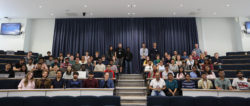
Birmingham Environment for Academic Research (BEAR) Newsletter July sees us nearing the end of a busy training, events, and conference season – we look forward to meeting new members of staff at the central induction event on Monday 21 July in the Great Hall. Three members of the team attended STEP-UP RSLondon last week, including myself, who … Continue reading “July 2025 BEAR Newsletter”
Bio-inspired FSI and HPC-driven aerodynamic optimisation
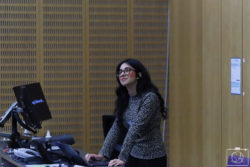
In this case study we hear from Hibah Saddal, a PhD student in Aerospace Engineering, who is using BlueBEAR to optimise aerodynamic performance. At the 14th BEAR Conference 2025, I had the opportunity to present my research carried out with my PhD advisor, Dr Chandan Bose, on bio-inspired fluid-structure interaction (FSI) problems, where we leveraged … Continue reading “Bio-inspired FSI and HPC-driven aerodynamic optimisation”
High-resolution soil hydrology analysis enabled by BlueBEAR

In this case study, we hear from Guilin Luo, a PhD student in the School of Geography, who has been harnessing BEAR’s advanced computing resources to investigate how temperate forest soils respond to climatic change. By integrating high-resolution environmental monitoring data from the Birmingham Institute of Forest Research (BIFoR) site, and using workflows in R … Continue reading “High-resolution soil hydrology analysis enabled by BlueBEAR”
BEAR helps delve into the infant gut and malnutrition

In this case study we talk to Leon, a PhD student in the Department of Microbes, Infection and Microbiomes, who is using bioinformatics of microbes that encompass the human gut microbiome. The human gut is inhabited by trillions of microbial cells and most of those cells have very important roles in human health. My work … Continue reading “BEAR helps delve into the infant gut and malnutrition”
BEAR Challenge 2025

Over the three days of 24-26 June, we welcomed 90 undergraduate and postgraduate taught students to #BEARChallenge2025. In an attempt to meet demand for places, this year we expanded to allow 15 teams but demand also rose at a pace, with 31 teams registering their interest! It is great to see the level of interest … Continue reading “BEAR Challenge 2025”
Using BEAR to peel back the layers on potato genetics

In this case study we talk to Jack, a PhD student in Biosciences, who is using bioinformatics to understand plant genetics. I am a PhD student working in plant sciences supervised by Dr Lindsey Compton. My research focuses on using bioinformatics to understand plant genetics. Canopy architecture traits, like height and area, impact photosynthesis, drought … Continue reading “Using BEAR to peel back the layers on potato genetics”
Do restaurants care about consumers’ ratings?
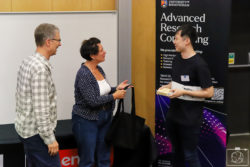
In this case study we talk to Zhuangchen Wu, a final year PhD student in Economics, he is also the winner of the best presentation at the BEAR Conference 2025. Zhuangchen is investigating customer anger and consumer ratings. Consumer anger or fair pricing theory (Rotemberg 2005, 2011) proposes that firms have stable prices because they … Continue reading “Do restaurants care about consumers’ ratings?”
How I used BEAR to understand investor behaviour in FinTech markets

In this case study we talk to Mohammad B M A J Aldoub, a PhD student in Economics, who is investigating how investors react to negative shocks in peer-to-peer (P2P) lending platforms. My research examines how investors react to negative shocks in peer-to-peer (P2P) lending platforms, with a particular focus on belief dispersion during uncertain times. P2P lending refers … Continue reading “How I used BEAR to understand investor behaviour in FinTech markets”