
In this case study, we hear from Peter Russell (School of Chemistry), who has been utilising BlueBEAR to focus on the computational and theoretical modelling of novel solid-state materials.
I am a first year PhD student in the Scanlon Materials Theory Group, based in the School of Chemistry. The group is focused on the computational and theoretical modelling of novel solid-state materials, with an overarching theme of green energy applications.
My work so far has been focused on the subdomain of optoelectronics, materials with particular optical and electronic properties, such as transparency and conductivity. These find use in solar panels, consumer electronics, aircraft, and more1.

The computational modelling of solids is a challenging problem, which is why access to BlueBEAR’s high-performance computing is so essential. The bulk of a crystalline solid is theoretically infinite, but we can simplify things by reducing it down to a single repeating unit:
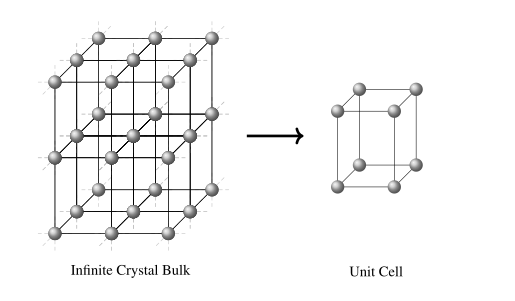
Whilst the problem is now small enough to fit inside a computer, depending on the structure of the material this single unit cell can contain many atoms, each introducing a swathe of electrons. It is the behaviour of electrons that dictate chemistry, and so we are faced with modelling a highly complex many-particle system; my calculations routinely involve anywhere between 150 and 300 electrons.
Well-developed methods based on density functional theory make this problem tractable, but the computational costs still necessitate the use of HPC resources like BlueBEAR.
1) Ellmer, K. Past achievements and future challenges in the development of optically transparent electrodes. Nature Photonics 2012, 6, 809–817, DOI: 10.1038/nphoton.2012.282.
Get in contact with Peter
https://uk.linkedin.com/in/peter-russell-98ab38270
We were so pleased to hear of how Peter was able to make use of what is on offer from Advanced Research Computing, particularly to hear of how he has made use of BlueBEAR HPC – if you have any examples of how it has helped your research then do get in contact with us at bearinfo@contacts.bham.ac.uk.
We are always looking for good examples of use of High Performance Computing to nominate for HPC Wire Awards – see our recent winner for more details.