
In this case study we talk to Jack, a PhD student in Biosciences, who is using bioinformatics to understand plant genetics.
I am a PhD student working in plant sciences supervised by Dr Lindsey Compton. My research focuses on using bioinformatics to understand plant genetics.
Canopy architecture traits, like height and area, impact photosynthesis, drought tolerance, and tuber yield in potato. Thus, my research looks to understand the genetics behind these traits which may inform the breeding of improved potato varieties.
Support and advice from the IT and BEAR team was invaluable in allowing me to access the software required to perform this process as fast and efficiently as possible.
For this analysis, I have used genetic data for over 280 potato varieties. My first step involved population clustering to group similar varieties and better understand relationships between them. To do so, I used Bayesian clustering, which must be run for many iterations and is extremely computationally demanding – so much so that I had to run the final analysis for nearly 10 days on the BlueBEAR supercomputer! Support and advice from the IT and BEAR team was invaluable in allowing me to access the software required to perform this process as fast and efficiently as possible.
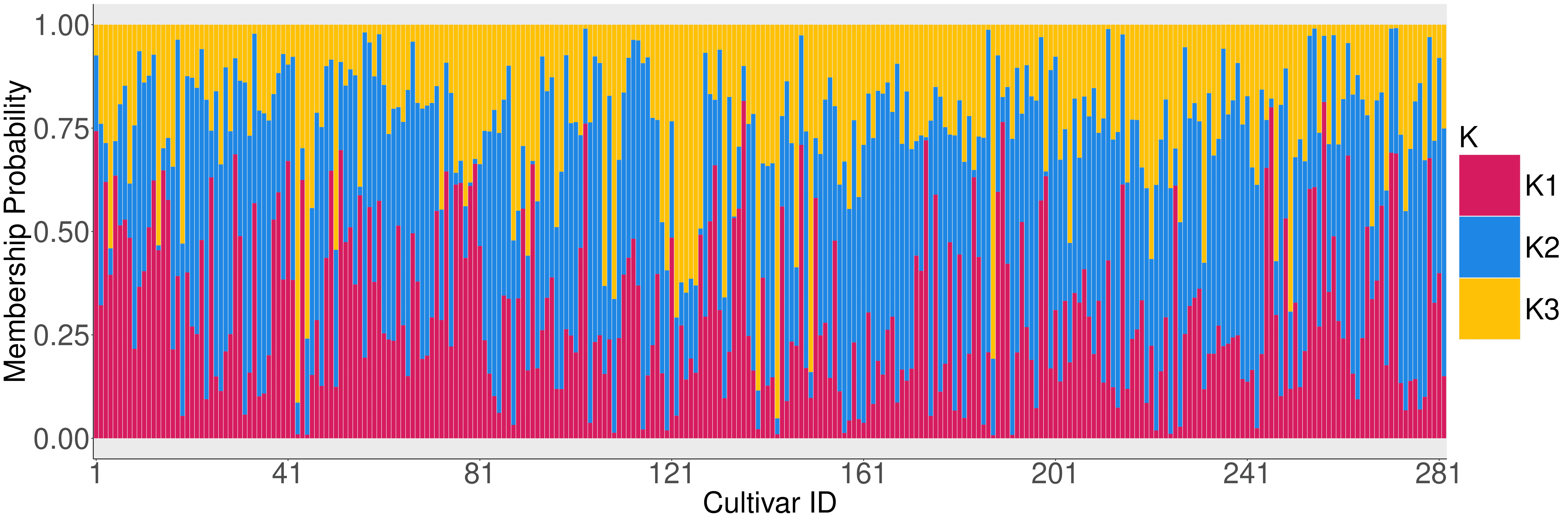
Each stacked bar shows the chance of a variety being from each of the three clusters in the population.
The other part of my research involved using a genome wide association study (GWAS) to find potential genes linked to yield and canopy growth in potato. This was made possible using various packages in the R programming language using the additional processing resources available remotely via the BEAR portal. Thanks to this resource, I made several interesting findings, including the potential links between components of the plant cell wall and traits like yield and canopy area in potato.
Overall, BEAR has been invaluable to my research and has allowed me to add to our understanding of the genetics behind key traits in an important food crop.
We were so pleased to hear of how Jack was able to make use of what is on offer from Advanced Research Computing, particularly to hear of how they have made use of the BEAR compute, storage, and our Research Application Specialists – if you have any examples of how it has helped your research then do get in contact with us at bearinfo@contacts.bham.ac.uk.
We are always looking for good examples of use of High Performance Computing to nominate for HPC Wire Awards – see our recent winner for more details.