
In this case study, we hear from Yukesh Karki, a doctoral student from Aerospace Engineering in the School of Metallurgy and Materials, who used BlueBEAR to identify the optimal three-dimensional nozzle geometry for hydrodynamic jet propulsion. He is also the winner of ‘best talk’ at the BEAR Conference 2026.
Nature has already evolved highly efficient methods of fluid propulsion. Squid, jellyfish, and many other aquatic organisms move by forcefully ejecting fluid through nozzle-like structures. Replicating this mechanism in engineered systems, however, while achieving both strong thrust and low energy use remains a significant challenge.
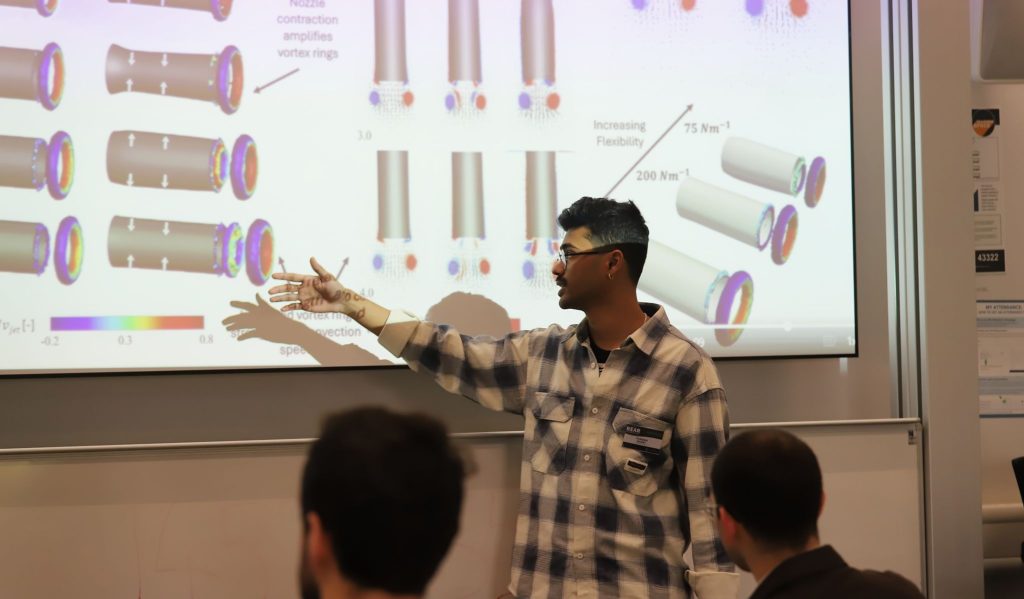
This collaborative project between the Bio-Inspired Fluid-Structure Interaction Laboratory (BioFSI Lab) at the University of Birmingham, UK, and the Bhamla Lab at the Georgia Institute of Technology, USA, aims to address this problem by identifying the optimal three-dimensional nozzle geometry for hydrodynamic jet propulsion.
BlueBEAR’s computational power enabled large-scale parallel simulations, significantly speeding up the exploration of the design space
To test each design, we use a fully coupled simulation pipeline built on three open-source tools.
- OpenFOAM for fluid dynamics
- CalculiX for structural analysis, and
- preCICE for communication between the two
Each coupled simulation requires a significant amount of computational time, and a large number of runs are needed to properly explore the design space. Running these simulations on a standard laptop or desktop machine would be completely impractical.
Watch previous work from the project in the following YouTube video.
By using BlueBEAR, I was able to run multiple simulations in parallel, making it possible to evaluate many design configurations within a reasonable timeframe. This also supported the use of a Bayesian optimisation approach, which learns from each simulation result and selects the next design to test. BlueBEAR made it possible for me to contribute meaningfully to this project. Without access to this level of computational power, running simulations at the required scale would simply not have been feasible.
I would also like to sincerely acknowledge the researchers and collaborators at the Bhamla Lab, Georgia Institute of Technology. It has been a valuable experience to contribute to and learn from such a strong collaborative team.
We were so pleased to hear of how Yukesh was able to make use of what is on offer from Advanced Research Computing, particularly to hear of how they have made use of the BEAR compute. If you have any examples of how it has helped your research then do get in contact with us at bearinfo@contacts.bham.ac.uk.
We are always looking for good examples of the use of High Performance Computing to nominate for HPC Wire Awards – see our recent winner for more details.