

In this case study, we hear from Mahdi Tavakol (based at University of Oxford, and visiting researcher), who has been utilising BEAR to study tooth mineralisation and demineralisation. My name is Mahdi Tavakol. I am a computational scientist in the Department of Engineering Science at the University of Oxford and a visiting researcher and collaborator … Continue reading “Elucidating the Pathways for Human Tooth Enamel Mineralisation”
February 2025 BEAR Newsletter

Birmingham Environment for Academic Research (BEAR) Newsletter This month we will be meeting new staff starters at the Central Induction and delivering the ‘Data and AI for Researchers’ session for the fully-booked UoB Data Conference, with researchers from across the University describing how they are using our services to benefit their research – we will provide … Continue reading “February 2025 BEAR Newsletter”
Modelling multiphase flows for sustainable manufacturing and thermal energy applications
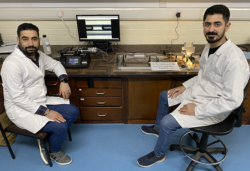
In this case study, we hear from Faysal Khaleel and Fahad Al-Gburi (based in the School of Engineering), who have been utilising BEAR to study fluid dynamics problems in materials synthesis and heat transport applications. We are PhD students within Dr. Jason Stafford’s research group in the School of Engineering and co-supervised by Prof. Yulong … Continue reading “Modelling multiphase flows for sustainable manufacturing and thermal energy applications”
Outreach throughout the BEAR world

The Researcher Engagement and Data Group (REDG) within Advanced Research Computing now comprises of 3.3FTE posts and engages with researchers across the University, from postgraduate level to senior academics, to ensure that they are aware of all the advanced computing facilities available to them through the Birmingham Environment for Academic Research (BEAR). The group also … Continue reading “Outreach throughout the BEAR world”
Quantum chemical modelling of solids for optoelectronic applications

In this case study, we hear from Peter Russell (School of Chemistry), who has been utilising BlueBEAR to focus on the computational and theoretical modelling of novel solid-state materials. I am a first year PhD student in the Scanlon Materials Theory Group, based in the School of Chemistry. The group is focused on the computational … Continue reading “Quantum chemical modelling of solids for optoelectronic applications”
10,12,14 to infinity: quantum research is classically hard
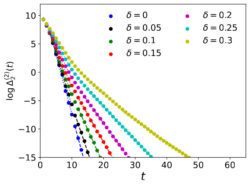
In this case study, we hear from Jonathon Riddell (School of Physics), who has been utilising BlueBEAR to study strongly correlated quantum systems out of equilibrium. My name is Jonathon Riddell, I am a fellow of non-equilibrium physics, in the Theoretical Physics Group. I am working on several projects, all of them with heavy reliance … Continue reading “10,12,14 to infinity: quantum research is classically hard”
January 2025 BEAR Newsletter
Birmingham Environment for Academic Research (BEAR) Newsletter Happy New Year! It has been a busy start to the year, and we would like to thank all our BEAR users for their patience whilst we performed our annual maintenance in December, as well as an additional downtime period in early January to connect the new transformer … Continue reading “January 2025 BEAR Newsletter”
BEAR storage changes – 3TB becomes 5TB!
We wanted to update existing and potential future users of our storage about an exciting change coming to the BEAR Research Data Store! From Tuesday 21 January, the amount of free, secure storage that can be requested per research project increases from 3TB to 5TB. At the same time, we have decided to simplify the … Continue reading “BEAR storage changes – 3TB becomes 5TB!”
We’re recruiting! Three posts in Advanced Research Computing: RSE; Senior RSE; and Senior RSE&Manager

Advanced Research Computing (ARC), at the University of Birmingham, is seeking to appoint three Research Software Engineer (RSE) posts. An RSE (grade 7), a Senior RSE (grade 8), and a Senior RSE&Manager (grade 8). All posts are permanent and will be in the Research Software Group, which is part of the award-winning ARC team, which … Continue reading “We’re recruiting! Three posts in Advanced Research Computing: RSE; Senior RSE; and Senior RSE&Manager”
Baskerville multi-GPU RSE call

Many new and upcoming HPC systems provide computing power through GPUs. Relatively little research software uses such hardware and less still can fully exploit multiple GPUs simultaneously. The Research Software Group (RSG) is in a position to offer time-limited support to researchers at the University of Birmingham with research software that currently runs on GPUs … Continue reading “Baskerville multi-GPU RSE call”