

The Birmingham Economic Review is out now!
This year’s report will provide a comprehensive analysis of the city’s economy amid the wider geopolitical landscape, and actionable measures that businesses and stakeholders from across the city-region can take to drive economic growth.
Read the full Birmingham Economic Review 2025.
Artificial intelligence is rapidly reshaping labour markets worldwide, creating new opportunities in high‑skill digital roles while increasing pressure on workers with fewer technical skills. Evidence shows that AI is changing hiring patterns, skill requirements, and wage dynamics across countries, with young workers in automatable roles particularly exposed and high‑skill occupations seeing the strongest growth. At the same time, AI adoption is spreading across industries—from manufacturing to finance—bringing both productivity gains and new risks.
Global and national evidence on AI and labour markets
Worldwide, artificial intelligence (AI) is reshaping labour markets through both risks and opportunities. A systematic review of the evidence of the impact of AI on the labour market reveals that job displacement effects of AI appear more prominent among workers with limited digital skills, while roles such as programmers, software developers, and e-commerce specialists are expanding.
Online vacancy data in the United States revealed significant growth in AI-related postings between 2010 and 2018, particularly after 2015. This increase was led by establishments with work tasks compatible with AI capabilities. These firms adjusted their hiring needs, as they dropped certain skills and introduced new ones. There was also reduced non-AI and overall hiring at such establishments, which seemed to be linked to automation of tasks that were once performed by workers. However, at industry and occupational levels, there were no detectable effects of AI exposure on employment or wages.
Another study from the United States found that, between 2007 and 2017, technological change explained almost half of the persistent decline in workers’ earnings after displacement. There were significant increases in computer and software requirements in some occupations, such as architects, engineers, advertising and marketing managers, and media and communication equipment workers. In contrast, restaurant staff, personal care workers, drivers and cleaners saw little change. Displaced workers without the new skills moved into lower-tech jobs that paid less. The fall was mainly in wages rather than hours. More educated, older, and White workers were more likely to be concentrated in jobs most exposed to technological changes.
However, a recent study from the USA provides evidence to support the hypothesis that AI revolution is beginning to have a significant and disproportionate impact on entry-level workers. Young people in occupations where AI automates, rather than augments, labour were most at risk. By contrast, older workers’ greater tacit knowledge accumulated through work experience may help protect them against AI-induced task replacement to a greater extent than younger workers more reliant on codified knowledge.
Across 16 European countries, including the UK, employment shares rose in occupations with higher exposure to AI between 2011 and 2019. This pattern was generally strongest in jobs with more high-skilled and younger workers, with increases between 3.1% and 6.6%. On the other hand, low- and medium-skill groups did not show significant changes. Evidence on wages was weaker, as no clear upward trend was linked to AI exposure. Moreover, there were differences between countries depending on education levels, regulation and the pace of technology diffusion.
A UK survey of 759 business leaders in 2018 found that one quarter of organisations had adopted AI within the past five years, either through equipment for physical tasks (15%), software for cognitive ones (21%), or both (11%). Employers that adopted AI were more likely to report job losses (44%) and job creation (46%) than those adopting other technologies only (6% and 11%). The overall net effects balanced, with 22% of organisations reporting more jobs and 22% fewer. AI adopters were more common in manufacturing, construction, finance, media and legal industries.
Generative AI has entered professional sectors worldwide, including academia, technology, communications, agriculture, government, and business. Examples of applications include education (where it personalises learning materials), medicine (where it supports diagnosis), and cultural industries (where it enriches heritage tourism). Research indicates that AI generally improves productivity by reducing mistakes, refining decision-making, and automating tasks. Nevertheless, certain risks arise around ethics, credibility, privacy, data protection, and bias.
Taken together, the evidence does not always point in the same direction about which groups of workers are most affected, but it is clear that AI is altering labour markets in ways that create both challenges and opportunities. The next section examines how AI-related trends are evident in the Greater Birmingham area.
Demand for AI skills in the Greater Birmingham area: insights from online job postings
The following analysis explores the demand for AI skills in the Greater Birmingham area using Adzuna online job postings data. As Figure 1 shows, the number of online job postings requiring AI skills (hereafter AI job postings) rose very sharply, from 311 in 2017 to 2,694 in the first three quarters of 2025 (a 55% year-over-year increase). Accordingly, the share of AI job postings in total job demand increased from 0.1% in 2017 to 1.3% in 2025. However, this share remained below the UK average of 2.1% in 2025. In the Greater Birmingham area, the upward trend was clear before the COVID-19 pandemic, as AI job postings doubled between 2018 and 2019. They then dropped in 2020 when overall vacancies contracted during the pandemic. From 2021, demand for AI skills increased again, particularly during 2024-2025.
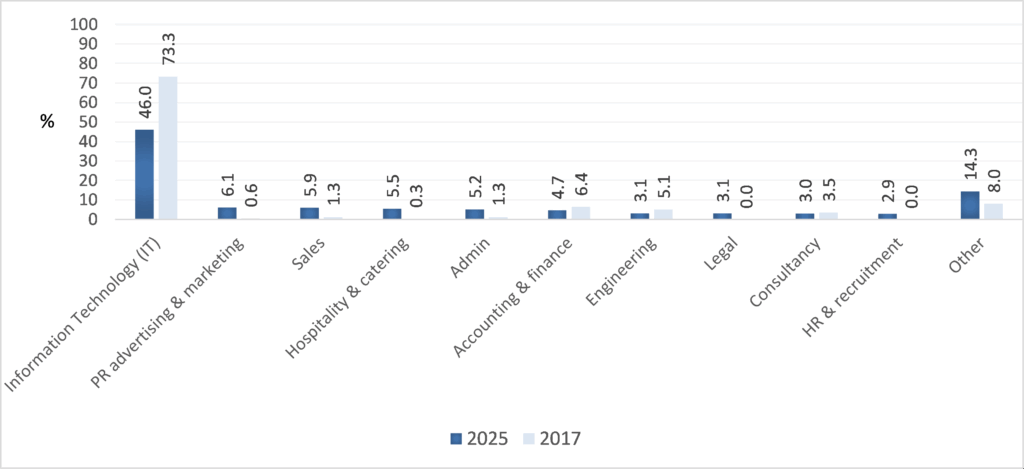
This rise in demand for AI skills is reflected, at least in part, in pay trends. Median salaries of AI job postings in the GBSLEP area increased from £40,200 in 2017 to £56,200 in 2022 (a 40% increase). Since then, salaries have fallen gradually, reaching £47,500 in 2025. This decline is likely explained by two factors. First, businesses have been more cautious in hiring because of economic uncertainty associated with the mild recession and high inflation in recent years. This may have put downward pressure on advertised salaries. Second, a wider range of sectors and occupations are now seeking AI skills. As Figure 2 shows, Information Technology (IT) jobs accounted for 73% of all AI job postings in 2017, but only 46% in 2025. Although IT remains the top sector, other lower-paid jobs such as sales, hospitality and catering, and admin have experienced a growing share. This picture suggests that AI skills are no longer confined to high-tech roles, as they are spreading across the labour market, but the average wage premium attached to them appears to have weakened.
In 2025, 83% of AI job postings in the Greater Birmingham area asked for degree-level or higher qualifications. Of these, 18% required a PhD. This shows that most of these roles demand advanced knowledge and skills. Some of the skills most often co-occurring in postings requiring AI skills include data, solutions, specialist expertise, assertiveness, management, digital, strategy, and innovation.
In sum, AI is continually impacting labour demand – both positively and negatively. It is expanding into new sectors and professions. In this context, education and training provision should aim to improve workforce readiness so that individuals can adjust to jobs that require AI skills. Employer investment in skills development and upskilling and reskilling can be promoted by policymakers and practitioners. It is critical to align the supply of skills with the changing demands of local economies.
Figure 1: Job Postings requiring AI skills in the Greater Birmingham area (2017-2015)
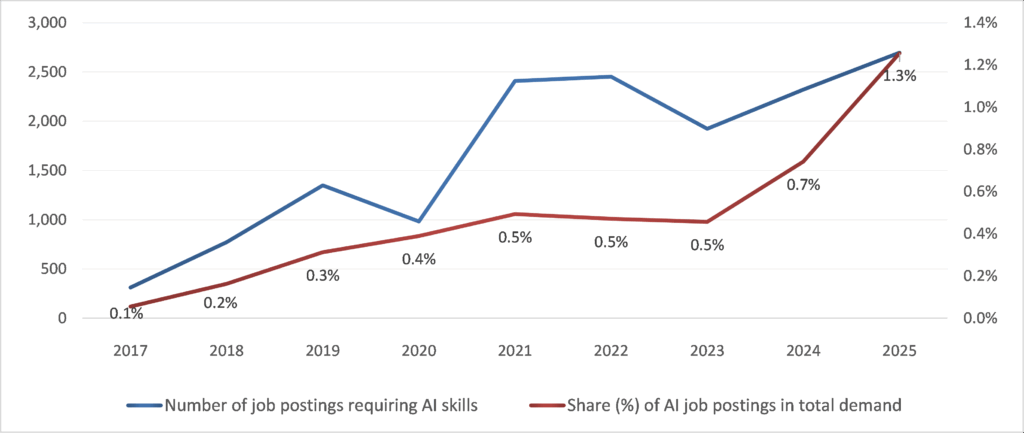
Figure 2: Top sectors (occupation categories) where AI skills are most in demand in the Greater Birmingham area (2025, compared with 2017 shares)
Source: Adzuna Intelligence, authors’ own calculation
This blog was written by Kostas Kollydas, Research Fellow at City-REDI, University of Birmingham.
Disclaimer:
The views expressed in this analysis post are those of the author and not necessarily those of City-REDI or the University of Birmingham.