
Dr Sara Hassan, Research Fellow at City-REDI (City Region Economic Development Institute), University of Birmingham, shares what a year of listening in Digbeth revealed about who regeneration is really for. The work is part of Creative Futures in Regeneration, funded through the Arts and Humanities Research Council (AHRC) Creative Communities programme.
A creative quarter at a turning point
Digbeth has been Birmingham’s creative heart for more than thirty years. Artists, makers, music venues and independent businesses moved into its old factories and warehouses when few others wanted them. Today it is home to around 500 creative firms.
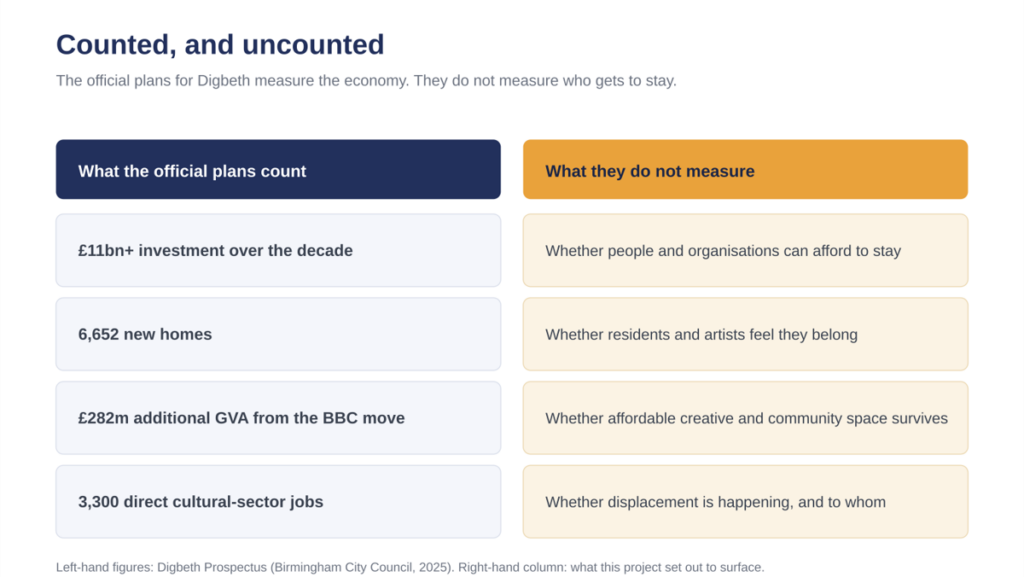
It is also at the centre of one of the largest regeneration programmes in the country. The Digbeth Prospectus sets out more than £11 billion of investment and 6,652 new homes over the coming decade. HS2 Curzon Street, the Smithfield redevelopment and the BBC’s move to Typhoo Wharf are bringing jobs, visibility and confidence. The BBC estimates its relocation alone will add over £282 million in gross value added (GVA).
That is welcome. But it raises a harder question. Will the people who made Digbeth valuable still be able to afford to stay?
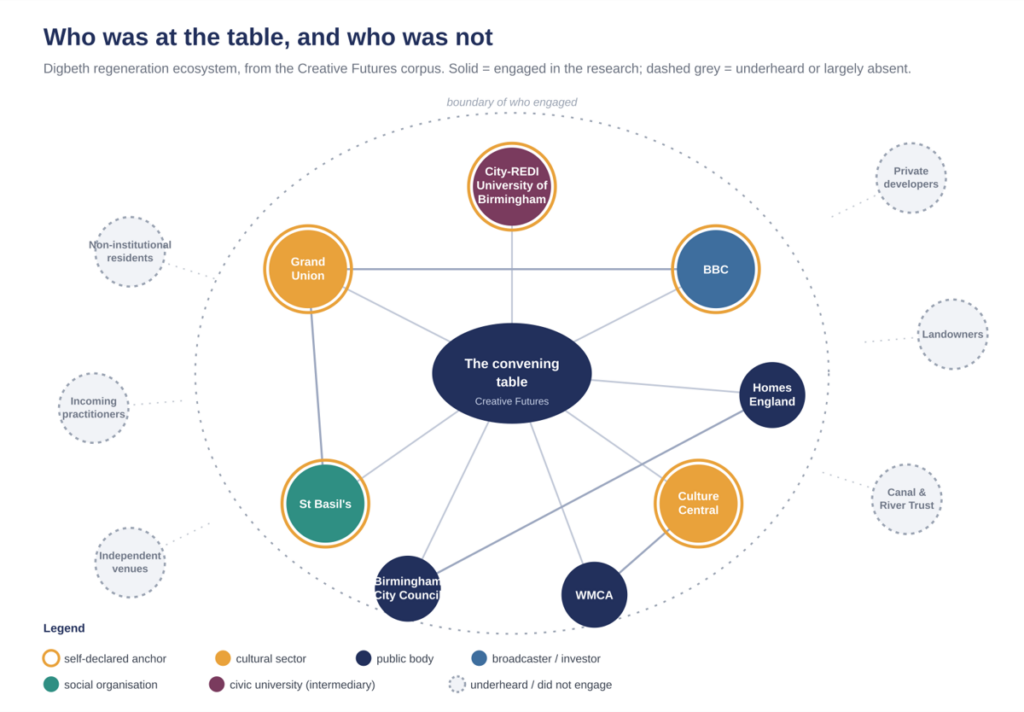
Over the past year, as an AHRC Community Innovation Practitioner, I brought together organisations with very different kinds of power over Digbeth’s future. Grand Union, St Basil’s, Culture Central, the BBC, Birmingham City Council, the West Midlands Combined Authority (WMCA) and Homes England all took part. We used interviews, walking conversations, workshops, ecosystem mapping and a podcast. Here is what we found.
The value that draws investment is the first thing it puts at risk
Digbeth’s creative identity is its greatest asset. It is also its biggest vulnerability. The cheap studios, venues and maker spaces that first made the area attractive to investors are the first thing rising rents remove.
Grand Union, an arts organisation and one of Digbeth’s anchors, saw its rents rise sharply as redevelopment plans intensified. Cheryl Jones, its Director and one of its founding members, put it plainly: “Everything is at stake: years of community-building now sit alongside significant precarity.”
This is happening while cultural funding shrinks. West Midlands cultural investment stood at £155 million in 2024, roughly a third below its 2016 level once inflation is taken into account. So the risk is not a missed opportunity. It is an active loss. Digbeth could keep the brand of a creative quarter while emptying of the people who earned it.
Public realm is more than streets and buildings
Regeneration plans tend to talk about public realm as squares, pavements and canal paths. The people we spoke to described something else.
St Basil’s has supported young homeless people in Digbeth since the 1960s. Its then Chief Executive described the area as a place of “psychological safety” and “neutrality”, where organisations can “wrap around the person” rather than passing them between disconnected services. A young person connected to St Basil’s told us Digbeth was somewhere she felt “safe to be as flamboyant” or “as confident” as she wanted to be.
One workshop conversation about rubbish, street life and visible vulnerability raised a sharp question. When a place is made investment ready, who or what gets cleaned away? Public realm, on this account, is also safety, care, confidence and belonging. None of these appear in a viability assessment.
Recognition is not the same as influence
Digbeth’s creative community has already named the risks. The community-led Digbeth Cultural Plan, Companion Culture: Four Actions for Digbeth, was developed by Grand Union and Eastside Projects with more than 300 people. Its four actions are to be good neighbours, secure cultural space, be a lighthouse and be inclusive. Its call to secure space now sits behind a proposal in the emerging Birmingham Local Plan for not-for-profit floorspace in Digbeth developments.
So culture is not ignored. It is praised in almost every plan. The problem is that praise has not yet turned into governance, secured space or binding commitments. People told us they were often consulted after decisions had already moved on. Many were reluctant to challenge more powerful institutions.
Slowing down changed who could speak
Digbeth has several organisations that see themselves as anchors, including the BBC, Grand Union, St Basil’s, Culture Central and City-REDI. But no shared framework connects them. The real constraint was not a shortage of ideas. It was limited trust, and no neutral space to test competing interests before positions hardened.
So we chose careful convening over quick answers. Workshops were designed to surface tension safely. When a thirty-minute partner slot proved too short for everyone to speak, we added an online board so quieter voices could contribute afterwards. Rebecca Riley, Co-director of City-REDI, described the university’s role as giving “a more equal weight to the voices that are in the room”.
It made a difference. Claire Starmer, Cultural Service Manager at Birmingham City Council, called the workshops “very open, safe environments”. Dr Anthony Ruck of Culture Central observed that people can feel they “have to take sides” between culture’s economic and social value. The conversations reframed that as a tension to navigate rather than a battle to win. Homes England began considering how cultural evidence could inform its assumptions about demand for homes and studios. The BBC explored what being a “good neighbour” might mean in practice.
We should be honest about the limits too. Landlords, developers, freelancers and many residents were underrepresented. Openness in a room is not the same as influence over decisions.
What needs to happen next
Our policy brief sets out four recommendations for Birmingham City Council, the WMCA and the new Birmingham East Mayoral Development Corporation.
First, give cultural and community voices a formal advisory role in regeneration decisions, before the next wave of sites comes forward. Second, protect affordable creative and community space as essential infrastructure, using tools that already exist, from Section 106 planning agreements to long-term leases and a community land trust for key cultural buildings. Third, turn “good neighbour” from a slogan into a published pledge, starting with the BBC, covering shared venue access, local procurement and skills pathways into creative jobs. Fourth, measure what matters. Track belonging, access, affordable workspace and displacement risk at neighbourhood level, alongside GVA and jobs.
Devolution makes this possible. Powers over planning, skills, housing and culture now sit closer to Digbeth than ever. But closeness alone does not produce inclusion. Communities need to shape decisions before outcomes are fixed.
Digbeth should be judged not only by what is built, but by who remains, who benefits and who gets to shape what comes next.
Find out more
You can read the case study and the policy brief, and listen to the podcast episode. All outputs are on the Creative Communities website.
This blog was written by Dr Sara Hassan, Research Fellow, City-REDI, University of Birmingham.
Disclaimer:
The views expressed in this analysis post are those of the author and not necessarily those of City-REDI or the University of Birmingham.