

The Birmingham Economic Review is out now!
This year’s report will provide a comprehensive analysis of the city’s economy amid the wider geopolitical landscape, and actionable measures that businesses and stakeholders from across the city-region can take to drive economic growth.
Read the full Birmingham Economic Review 2025.
Innovation Accelerator pathfinder funding announced in the ‘Levelling Up the United Kingdom’ White Paper has been used to make significant improvements to the West Midlands health technology innovation ecosystem.
Initially £100 million was made available for three Innovation Accelerators (IAs) pathfinders in the West Midlands, Glasgow, and Greater Manchester. IAs are public-private-academic partnerships aimed at catalysing innovation clusters modelled after Stanford-Silicon Valley and MIT-Greater Boston. The IAs are specialised vehicles that bring together public sector stakeholders, private sector stakeholders, and leading research institutions. The goal was to align public and private investment to fund local research development and innovation RD&I projects that generate wider public benefits in addition to those accrued by programme beneficiaries
The West Midlands Plan for Growth identified HealthTech and MedTech sector having a medium level of strength compared to the national average, and with high growth potential, offering significant opportunities and comparative advantages that could be leveraged for a step change in performance. Additional growth opportunity: a further £400m to £430m of output and 5,300 to 5,900 jobs by matching the growth trajectory of leading UK regions for similar clusters.
The West Midlands health technology innovation ecosystem has many strengths but was fragmented and difficult to navigate for innovators wishing to commercialise their ideas and technology. This being mirrored by the region not being able to attract investment businesses require to scale. Underexploited key strengths of the region include:
- Research assets including university centres offering R&D collaboration and product development support, catapults, NHS R&D units. Many of these assets having previously worked in collaboration to support the sector and the adoption of new technologies by healthcare providers.
- The ability to retain production within the region by pivoting a strong manufacturing base with transferable advance manufacturing expertise to support prototyping and supply chain development to support local manufacturing.
- Good market access for businesses wishing to be locate and scale through being centrally located distribution centre and access to local health care commissioners.
- Access to affordable infrastructure including innovation parks and hubs with land, lab space and incubation space and public and private sector expertise covering all aspects of the commercialisation journey of new health technologies. Operating costs 15-20 percent lower than London and the Southeast
- Talent pipeline including 40,000 annual science graduates and specialised training programme with the potential for more spin outs from universities.
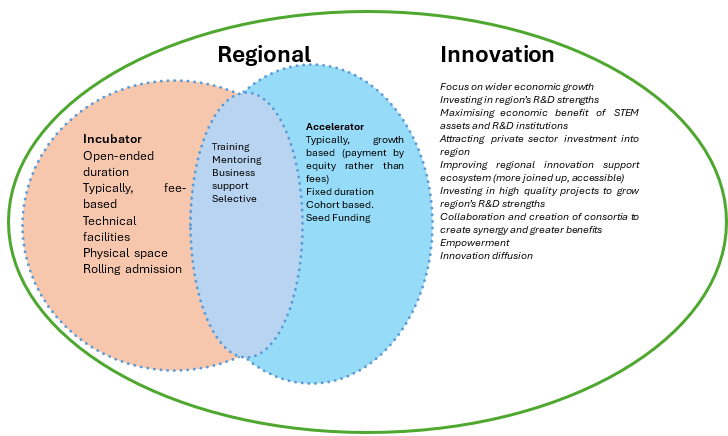
The West Midlands Health Tech Innovation Accelerator (WMHTIA) is a unique consortium that brings together diverse providers of support for the health technology sector, especially to overcome the challenges. Unlike traditional innovation accelerators that focus primarily on preparing startups for external investment, the WMHTIA has a broader mission (see Figure 1) including:
- Single access point for support to health tech companies at various stages of development
- Transforming the regional innovation ecosystem
- Establishing the West Midlands as a preferred location for medical technology entrepreneurs.
The West Midlands HealthTech Innovation Accelerator brought together 21 partners into an agile consortium capable of covering the full spectrum of support required by HealthTech enterprises from the academic, commercial and health care sectors.
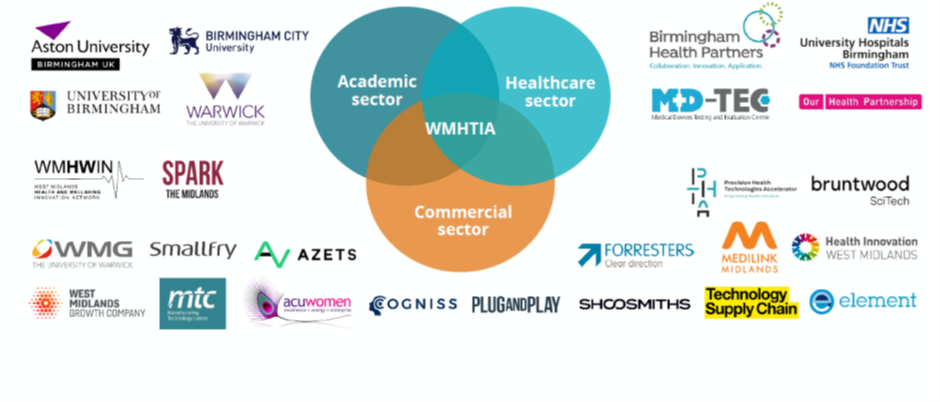
Though academic partners including Aston University, Birmingham City University, University of Birmingham and University of Warwick, HealthTech enterprises have been able to access:
- NHS commissioners through West Midlands Health and Wellbeing Innovation Network which supports procurement of innovations in response to identified needs in the region.
- Warwick Manufacturing Group
- SPARK the Midlands
- Support with regulations, cybersecurity and prototyping
- Clinical Immunology Service, Healthcare Technology Institute, Chemical Engineering, Electrical Engineering, AI Hub (Genomics) and City Regional Economic Development Institute (City-REDI)
Through healthcare partners including University Hospital Birmingham NHS Foundation, Health Innovation West Midlands, and Our Health Partnership providing access to primary care they have also been able to access:
- Medical Devices Testing and Evaluation Centre (MD-TEC), access to Birmingham Health Partners (BHP) including NHS Trusts, BHP Centre for Regulatory Science and Innovation, NIHR Health Technology Research Centre (Devices, Digital and Robotics)
- Clinicians, potential collaborators and care commissioners support at all stages of their commercialisation journey
WMHTIA was able to provide demand led holistic and integrated business support provision required by the sector through the inclusion of commercial and third sector partners.
Partners in the pathfinder included Acuwomen, Azets, Bruntwood SciTech/ Birmingham Health Innovation Campus, Cogniss, Element Materials Technology, Forresters, Medilink Midlands, Manufacturing Technology Centre, Plug and Play UK, Precision Health Technologies Accelerator Shoosmiths, Smallfry (Tagdraw Ltd), and Technology Supply Chain. Who provided information and bespoke support covering intellectual property, regulation, access to finance including introductions to investors, design, prototyping, manufacturing, inward investment and international markets, supply chain development, app development and business strategy and premises.
Over 275 enterprises have registered with the WMHTIA. This has provided a more comprehensive overview of the cluster (see next article) and the developmental needs of enterprises within the sector
The MTC and University of Birmingham have developed the venture readiness canvass (VRC) assessment tool which they are live piloting with partners to assess developmental needs and progression in the following capability areas:
- Regulatory and clinical including Clinical evidence, Patient acceptance, End-user acceptance and Regulatory Strategy
- Organisational developmental including development of team. organisation and partnership and networks
- Intellectual Property, legal, Venture Capital and clinical R&D support
- Business support including business model, market, customer and value proposition development
- Technology support including external contract manufacturing, software development and data analysis
- Product development
- International markets
The VRC originally came about to provide evidence of the impact of support being provided by WMHTIA and similar innovation support programmes. More importantly is its role as a tool for communicating needs of and ensuring joined up cohesive support for HealthTech enterprises. Once necessary IP has been secured the intention is train more people in its use and make more widely available.
This blog was written by George Bramley, Annum Rafique, Gerardo Javier Arriaga Garcia, City-REDI, University of Birmingham and Thorsten Kampmann, Luan Linden-Phillips, Derek Sear.
Disclaimer:
The views expressed in this analysis post are those of the authors and not necessarily those of City-REDI or the University of Birmingham.