

Dr Matthew Lyons summarises the annual Birmingham Economic Review 2025, in collaboration with the Birmingham Chambers of Commerce.
The annual Birmingham Economic Review is produced by the City Region Economic Development Institute (City-REDI) at the University of Birmingham and the Greater Birmingham Chambers of Commerce.
The report launched on Thursday 4th of December at The Exchange brings together insights from a wide range of voices across the region to provide an in-depth exploration of the economy of the United Kingdom’s second city and a high-quality resource for informing research, policy and investment decisions.
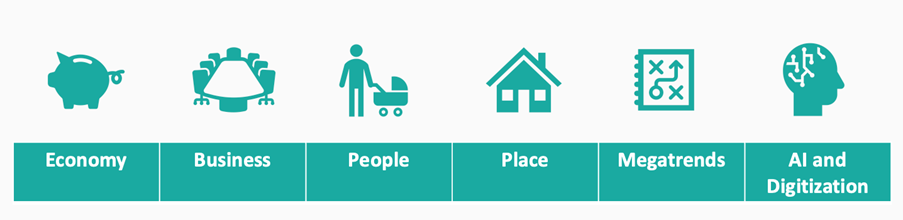
The 2025 edition of the Birmingham Economic Review has 6 chapters – this blog provides a summary of the key impressions from each theme.
Economy – A year of tariffs and trade tensions
The year has seen interest rates fall gradually and inflation rates remain stubbornly high. The economy has also faced unexpected shocks as a result of increasing trade tensions globally. Most notable of these was the proposed US tariffs on the UK’s automotive sector which has an outsized impact in the Greater Birmingham region. Although partially mitigated by the US-UK trade deal, this is still forecast to reduce GDP in the region by £2.5bn by 2030. These macroeconomic factors have further led to the perpetuation of business uncertainty and delayed decisions. Despite these issues bright spots include higher than expected GDP growth in 2025 (+1.4% forecasted) with the IMF predicting the UK to be the second fastest growing economy in the G7.
The Economy key numbers:
- Global backdrop: 2025 opened with trade tensions and high inflation, yet the IMF forecasts UK GDP to grow 1.5% in 2025, second-fastest in the G7 after the US.
- Inflation & rates: UK inflation rose to 4.1% in August 2025, the highest in G7, prompting the Bank of England to pause its rate cuts at 4%.
- Regional growth: Greater Birmingham’s economy grew by 1.4% in 2023, led by Birmingham, Redditch, and Cannock Chase, with strong post-pandemic growth in specialised construction and manufacturing sectors.
- Consumer spending: Household consumption resilient, and the West Midlands saw particularly strong recovery in spending.
- Trade & investment: The West Midlands led Foreign Direct Investment (FDI) outside London with 130 projects (2024–25) but exports fell amid global uncertainty and proposed US automotive tariffs, which were partially mitigated by new US–UK trade deal.
Business Uncertainty and dipping confidence
The West Midlands economy shows signs of both resilience and strain. Business formation has slowed, but modest declines in transport and storage across Greater Birmingham have been offset by steady expansion in property and health, indicating a shift toward service-based activities. Business confidence has fallen sharply over the year, with may pulling back from capital and R&D investment in response to tightening financial conditions and delayed public projects. Despite these challenges, the region remains strong in research and development. Significant initiatives in 2025, including the Birmingham Knowledge Quarter and West Midlands Health Tech Innovation Accelerator, alongside events like Birmingham Tech Week, highlight growing innovation capacity. The task ahead will be translating this momentum into sustained productivity growth through investment in technology and skills to build a more resilient, inclusive regional economy.
Business – Key numbers:
- Business demography: Greater Birmingham & Solihull had 72,620 enterprises in 2024, slightly down from 2023; Transport & Storage fell by 14%, while Property and Health grew modestly.
- Confidence: Regional business confidence declined from 12.9 (Q2 2024) to 7.9 (Q2 2025), below the national average.
- Investment: UK business investment fell 1.1% in Q2 2025, but remains 3% above 2024.
- Research & Development: West Midlands Gross Domestic Expenditure on Research and Development (GERD) was £5.5bn in 2023 (8% of the UK total).
- Innovation: Over £800m of new investment was announced in 2025, including £400m for the Birmingham Knowledge Quarter.
People – Still young, still growing
Greater Birmingham’s labour market is currently stronger than at any point in modern history, following decades of population decline and industrial contraction. Employment and working-age population have grown steadily over the past 25 years, with unemployment and economic inactivity at historic lows, youth unemployment remaining below 10% for four consecutive years, and narrowing ethnic minority employment gaps. However, new challenges are emerging. Rising levels of work limiting disability threaten inclusion and productivity, requiring better health support, workplace adaptation, and coordinated public policy. Simultaneously, technological disruption from AI and automation is reshaping labour demand and skills requirements. Although the region’s strong university base and expanding AI ecosystem offer opportunities, digital skills shortages and unequal access to technology risk widening inequalities if left unaddressed.
Key points
- Demographics: Birmingham remains one of the UK’s youngest and most diverse cities, and its population continues to grow, driven by migration.
- Health: Life expectancy and healthy life expectancy in the West Midlands remain below national averages.
- Labour market: Real pay growth has turned slightly positive, driven by strong public-sector and service-sector wage gains, though unemployment (5.1%) and inactivity (23.1%) in Greater Birmingham remain above national averages.
- Skills: Qualification levels are improving and skills-shortage vacancies remain low, while Greater Birmingham shows record employment levels.
- Youth exposure to automation: Young people are especially vulnerable to AI-driven disruption in entry-level jobs, heightening risks of underemployment
and labour-market polarisation.
Place – Sustainable communities and pride in place
The West Midlands continues to strengthen its social and cultural foundations while adapting to structural change. Tourism has rebounded strongly from the shocks of the pandemic, with Birmingham remaining among the UK’s top four destinations. Major events, such as the 2026 European Athletics Championships, are expected to enhance the region’s profile as a vibrant, globally connected destination, and boost visitor spending further.
Key points
- Tourism: Birmingham’s visitor numbers hit 934,000 in 2023, closing the gap with Manchester. Upcoming major events are expected to boost visibility and spending.
- Cultural impact: The passing of Ozzy Osbourne in July 2025 brought global attention to Birmingham’s musical heritage. His final concert generated an estimated £33.8m in gross output, with £27.6m retained in the West Midlands.
- Housing: The West Midlands’ affordability ratio improved to 6.86 (below England’s 7.53), however 116,000 households remain on waiting lists for social housing.
- Sustainability: The West Midlands ranks mid-table for housing energy efficiency but leads on large-scale retrofit delivery.
- EV transition: The West Midlands has emerged as a national leader in EV charging, with 725 charge points per 100k people (2025), up from 43 in 2019.
Megatrends – challenges and opportunities
Regional economies are being reshaped by powerful global forces or ‘megatrends,’ such as rising geopolitical tensions, climate change, technological disruption, and demographic change. These megatrends create both risks and opportunities for regions and cities. Greater Birmingham has a mixed exposure to such trends: while certain sectors demonstrate resilience, others remain vulnerable to trade shocks, automation, and AI-driven labour displacement, especially among younger and lower-skilled workers. The region is also home to a series of emerging clusters that could act as future engines of growth and prosperity.
Investment in the City
- Midlands Rail Hub: 20 million extra seats for passengers and up to 300 extra trains every day.
- The Eastside extension of the West Midlands Metro: Connecting Birmingham City FC’s planned 60,000 seat stadium and will serve the HS2 station at Curzon Street.
- HS2 Curzon Street: Expected completion by 2028
- £4bn Sports Quarter: new Birmingham City FC stadium
- Birmingham Knowledge Quarter (B-KQ): Series of government incentives for business.
- Tourism: 2026 will welcome the European Athletics Championships building on the success of other recent megaevents. Over 86,000 tickets sold so far.
Artificial Intelligence -Opportunity and uncertainty
Artificial Intelligence is continuing to disrupt how businesses and the public sector operate. The impact on the labour market is likely to be profound but remains difficult to forecast. Greater Birmingham is beginning to see how disruptive AI and maturing digitisation are interacting in its own distinctive way for the region. The region has a distinct sectoral mix with advanced manufacturing, creative industries and health technology all adopting and diffusing these new technologies in different ways. AI applications are reshaping productivity, investment planning and the future of work.
Key points
- Growing AI ecosystem: The UK’s AI sector now includes 5,800 firms, up 85% in two years, generating £11.8bn in Gross Value Added (GVA) and over £20bn in private AI investment since 2016.
- Regional presence: Greater Birmingham hosts around 180 AI firms (1.8% of the UK total) and this has seen strong growth recently – 59 new AI firms were established in the region in first 10 months of 2025.
- Challenges and opportunities: Digital skills shortages and limited data infrastructure remain barriers, but the region’s strong university base and potential for AI-focused infrastructure investment offers growth potential.
Some Reflections from the BER in 2025
Despite some encouraging signs in the economy, business confidence has been slipping in recent months. The worst-case scenario for the automotive sector has been avoided, thanks to the UK-US trade deal that mitigated the impact of potential tariffs. However, the recent cyberattack on Jaguar Land Rover serves as a stark reminder of both the sector’s importance to the city and region and the significant risks posed by such incidents.
The West Midlands stands out as the only region in the UK with assets across all eight priority sectors identified in the Industrial Strategy, reinforcing its strategic economic position. Meanwhile, artificial intelligence continues to be a disruptive force bringing both opportunities and challenges with those at the extremes of the age spectrum particularly vulnerable to its impacts.
Read the report in full.
This blog was written by Matthew Lyons, Research Fellow, City-REDI, University of Birmingham.
Disclaimer:
The views expressed in this analysis post are those of the authors and not necessarily those of City-REDI / WMREDI or the University of Birmingham.