

When you’ve got a promising research idea but lack the engineering bandwidth to make it production-ready, knowing where to turn for help can be challenging. Anas Rana, a researcher from the Institute of Cancer and Genomic Science discovered that partnering with dedicated Research Software Engineers from the Advanced Research Computing Team (ARC) within IT Services, transformed their exploratory codebase into something truly reusable.
The Challenge
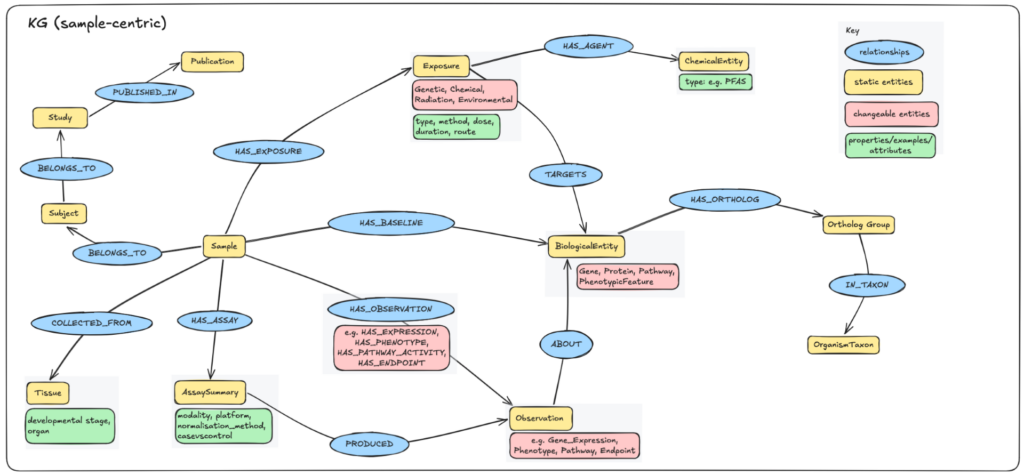
The team was working with fragmented molecular perturbation data, scattered across different species and assay types. Their prototype worked, but it wasn’t modular, tested, or documented well enough to scale. The team needed a way to demonstrate that heterogeneous transcriptomic and perturbation data can be integrated into a coherent graph representation with documented provenance. This was when the team decided it was time to bring in the ARC team to offer some expert help – a step made possible thanks to an Institute for Data and AI (IDAI) Collision Grant.
The Collaboration That Made a Difference
What stood out wasn’t just the code delivered. The real value came from working through the schema design together. Bringing fresh perspectives to the project helped the research team make their biological assumptions explicit. The collaboration produced a versatile ingestion architecture, meaning that adding new datasets is now straightforward.
But perhaps most crucially, the team produced exceptional documentation, something research groups rarely have the time to prioritise internally. This proved invaluable for bringing new people onboard and supporting future funding applications, producing benefits for years to come.
The Outcome
The team now has a documented, reproducible prototype with proper version control, testing, and extensible architecture. The pilot proved feasible and paved the way for scaling to additional species and modalities.
The takeaway? Good ideas deserve engineering discipline. Early engagement and realistic scope-setting make all the difference.
We were pleased to hear how Anas was able to use what is on offer from Advanced Research Computing. If you have any examples of how it has helped your research, please get in touch with us at bearinfo@contacts.bham.ac.uk.
We are always looking for good examples of the use of High Performance Computing to nominate for HPC Wire Awards – see our recent winner for more details.