
In this case study, we hear from Phillip Nicolson, a researcher in Cardiovascular Sciences and consultant haematologist, who uses the research data store (RDS) to store data on clotting caused in a small number of people after receiving the COVID-19 vaccine.

In 2021, a new blood disorder, vaccine-induced immune thrombocytopenia and thrombosis (VITT), emerged in a small number of people shortly after their first COVID-19 vaccine, causing dangerous clotting alongside a falling platelet count. As a consultant haematologist and researcher at the University of Birmingham, I’ve spent the last five years working with my team to understand exactly how this happens, from the clinic through to the lab bench.
Our work has ranged from characterising patients’ clinical course and antibody levels, to laboratory experiments uncovering how the platelet-activating antibodies in VITT actually switch platelets on; including a newly discovered signalling pathway via the receptor c-Mpl and a newly discovered viral trigger for VITT (cytomegalovirus).
The BEAR RDS drive has been central to all of it. It’s where our whole team stores and shares experimental and (anonymised) patient data securely, letting us collaborate on the same datasets from the clinic and the lab without ever emailing spreadsheets around.
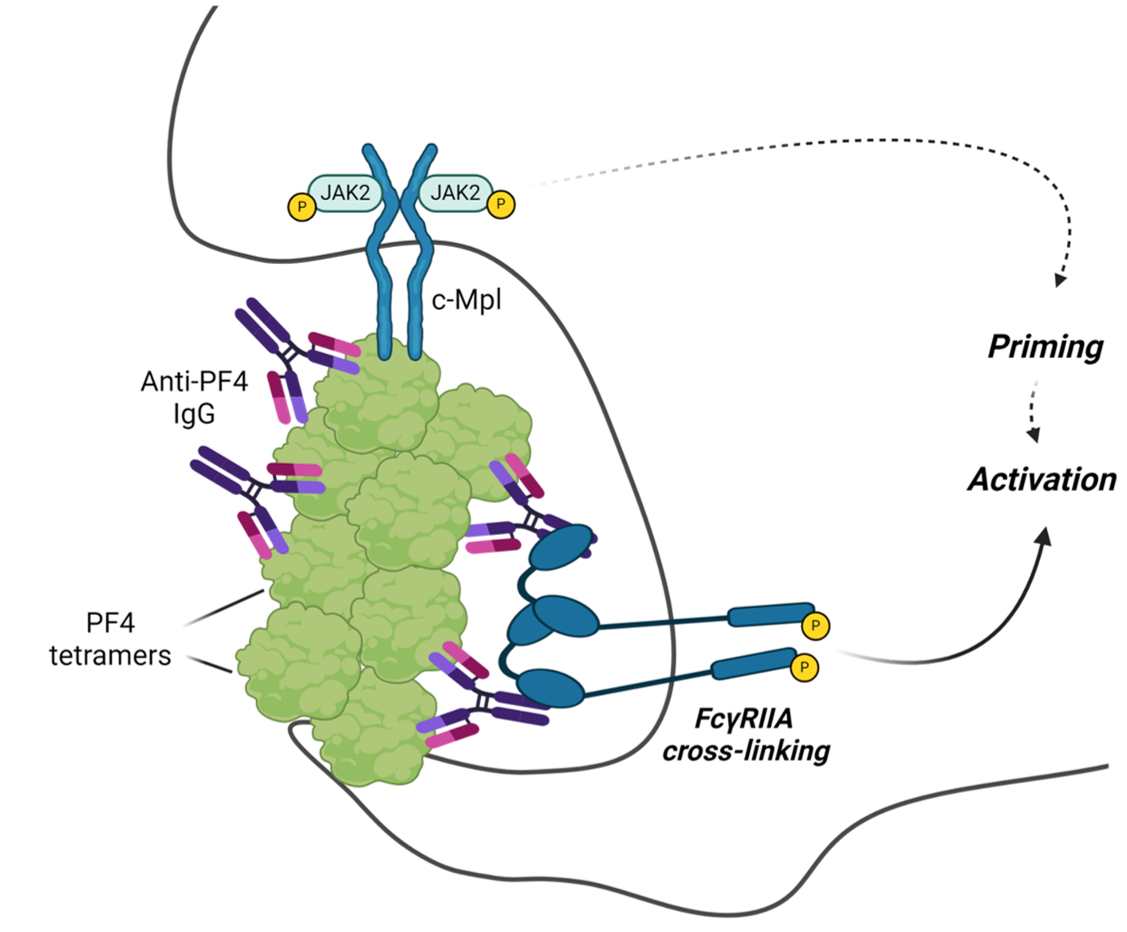
As well as the accepted cross-linking and activation of platelet FcɣRIIA by anti-PF4 antibodies bound to PF4 in immune complexes, PF4 itself also activates the c-Mpl receptor on platelets. c-Mpl: c-myeloproliferative leukaemia protein; FcγRIIA: Fc gamma receptor IIA; IgG: immunoglobulin; JAK2: Janus kinase 2; P: phosphorylation; PF4: platelet factor 4; VITT: vaccine-induced immune thrombocytopenia with thrombosis.
This research has since helped secure a British Heart Foundation Intermediate Fellowship for my colleague Dr Sam Montague, who has just taken up the award to continue the work.
We were pleased to hear how Phillip was able to use what is on offer from Advanced Research Computing. If you have any examples of how it has helped your research, please get in touch with us at bearinfo@contacts.bham.ac.uk.
We are always looking for good examples of the use of High Performance Computing to nominate for HPC Wire Awards – see our recent winner for more details.