
Hannah Trivett is a Research Fellow in Prof Lindsay Hall’s research group in the Department of Microbes, Infection and Microbiomes, where she studies how long-read metagenomic sequencing can be used to understand how microbes within the gastrointestinal ecosystem contribute to health and disease.

Most recently, I explored this in patients with advanced chronic liver disease (cirrhosis), investigating whether microbial biomarkers are associated with disease severity and how antimicrobial resistance genes circulate within the gut microbiome. Using Oxford Nanopore long-read metagenomics, we identified progressive loss of beneficial gut bacteria, expansion of opportunistic pathogens such as Enterococcus faecium, and increasing antimicrobial resistance as disease severity worsened. We also reconstructed hundreds of microbial genomes directly from patient samples, providing strain-level insight into potential reservoirs of antimicrobial resistance. This work has been published in BMC Genome Medicine (DOI:10.1186/s13073-026-01724-9)
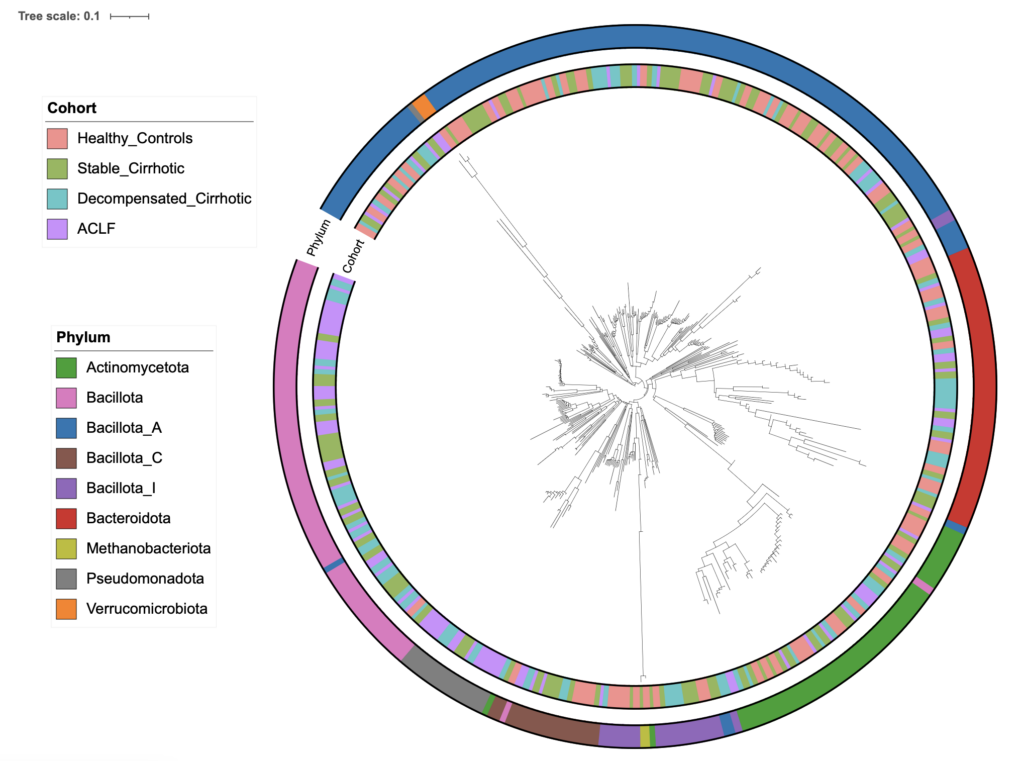
To generate these results, I relied heavily on BlueBEAR’s high-performance computing resources. The project involved processing and analysing large-scale long-read metagenomic datasets from 76 participants, including read quality control, host-read removal, metagenome assembly, genome binning, antimicrobial resistance profiling, and phylogenetic analyses. Many of these computationally intensive workflows would have been impractical to run efficiently on a standard desktop computer. BlueBEAR enabled me to analyse hundreds of GB of sequencing data, reconstruct 389 metagenome-assembled genomes, perform comparative genomics, and generate the figures and statistics that underpin the study. By providing the computational capacity required for these analyses, BlueBEAR has enabled outputs that have advanced my research programme and been showcased at major scientific conferences, including The Human Microbiome Conference (EMBL Heidelberg, Germany) and the 2025 Molecular Microbial Ecology Group Meeting at the University of Birmingham.
We were so pleased to hear how Hannah was able to make use of what is on offer from Advanced Research Computing. If you have examples of how it has helped your research, please contact us at bearinfo@contacts.bham.ac.uk.
We are always looking for good examples of the use of High Performance Computing to nominate for HPC Wire Awards – see our recent winner for more details.