
In this case study, we hear from Alexis Manche, a Research Associate in the Scanlon Materials Theory Group in the School of Chemistry, who uses BlueBEAR to investigate how atomic-scale defects and charge transport affect next-generation battery materials.

I am a computational materials chemist working in the Scanlon Materials Theory Group at the University of Birmingham and as part of the Faraday Institution’s NEXGENNa programme. My research focuses on a deceptively simple question: what happens inside a battery material when an ion moves or an electron is added or removed?
The answer matters because the performance of a battery is not determined only by the ideal crystal structure shown in a textbook. Real materials contain vacancies, substituted atoms, disordered regions and local distortions. These defects can help ions move, trap charge or trigger structural changes during cycling. Understanding them is essential if we want to design batteries that charge faster, last longer and rely on more sustainable materials.
To study these processes, I use density functional theory (DFT), a quantum-mechanical method that allows us to calculate the energies and electronic structures of materials from their atomic arrangements. I combine DFT with automated structure generation, point-defect calculations, molecular dynamics and nudged elastic band simulations, which map the energy barriers encountered as an ion or electron moves through a crystal. I also calculate properties that can be compared with experiments, including electronic structure and spectroscopic signatures.
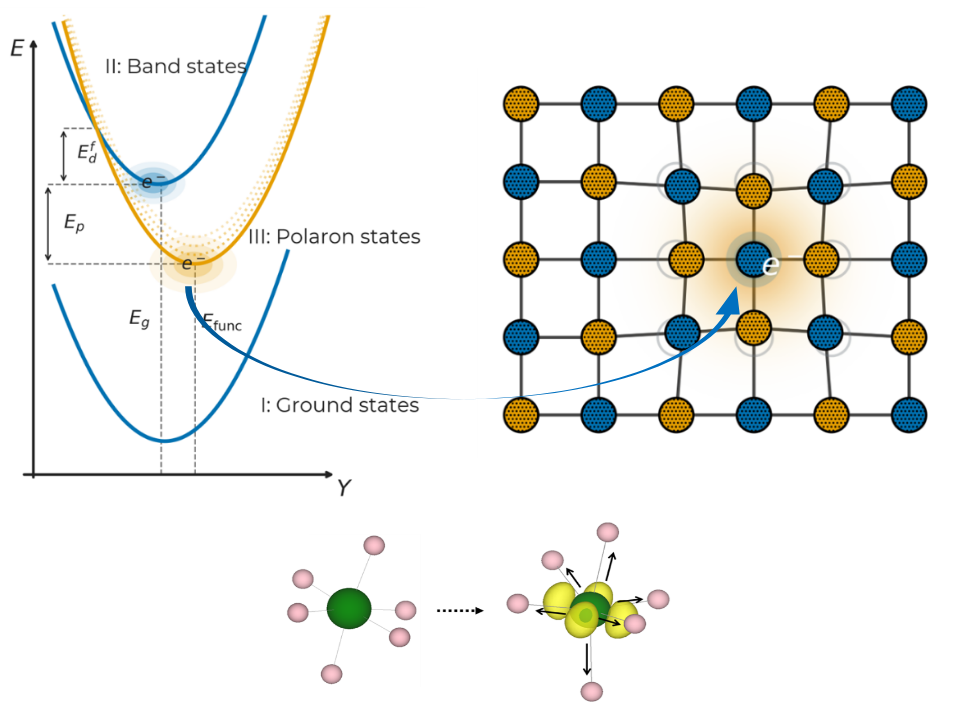
One example is my work on T-Nb₂O₅, a niobium oxide being investigated as an anode for fast-charging lithium-ion batteries. Its relatively open crystal structure has often been associated with rapid lithium storage, but experiments on dense thin films suggest that lithium diffusion within the material can still be slow. We therefore wanted to understand whether the limitation comes only from the motion of Li⁺ ions or whether the accompanying electrons also play an important role.
When lithium enters T-Nb₂O₅, it contributes both a Li⁺ ion and an electron. Our calculations indicate that the electron does not necessarily spread evenly through the crystal. Instead, it can localise on a nearby niobium atom, forming a small polaron and producing a local distortion of the surrounding structure. By testing different lithium positions, electronic configurations and migration pathways, we can determine how the lithium ion and this localised electron influence one another. The results show that ionic and electronic transport should not always be treated as separate processes: lithium motion can be coupled to the localisation and movement of the polaron.
This type of problem is computationally demanding. A single result may require many competing atomic and electronic configurations to be relaxed before the lowest-energy state can be identified. Migration calculations then repeat the quantum-mechanical calculation for a series of intermediate structures along each possible pathway. Looking at different compositions, defects and charge states quickly turns one scientific question into hundreds of substantial calculations.
BlueBEAR allows me to move beyond testing one idealised structure and instead compare the many competing atomic-scale mechanisms that can control a real battery material.
BlueBEAR makes this research practical by allowing many calculations to run in parallel and by providing the computing power needed for larger, more realistic models, while the Research Data Store provides a central location for the large output files generated by VASP. Together, these services let me follow a project from initial structure generation through to the comparison of transport mechanisms and predicted experimental observables.
The aim is not simply to produce more calculations. It is to give experimental collaborators a clearer explanation of what they observe and to help identify which material modifications are worth pursuing. In T-Nb₂O₅, for example, the calculations suggest that improving fast charging may require us to consider ion mobility, electronic localisation and microstructure together. The same approach can be applied to sodium-ion cathodes, solid electrolytes and doped electrode materials, where a small change in local chemistry can have a large effect on performance.
Alongside this work, I am now developing new spectroscopy capabilities for an open-source Python package developed by our group for modelling point defects in solids. The aim is to connect atomistic defect calculations more directly with experiments by predicting how dopants and defects alter Raman, infrared, solid-state NMR or X-ray absorption spectra for example. This project also forms part of my wider work on AI-assisted point-defect modelling: automated calculations can generate carefully curated datasets that machine-learning and surrogate models can use to identify important defects and their experimental signatures more efficiently. BlueBEAR provides the computational scale needed to calculate, test and validate these predictions across many defect configurations and materials. To find out more about the work of the Scanlon Materials Theory Group, visit davidscanlon.com.
We were pleased to hear how Alexis and the Scanlon team were able to use what is on offer from Advanced Research Computing. If you have any examples of how it has helped your research, please get in touch with us at bearinfo@contacts.bham.ac.uk.
We are always looking for good examples of the use of High Performance Computing to nominate for HPC Wire Awards – see our recent winner for more details.