
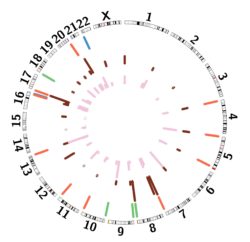
In this case study we hear from Ronan and Anubrata, both research staff in Cancer and Genomic Sciences, who have been using BlueBEAR to find therapeutic targets and biomarkers for the diagnosis of ALT-reliant cancers such as high-grade glioma. Our lab is investigating the Alternative Lengthening of Telomeres (ALT) process; a molecular mechanism used by … Continue reading “Investigating the Alternative Lengthening of Telomeres (ALT)”
Category: User case study RDS
Bayesian Modelling of Rising Decision Thresholds in DDMs using BlueBEAR

In this case study we hear from Sophie Wetz, a Masters student in Psychology, who has been using BlueBEAR to investigate whether a dynamic, rising boundary improved the fit of the full Drift Diffusion Model (DDM) to Random Dot Kinematogram (RDK) task data. I’m a Master’s student on the Computational Neuroscience stream in the School … Continue reading “Bayesian Modelling of Rising Decision Thresholds in DDMs using BlueBEAR”
BEAR helps delve into the infant gut and malnutrition
In this case study we talk to Leon, a PhD student in the Department of Microbes, Infection and Microbiomes, who is using bioinformatics of microbes that encompass the human gut microbiome. The human gut is inhabited by trillions of microbial cells and most of those cells have very important roles in human health. My work … Continue reading “BEAR helps delve into the infant gut and malnutrition”
Using BEAR to peel back the layers on potato genetics

In this case study we talk to Jack, a PhD student in Biosciences, who is using bioinformatics to understand plant genetics. I am a PhD student working in plant sciences supervised by Dr Lindsey Compton. My research focuses on using bioinformatics to understand plant genetics. Canopy architecture traits, like height and area, impact photosynthesis, drought … Continue reading “Using BEAR to peel back the layers on potato genetics”
How I used BEAR to understand investor behaviour in FinTech markets

In this case study we talk to Mohammad B M A J Aldoub, a PhD student in Economics, who is investigating how investors react to negative shocks in peer-to-peer (P2P) lending platforms. My research examines how investors react to negative shocks in peer-to-peer (P2P) lending platforms, with a particular focus on belief dispersion during uncertain times. P2P lending refers … Continue reading “How I used BEAR to understand investor behaviour in FinTech markets”
Shaking up mixing: optimising mixing using BlueBEAR
In this case study we talk to Emily Allman, MEng Chemical Engineering undergraduate student, who looked into the efficiency of Resonant Acoustic Mixers (RAM) using BlueBEAR, for her final-year research project. Emily presented her paper at the recent BEAR PGR Conference 2025. I am a final-year MEng Chemical Engineering student at the University of Birmingham. For … Continue reading “Shaking up mixing: optimising mixing using BlueBEAR”
Extracting tender information with BlueBEAR: tackling complex documents with NLP and image processing

In this case study we talk to Asim Abbas, PhD Researcher in Artificial Intelligence (School of Computer Science), who is using BlueBEAR to extract structured information from unstructured and ambiguous tender documents. My research focuses on extracting structured information from unstructured and ambiguous tender documents, whereas these documents present distinctive processing challenges due to their … Continue reading “Extracting tender information with BlueBEAR: tackling complex documents with NLP and image processing”
RNA sequencing analysis made easy with BEAR
In this case study we talk to Jonny Lewis (researcher in Inflammation and Ageing) about how BEAR helps in understanding changes in the cells lining blood vessels when blood flow is not linear and smooth – altering what they release and communicate with. The sound of a computer, working at its limit, the fan desperately … Continue reading “RNA sequencing analysis made easy with BEAR”
Extraction and Analysis of Hydrological Spatial Data

In this case study, we hear from Chenlu Yang, a PhD student in the School of Geography, who has been leveraging BEAR (Birmingham Environment for Academic Research) to study flood behavior and hydrological extremes My research focuses on analyzing trends in flood behavior and hydrological extremes across the UK using high-resolution gridded datasets and long-term … Continue reading “Extraction and Analysis of Hydrological Spatial Data”
Unlocking the power of BlueBEAR for social science research
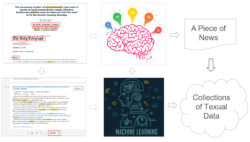
In this case study, we hear from Shuyu Li (based in the Department of Economics), who has been utilising BEAR for tackling complex environmental economics problems. As a PhD student in Environmental Economics at the University of Birmingham, I’ve always been fascinated by the ways in which cutting-edge technology can unlock new avenues for research. My work … Continue reading “Unlocking the power of BlueBEAR for social science research”