

The Birmingham Economic Review is out now!
This year’s report will provide a comprehensive analysis of the city’s economy amid the wider geopolitical landscape, and actionable measures that businesses and stakeholders from across the city-region can take to drive economic growth.
Read the full Birmingham Economic Review 2025.
In a new blog for the Birmingham Economic Review, Matthew Lyons, Huanjia Ma and George Bramley discuss how the West Midlands Health Tech Innovation Accelerator is accelerating health‑tech businesses by reducing fragmented support, crowding in significant co‑investment, and generating early evidence of regional economic and employment impacts.
The WMHTIA has clearly demonstrated demand for its offer. The WMHTIA programme exceeded its original targets of engaging 150 enterprises over two years by 180 per cent (269 enterprises ) and delivery of 50 high value or intensive support packages by 228 percent (114).
WMHTIA has significantly reduced fragmentation of support available for HealthTech enterprises that has been impeding growth of individual enterprises and the cluster. It has achieved this by bringing together partners who can provide support across all capability domains that must mastered to successful commercialise a new technology.
The way WMHTIA is structured has achieved high levels of trust archived necessary for a sustainable partnership model. There is evidence of kitemarking effect for participating health technology enterprises projects being supported: the WMHTIA programme through integrating the wider innovation ecosystem provides an important signal to investors about reduced risks in propositions being supported.
HealthTech enterprises have benefitted from:
- Unprecedented range of support and expertise available through a single point of access.
- Diagnostic surgeries that identify and prioritise their technology and business development needs
- More holistic support for the development and commercialisation of their innovation
- Between 6 to 12 months acceleration for those in receipt of a competitive grant
- Identification of new international market opportunities
- Safe spaces to discuss challenges they face with their peers
- Introductions to and collaborations with NHS partners including development of innovative to solutions to real world problems faced by local trusts as well as access to clinicians, testing facilities and efficacy studies and adoption opportunities.
- Introductions to both potential Venture Capital and Corporate Venture partners as well as information on other forms of financing that may be more appropriate
- Support with prototyping and developing their supply chain including local manufacturing thereby retaining more value within the region.
Partners and the region have benefitted from:
- Improve data and knowledge flows necessary to both support commercialisation of innovations and to innovate in their offer to the cluster
- Expanded base for future collaborations and creating systematic efficiency (i.e. more joined-up and effective policy and delivery)
- Inward investment including HealthTech enterprise relocating to the region, as well as investment in infrastructure and individual businesses
- Expansion of demand led innovation addressing specific challenges of NHS Trusts
We can only provide at this stage an initial assessment of the wider economic impact of the programme as there has been insufficient time impacts be realised. The ability to undertake such an assessment at a future date has been built into programme delivery with enterprises consenting at registration to being follow up including linking the data-linking with commercial and public databases that collate business performance information.
In April 2025, the estimated level of co-investment achieved to date is £67.3m. Following the definitions provided by Innovate UK, this comprises £15.1m Type 1 and 2 (pledged and accompanying) co-investment, £6.0m Type 3 (aligned) co-investment, and £46.2m Type 4 (follow-on) co-investment. The figure below provides an alternative breakdown: £49.4m investment been realised from private sources – including £36.3m direct investment into businesses – and a further £17.9m has been realised from public sources. The Type 3 and 4 co-investment figures (equal to the sum of ‘leveraged from investors’ and ‘grants and aligned funding’ in Figure below) are expected rise substantially with time given the potential for new initiatives within and between partners as well as further successful fundraising by the business cohort.
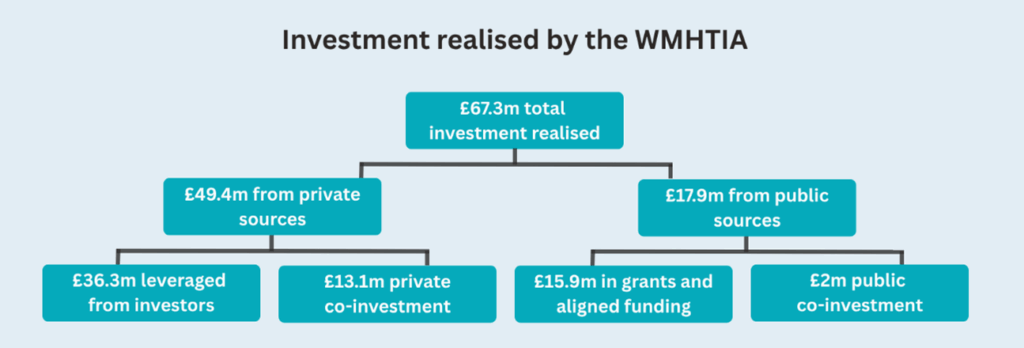
An early assessment of the potential economic impact of the WMHTIA programme has estimated an uplift of £38.3m in regional GVA and a £45.0m uplift in national GVA, based on £42.3m R&D activity taking place within WMHTIA partners and businesses between 2023/24 and 2026/27.
This £42.3m R&D activity comprises:
- £15.2m R&D activity within WMHTIA partners during the pathfinder period
- £9.9m R&D activity within WMHTIA businesses during the pathfinder period
- £17.2m R&D activity within WMHTIA businesses in the two years following the pathfinder period
Please note that the estimated co-investment for the programme has risen from around £28m at the interim point this analysis took place to more than £67m at project end.
City-REDI used SEIM to estimate the wider employment and Gross Value Added (GVA) effects of the WMHTIA programme to the West Midlands region. This estimate includes jobs not directly created or safeguarded by the programme captured by the job audit. We used the model instead of surveying the participating business because it was not feasible to collect direct and indirect employment data at this early stage. This assumed £42.3m R&D activity taking place within WMHTIA partners and businesses between 2023/24 and 2026/27, split across the health, education, information and communication, and professional, scientific and technical sectors. The modelling results associated this investment with a £30.1m GVA uplift in these sectors in the West Midlands, an £8.2m GVA uplift in other sectors in the West Midlands, and a £6.7m GVA uplift in other UK regions. The R&D activity supported 739 FTE job-years in the West Midlands and 90 FTE job-years in other regions. The total uplift in UK GVA was £45.0m and the total FTE job-years at the UK level was 829.
This blog was written by Matthew Lyons, Huanjia Ma and George Bramley , City-REDI, University of Birmingham.
Disclaimer:
The views expressed in this analysis post are those of the author and not necessarily those of City-REDI or the University of Birmingham.