

In May 2026, Aston Villa won the Europa League, their first European trophy for 44 years. England have two more representatives, Arsenal and Crystal Palace, in the finals of the Champions League and Conference League – the other two major European competitions. This can be a cause for celebration of the strength of English football. But, what this really shows, is the balance of power is skewed towards the wealthiest. And we must take this shift seriously. The changing geography of power towards the wealthiest has implications for the English football and the 2026 local elections.
From capital cities, regional cities and back again
The inequalities you see in football are very similar to what is happening in wider society. I have written how football mirrors the wider economy before. And the same point applies here.
I was struck that the 2025/26 Champions League Final between Arsenal and Paris St. Germain is only the sixth final in 60 years to be played by two teams from their respective capital cities. Three of those finals have occurred since 2014. The last one before that was Ajax (Amsterdam) vs Panathanaikos (Greece) in 1971.
Figure 1 shows the most successful clubs have moved from capital cities, then to regional cities, and back again. Over half of finalists in the Champions League/European Cup in the 1960s and 1970s were from capital cities. This fell in the 1980s (20%) and 1990s (10%). Now more clubs from capital cities are reaching the finals of top European competitions again in the 2000s (30%), 2010s (40%) and 2020s (50%).
Figure 1 The percentage of Champions League/European Cup finalists from their country’s capital city
| Decade | Total appearances | Capital | Capital % | Non‑capital | Non‑capital % |
| 1960s | 20 | 12 | 60% | 8 | 40% |
| 1970s | 20 | 11 | 55% | 9 | 45% |
| 1980s | 20 | 4 | 20% | 16 | 80% |
| 1990s | 20 | 2 | 10% | 18 | 90% |
| 2000s | 20 | 6 | 30% | 14 | 70% |
| 2010s | 20 | 8 | 40% | 12 | 60% |
| 2020s* | 14 | 7 | 50% | 7 | 50% |
This trend is mirrored in Europe’s second-tier competition in the UEFA Cup/Europa League. Around 25% of finalists in the 1970s, 1980s and 1990s were from capital cities. In the 2020s, this has risen to 50%. The third-tier European competition (Cup Winners’ Cup/Conference League) has stayed stable, with the proportion of finalists from capital cities holding steady at around one-third of clubs.
The Premier League is shifting further south
In the Premier League, there is a similar shift in the balance of power. This time, it is towards the south of England at the expense of teams from the north and midlands.
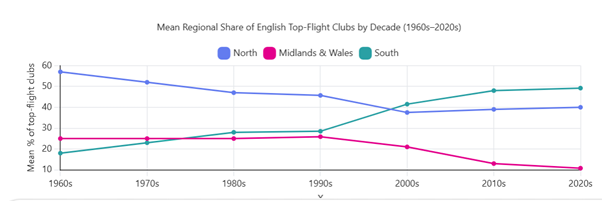
I grouped the top-flight clubs in England into three broad regions – North, Midlands & Wales, and South. Figure 2 shows the share of clubs from northern England has steadily fallen from 57% the 1960s to 40% today. Midlands clubs’ share in the top division has also fallen from 25% in the 1960s to 11% in the 2020s. This decline has come at the expense of growing presence of clubs in the south of England – growing from 18% in the 1960s to making up 49% of Premier League clubs in the 2020s.
The same trend exists in non-league football, where the line separating the North/South regional divisions has steadily moved further south. When the National League North/South divisions first set up in 2004/05, the dividing line flowed across the Midlands through Worcester, Redditch and Hinckley. Fast-forward to today, and the dividing line for the 2026/27 National League North lies between Oxford City, Merthyr Town, Bedford Town and King’s Lynn Town.
Football mirrors the wider economy
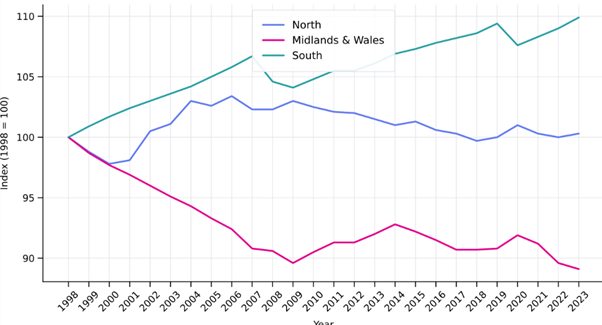
The southern shift of English football coincides with southern shift of the economy. Figure 3 shows regional gross value added (GVA) per capita has grown by 9.9% in the South since 1998. In the same time period, regional GVA per capita has been broadly flat in the North (+0.3%) and fallen in the Midlands and Wales (-10.9%).
Shifting power towards local people
What the trends in football show is that the balance of power is shifting towards capital cities and towards the south of England. The fragmented voting patterns in the 2026 local elections show that people recognise that – and are unhappy about it. People in small and medium-sized towns across the north of England and the midlands are moving away from the traditional voting trends. The growth in support for Reform and Green parties, as well as independent councillors, is at the expense of established support for Labour and Conservatives. Notwithstanding the rose-tinted view that nostalgia sometimes brings, there is a clamour in these places to regain the strengths and successes of the past.
Whilst Aston Villa’s European success is something to be celebrated, it comes in the context of the balance of power, in football and in politics, shifting towards the wealthiest. So, what can be done? In England, decision-making and policy-making needs to be moved closer to local people. Some levers to address geographic inequalities include: supporting regional economic development organisations, similar to the English Regional Development Agencies in the 2000s; devolving tax policy, similar to that in Scotland; the EU cohesion policy; or reunification of East and West Germany. A more radical option would be a federal England which would bring an end to the uneven patchwork of devolution. Also, the Independent Football Regulator aims to improve financial resilience and the heritage value of football. All these options can make a difference in bringing decision-making closer to the interests of local people. And the political parties that tackle devolution and bring power back to local people will be best placed for success into the future.
This blog was written by Hannes Read, Policy and Data Analyst, City-REDI, University of Birmingham.
Disclaimer:
The views expressed in this analysis post are those of the author and not necessarily those of City-REDI or the University of Birmingham.