
In a new series of blogs, we will be introducing our City-REDI Associates, learning more about them and what they plan to do whilst working with us.
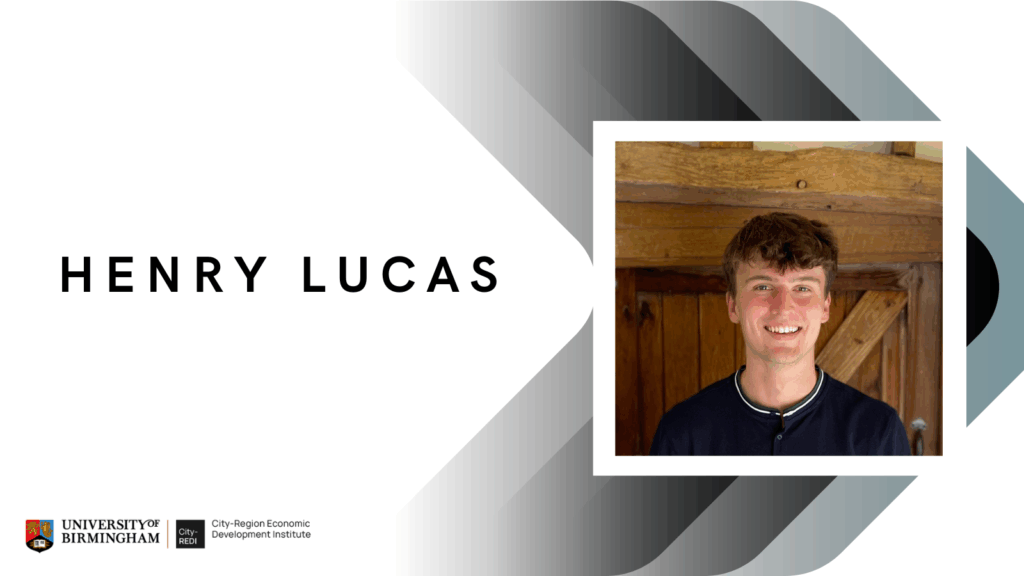
The first instalment of this series, we introduce Henry Lucas.
Introducing my role and focus
Hello – I’m Henry! I’m a Senior Socio-Economic Consultant at Ramboll, working at the intersection of economics, planning and development, and place-based analysis. My work focuses on understanding how infrastructure and development projects influence local economies, communities, and long-term outcomes, and how robust socio-economic evidence can support more informed and equitable decision-making.
Ramboll is a global architecture, engineering and consultancy company with over 18,000 experts in 35 countries, delivering multidisciplinary expertise to support sustainable development across sectors including transport, energy, buildings and the environment. I am part of a planning and development team, advising public and private sector clients on the economic and social implications of development, and supporting the delivery of evidence-led planning and investment decisions.
Connecting applied consultancy and academic research
My professional interests are closely aligned with the research agenda of the City-Region Economic Development Institute (CITY-REDI), particularly in relation to inclusive growth, spatial inequalities, and place-based policy. I am keen to further engage with the wider research community working in these areas, recognising the importance of bridging academic research and applied consultancy to improve the quality and impact of decision-making in practice.
How my academic background shaped my interests
This interest is rooted in my academic background. I am a graduate of the University of Birmingham, specialising in economics, economic geography, and political economy. My dissertation, which was awarded the Birmingham Business School Dissertation Prize, examined young people’s perceptions of the relationship between inequality and economic growth in the UK. This work sparked a continued interest in how macroeconomic trends and policy decisions translate into lived experiences at the local level, and directly informs my current work in social and economic impacts.
Building experience in economics, social impacts and social value
Professionally, I have developed experience across a range of socio-economic, social value and impact assessment disciplines. I began my career in social value consultancy, producing assessments and strategies for major infrastructure and real estate projects, before moving into broader economics and planning work. Through these roles, I have worked with a range of local authorities, developers, and infrastructure clients to support planning applications, policy development, and investment cases.
At Ramboll, my work centres on the delivery of socio-economic assessments for major infrastructure and development projects. This includes leading and contributing to Environmental Statement chapters, Economic Benefit Statements, and Health and Equality Impact Assessments, as well as supporting Green Book-compliant appraisal. I am involved throughout the assessment process, from scoping and defining methodological approaches, to undertaking analysis and translating findings into clear and defensible narratives for planning and decision-making.
A central aspect of my role is the integration of quantitative analysis with policy insight. I work extensively with spatial and data, undertake economic modelling, and use publicly available datasets to understand local conditions and forecast potential impacts. Equally important, is the communication of these findings in a way that is accessible and relevant to clients, stakeholders, and decision-makers, ensuring that complex evidence can effectively inform policy and investment outcomes.
More recently, I have contributed to and led work on Nationally Significant Infrastructure Projects and large-scale urban developments, working within multidisciplinary teams to deliver robust, policy-aligned assessments. This has included coordinating technical inputs, managing project delivery, and supporting the development of mitigation and enhancement measures to maximise social and economic benefits.
Strengthening analysis through data science and AI
Alongside my consultancy work, I am currently undertaking postgraduate training in data science and artificial intelligence. This reflects a broader interest in how emerging analytical approaches can strengthen socio-economic evidence, and support more sophisticated, data-driven approaches to place-based analysis and policy development.
Looking ahead: inclusive and sustainable outcomes
Looking ahead, I am particularly interested in how my work social and economic imp can evolve to better reflect issues of inequality, wellbeing, and long-term community outcomes. There is a growing opportunity to strengthen the integration between academic research, policy development and applied consultancy, ensuring that development and infrastructure projects deliver more inclusive and sustainable outcomes. I am keen to continue contributing to this agenda, including through deeper engagement with research institutions such as CITY-REDI and the wider academic community!
About Henry
Henry Lucas is a Senior Socio-Economic Consultant at Ramboll, specialising in economic development, socio-economic assessment, social value, impact assessment, and place-based analysis. His work focuses on helping public and private sector clients understand how infrastructure and development projects can support more inclusive, sustainable and evidence-led outcomes. For any enquiries, please contact Henry at henry.lucas@ramboll.com.
About Ramboll
Ramboll is a global architecture, engineering and consultancy company founded in Denmark in 1945. With more than 18,000 experts working across 35 countries, Ramboll delivers sustainable solutions across sectors including buildings, transport, energy, environment and health, water, management consulting, and architecture and landscape. Ramboll’s work is guided by its ambition to create sustainable societies where people and nature flourish.
Disclaimer:
The views expressed in this analysis post are those of the author and not necessarily those of City-REDI or the University of Birmingham.