
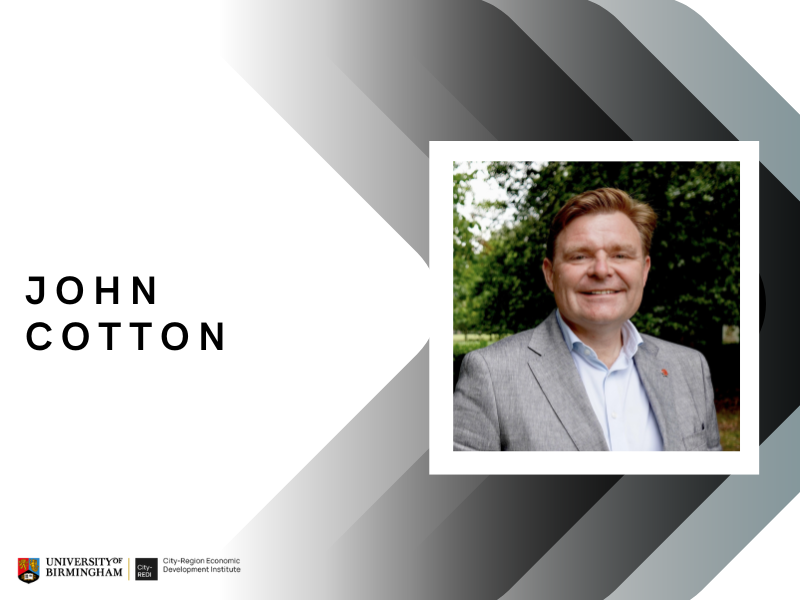
In a new series of Blogs, we hear from new City-REDI Associate John Cotton.
As a born and bred Brummie, and someone who has spent over 25 years in civic leadership working on the big political, economic and social questions facing our city and region, I’m delighted to be joining the team of associates at City-REDI.
Ours is a city and region with huge opportunities and potential. Birmingham itself is attracting huge levels of inward investment, of which the cranes on the city centre skyline, the eye-catching new buildings shooting out of the ground, and the transformation of tired streetscapes into vibrant new urban environments are a very visible symbol. Our region is home to cutting edge sectors that are driving national growth: in life sciences, advanced manufacturing, green technology, professional services and the creative industries. There is so much to be optimistic about.
Yet you don’t have to take too long a stroll away from this vista of growth and opportunity to find a very different city. Streets with some of the highest levels of structural unemployment in the country. Neighbourhoods where over half of children grow up below the poverty line and overall life expectancy averages a decade less than those living in places just a short walk or bus ride away. We must be honest: Birmingham’s story is also a tale of two cities, and one that is repeated in too many neighbourhoods across the wider West Midlands.
The moral imperative to tackle poverty and challenge social injustice is the thing that drove me into public life as a twenty-something political neophyte back in the 1990s. But over my quarter of a century as a Councillor, Cabinet Member and ultimately as Leader of Birmingham City Council, something else became very clear. Ending our tale of two cities is not simply a moral obligation alone. Its continued existence is nothing less than an act of economic and social sabotage that holds our city and region back. Leaving in place the obstacles that leave potential untapped, talent undeveloped and opportunity denied in these communities actively undermines our capacity for economic growth that benefits us all.
I’ve joined City-REDI because I want to help find an answer to this most crucial of questions. Why have the benefits and opportunities of growth and regeneration persistently failed to reach all neighbourhoods? Whether we are talking about the physical regeneration and shift from a manufacturing to service-based economy that began in the Birmingham of the mid-1980s, or the life science and digital revolution that is changing our world in 2026, access to opportunity has not been equitable. A generally rising tide (notwithstanding the big economic shocks of the last two decades) has stubbornly failed to raise all boats.
It can’t go on like this, and frankly I can understand those who feel some despair over whether it’s possible to really deliver the scale of change that so many of our communities are crying out for. Indeed, as council leader, and as a local councillor who represented a part of the city where the consequences of the “tale of two cities” were most harshly felt, I met many who took that view. But I remain firmly optimistic. We can do better – and we are at a moment of opportunity that is, if we are bold enough, there to be seized.
Locally, some of the challenges that prevented Birmingham City Council from playing its full role in transforming our city: ongoing budget problems, the burden of historic equal pay liabilities and an outmoded organisational culture have been addressed – and that’s something I am proud to have helped deliver during my term as council leader. The investment picture continues to be a rosy one, despite economic turbulence. We have massive growth opportunities in the form of the £4billion Sports Quarter, the housing-led regeneration of Ladywood and Druids Heath, and with the transformation of our infrastructure through HS2, Curzon Street Station and the ongoing expansion of the Midland Metro.
Nationally, the debate is focused more than ever on how to unlock growth through devolution to regions and localities, with a welcome focus on localising the skills pipeline, extending fiscal flexibilities and addressing a system of local government finance that is fundamentally broken and no longer fit for purpose. It is little wonder that so many councils find themselves unable to spare sufficient time and resource on enabling good growth in our communities when they are being dragged under by the costs dealing with the failure of social care and housing markets.
Freeing up local leaders to build partnerships between the public and private sector, and abandoning the old fashioned, top down, “we know best” approach to empowering and regenerating communities, clears the path to realising the new Prime Minister’s ambition of growth in every postcode. Where better to start that work than here in Birmingham?
As we forge ahead, City-REDI has a crucial role to play supporting our political, business and community leaders to seize this moment, by asking the questions, providing the intelligence and laying down the constructive challenges that drive good policy and decision-making. As a member of the City-REDI team, I make no claims to academic expertise (and if I did, it would be a risible attempt given the hugely impressive intellectual records of my fellow associates), but what I hope to offer is a perspective rooted in the practicalities and frustrations of trying to deliver the meaningful and lasting change that so many people in our city and region so desperately need.
I firmly believe Birmingham and the West Midlands’ best days lie ahead, but only if we are bold enough to ensure that this time, no one gets left behind.
This blog was written by John Cotton, a City-REDI Associate.
Disclaimer: The views expressed in this post are those of the author and not necessarily those of City-REDI or the University of Birmingham.