

Donald Houston summarises his recent report examining the geographic inequalities in young people who are not in employment, education or training (NEET) across the UK.
The issue
The dominant policy response for decades to tackle youth employment has been chiefly supply-side in nature, tackling ‘deficiencies’ in young people themselves. New analysis just published in a City-REDI research and policy briefing demonstrates that living in a buoyant local labour market will do more to bring down NEET rates than supply-side improvements. There is therefore an important, currently largely missing, role for co-ordinated demand-side interventions and local and regional economic development.
The Milburn Review into young people and work is due to publish its final recommendations in the Autumn of 2026 after publishing interim findings in June 2026 (DWP, 2026). This independent review addresses both supply side (e.g. skills and health) and demand side (e.g. hiring) solutions to the NEET crisis. This dual approach is to be welcomed after decades of coercive supply-side labour market activation policies. However, the demand-side issues addressed in the Milburn Review largely focus on how employers can be incentivised to hire more young people. Incentive structures for employers are important, but the number of job openings available and the buoyancy of the national and local economies is a crucial pre-condition for employers to be able to respond to incentives.
Local labour market conditions can reveal the relative importance of structural versus individual factors affecting risk of being NEET, chiefly the relative availability of jobs versus individual skills (Houston, 2005). Long-term structural shortages of labour demand in Britain’s former industrial heartlands go some way to explaining the geography of unemployment and health-related benefit claims (Beatty and Fothergill, 2005, 2020).
The UK displays high levels of regional inequality in a range of labour market and health indicators. The analysis reported here reveals that the NEET rate is no exception, and that understanding its geography is fundamental to understanding the causes of the UK’s NEET crisis. This finding is based on a novel dataset that has been created for 179 International Territorial Level (ITL3) regions (available via the UK Data Service here).
The geography of local NEET rates and its drivers
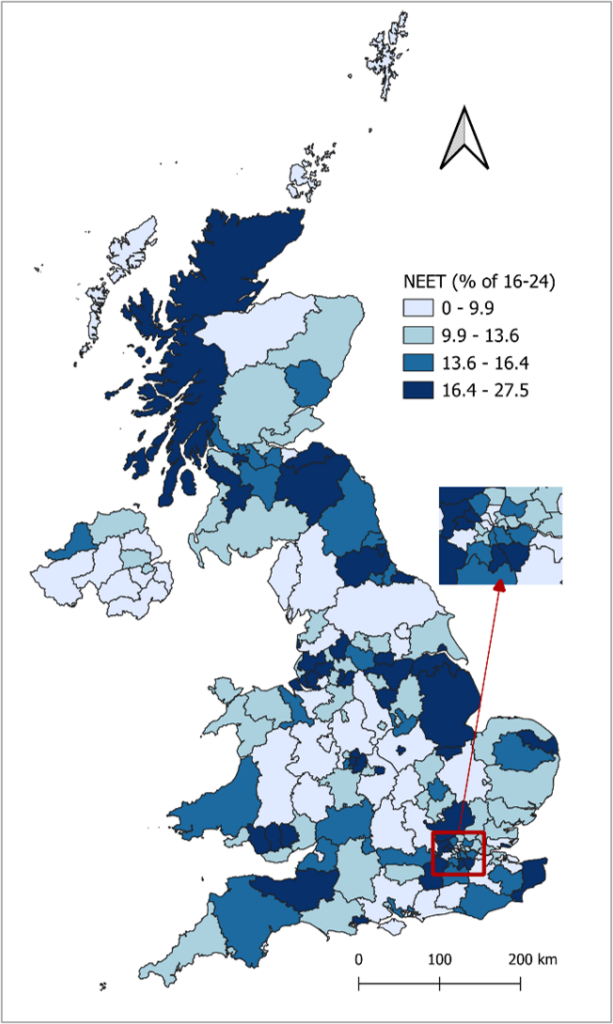
NEET rates vary between ITL3 regions from just a few percent to over 25 percent (Figure 1). The highest rates are mainly found in large cities outside London (although some London Boroughs have high rates, particularly Ealing, Croydon and Brent) and former industrial and coalmining areas, such as the South Wales Valleys, Teeside and parts of Kent. Weaker rural and coastal economies also tend to record high NEET rates, such as Blackpool, parts of Lincolnshire, Northumberland and western Scotland.
Figure 1. NEET rate by ITL3 areas, 2022-24
The primary aim of the analysis is to differentiate between local labour market conditions and labour supply influences on local NEET rates. Local labour market conditions are captured in overall local unemployment rates. The quality of labour supply is captured by qualification and health of local people aged 16-24 years.
Analysis reveals that local youth NEET rates are correlated with the overall local unemployment rate. This suggests that the causes of young people being NEET are similar to the causes of unemployment for older age groups, chiefly the overall buoyancy of local labour markets.
What will bring down the NEET rate the most?
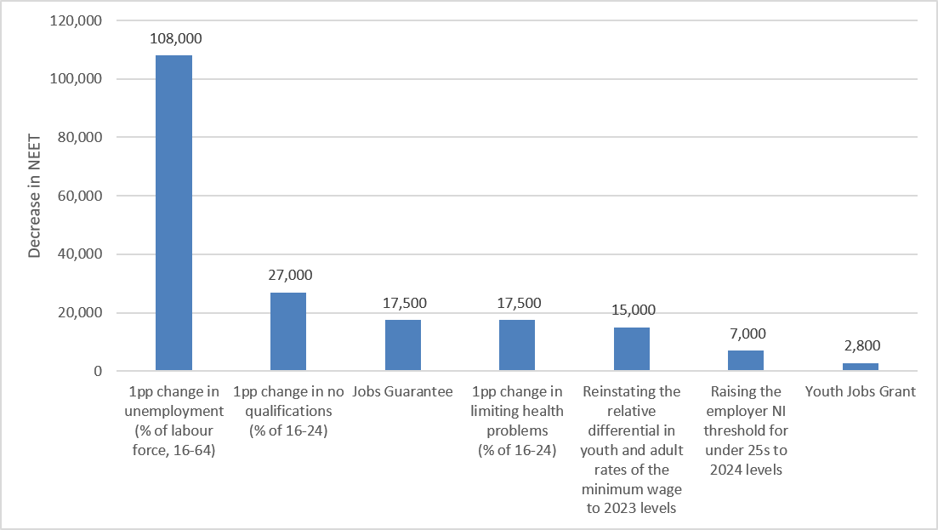
The analysis indicates that a one percentage point decrease in unemployment would reduce the NEET rate by 1.452 percentage points and the NEET number by 108,000. Supply-side improvements are also need and can make a difference, but on a smaller scale than local and national economic recovery. A one percentage point decrease in young people with no qualifications would reduce the NEET rate by 0.360 percentage points and the NEET number by 27,000. A one percentage point decrease in young people with limiting health problems would reduce the NEET rate by 0.232 percentage points and the NEET number by 17,500.
Bringing down local unemployment will do more to bring down NEET rates than even substantial supply-side improvements and hiring incentives for employers (Figure 2). Only the Jobs Guarantee scheme and increasing the differential between youth and adult minimum wage rates have the potential to bring down youth (16-24 years) NEET rates on a scale commensurate with changes to labour supply (skills and health).
Figure 2. How much could national youth (16-24 years) NEET numbers be brought down by different policy measures versus improvements to local labour market conditions and labour supply
Policy recommendations
National policies to the NEET ‘crisis’ will not work in many places. In places with low youth NEET rates and strong labour markets, supply-side measures on their own may make a difference. In places with high youth NEET rates and weak labour markets, a combination of supply-side interventions and demand-side hiring incentives and job creation and economic development will be required.
Devolution of powers and resources to design and fund relevant local policy interventions will therefore be required to tackle the UK’s NEET crisis. Some places are short of workers while others are short of jobs.
Governments in neoliberal mature economies have rather given up on the idea that they may be able to shape the direction of the economy and labour market in meaningful ways by supporting businesses and workers. Just as poor health and low skills hold back some young people, so the poor health of the economy holds back employers from hiring young people. Both sides of the equation, labour supply and labour demand, need to be addressed. The UK Government must not shy away from using macroeconomic management and regional and urban policy as part of a policy package to tackle the youth NEET ‘crisis’.
This blog was written by Professor Donald Houston, City-REDI Associate, City-REDI, University of Birmingham.
Disclaimer:
The views expressed in this analysis post are those of the authors and not necessarily those of City-REDI / WMREDI or the University of Birmingham.