

Dr Tarek Mostafa provides a longitudinal analysis of young people’s career aspirations and early occupational outcomes in England. It provides important context for more focused local research investigating the transitions of young people’s transitions into good employment.
Introduction
In the UK more than one million young people are not in education, employment, or training (NEET). They represent 1 in 8 16-24 year olds. The Milburn Review interim report highlights that we are facing a generational fault line that is no longer about short-term youth unemployment but about a generational shift characterised by youth detachment from the labour market.
Here we use longitudinal data to investigate adolescents’ career aspirations, early adulthood occupational outcomes and the mismatch between the two. We use a latent profile analysis approach (LPA) to identify profiles that best align with each young person’s outcomes and characteristics, with profile membership being explained by predictors reflecting the dimensions – including age, gender, ethnicity, socioeconomic disadvantage, education, health, disability and place of residence – identified in the Milburn Review.
Methods
We use data from the England sample of the Millennium Cohort Study (MCS): a nationally representative longitudinal survey following children born in 2000 from infancy to early adulthood. Data were drawn primarily from age 14 (Wave 6) and age 23 (Wave 8). Although more than 12,000 cohort members were included initially, attrition reduced the productive sample at age 23 to 6,439 cases. After excluding cases without occupational information or aspiration data, the analytical sample consisted of 5,231 participants.
The analysis examines the relationship between occupational aspirations in adolescence and realised occupational outcomes in early adulthood and the socio-demographic factors that explain mismatch. Three key indicators were used: occupational aspirations at age 14, occupational status at age 23, and the mismatch between aspirations and realised occupations. Aspirations and occupations were coded using the SOC2010 classification and converted into continuous occupational-status measures using CAMSIS (Cambridge Social Interaction and Stratification) scores. This allowed direct comparison between adolescent career goals and later employment outcomes.
To identify distinct patterns of aspiration-attainment relationships, we employed Latent Profile Analysis (LPA). Rather than examining aspirations and achievements separately, LPA identifies unobserved groups of young people sharing similar combinations of aspirations, occupational outcomes, and mismatch. Models were estimated using Generalised Structural Equation Modelling.
A wide range of explanatory variables was included to predict profile membership. Childhood variables captured gender, ethnicity, parental education, parental occupational class, parental unemployment, deprivation, family structure, and parental mental health. Early-adulthood variables included educational attainment, region of residence, physical and mental health, disability status, and attitudes towards work.
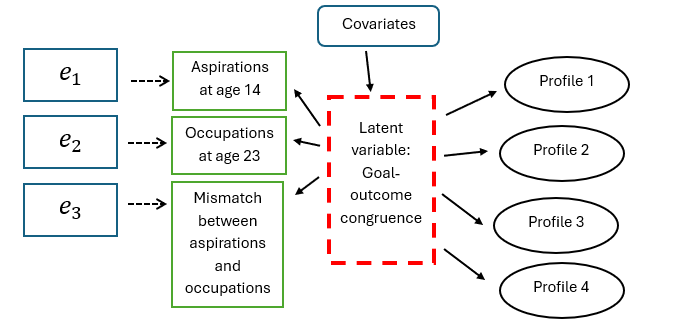
The main assumption of LPA is that profile membership is unobserved but can be inferred from the patterns of observed variables. Unlike traditional variable-focused econometric models that try to identify the link between aspirations at a younger age and later achievements, LPA assumes that both aspirations and achievements are shaped by experiences, living circumstances, and individual agency that ultimately define goal-outcome congruence (i.e. the latent construct), as shown in Figure 1.
Figure 1: Latent Profile Analysis
Findings
The findings indicate that occupational aspirations at age 14 were generally high regardless of subsequent occupational destination. Mean aspiration CAMSIS scores clustered between approximately 57 and 65 across all occupational groups. By contrast, realised occupational outcomes at age 23 were substantially lower and more dispersed. For most participants, occupational mismatch was negative, indicating that they had not yet reached the occupational status they aspired to during adolescence.
The mismatch was smallest among those employed in professional occupations and largest among those working in elementary, sales and customer service, and operative occupations. These findings challenge narratives suggesting a lack of ambition among young people. Instead, they indicate widespread ambition accompanied by difficulties translating aspirations into early labour-market success. They could also indicate unrealistic aspirations at age 14.
Table 1: Mean CAMSIS scores for aspirations at age 14 and occupations at age 23 by the nine SOC categories for occupations at age 23
| Unweighted Freq. | Weighted percent | Average CAMSIS score | |||
| SOC 2010 nine category classification | Age 14 aspirations | Age 23 occupations | Mismatch | ||
| Not in employment at age 23 | 1,368 | 24.6 | 63.67 | ||
| Managers and senior officials | 198 | 3.84 | 63.08 | 54.43 | -8.63 |
| Professional occupations | 644 | 11.82 | 65.54 | 67.34 | 1.96 |
| Associate professional and technical occupations | 786 | 15.77 | 64.06 | 57.95 | -6.17 |
| Administrative and secretarial occupations | 416 | 7.63 | 64.47 | 51.00 | -13.42 |
| Skilled trades occupations | 336 | 7.84 | 58.83 | 41.17 | -17.66 |
| Personal service occupations | 461 | 8.4 | 61.57 | 44.62 | -16.88 |
| Sales and customer service occupations | 413 | 7.31 | 63.04 | 40.65 | -22.25 |
| Process, plant and machine operatives | 143 | 2.74 | 57.77 | 34.77 | -23.47 |
| Elementary occupations | 466 | 10.06 | 60.25 | 31.47 | -28.82 |
| Overall standard deviation | 62.89 | 49.46 | -13.15 | ||
| Total and overall mean | 5,231 | 100 | 10.00 | 12.94 | 14.71 |
From the LPA analysis four distinct groups were identified:
- Disillusioned (30%): reported very high aspirations but relatively low occupational outcomes, producing the largest aspiration-achievement gap.
- Low Trajectory (10%): combined low aspirations with low occupational outcomes, but showed relatively little mismatch because outcomes broadly matched expectations.
- Highflyers (36%), combined high aspirations with high-status occupations and displayed minimal mismatch.
- Misaligned (24%), reported moderate aspirations but low occupational outcomes, creating moderate levels of mismatch.Table 2: profile sizes, marginal means and probabilities
| Profiles | Variables | Unweighted Frequencies | Profile size % | Latent profile marginal means | Marginal probabilities |
| Profile 1: Disillusioned | Age 14 aspirations | 1665 | 30.16 | 70.32 | 0.30 |
| Age 23 job status | 41.45 | ||||
| Mismatch | -28.72 | ||||
| Profile 2: Low Trajectory | Age 14 aspirations | 486 | 10.08 | 42.76 | 0.10 |
| Age 23 job status | 48.00 | ||||
| Mismatch | 5.17 | ||||
| Profile 3: Highflyers | Age 14 aspirations | 1898 | 35.68 | 66.19 | 0.35 |
| Age 23 job status | 62.79 | ||||
| Mismatch | -3.20 | ||||
| Profile 4: Misaligned | Age 14 aspirations | 1182 | 24.08 | 57.37 | 0.25 |
| Age 23 job status | 41.36 | ||||
| Mismatch | -16.09 |
Occupational distributions differed markedly across profiles. Highflyers were strongly concentrated in professional and associate professional occupations and were largely absent from lower-status occupations. Disillusioned participants were heavily represented in personal service, sales, customer-service, and elementary occupations. Misaligned participants were particularly concentrated in skilled trades and elementary occupations, while Low Trajectory participants were distributed across associate professional, personal service, and elementary occupations.
The quality of jobs also differed across groups. Highflyers were least likely to experience zero-hours contracts, shift work, or NEET status. Disillusioned, Low Trajectory, and Misaligned participants were more likely to experience insecure working conditions. Highflyers were also employed in occupations with higher exposure to generative artificial intelligence, reflecting concentration in knowledge-intensive occupations.
Multinomial regression analyses showed that childhood socio-economic disadvantage was a major predictor of profile membership. Compared with Highflyers, membership of the Disillusioned, Low Trajectory, and Misaligned profiles was associated with lower parental occupational status, parental unemployment, and lower educational attainment by age 23. All ethnic groups were less likely to belong to the low trajectory profile in comparison with the White majority group.
Higher qualifications substantially increased the likelihood of belonging to the Highflyer group. Mental health also emerged as an important factor. Young adults experiencing psychological distress were significantly more likely to belong to the Disillusioned, Low Trajectory, and Misaligned profiles. The relationship was particularly strong for the Disillusioned and Misaligned groups, suggesting that poor mental health may contribute to difficulties in converting aspirations into realised occupational outcomes.
Region of residence was strongly associated with membership of the Misaligned profile. Young people living outside London were significantly more likely to experience moderate aspiration-outcome mismatch than those living in London. In an ‘escalator effect’, the concentration of opportunities in the capital may facilitate faster career progression and improve the likelihood of realising aspirations.
Overall, the analysis demonstrates that most young people hold ambitious occupational goals, but their ability to realise those ambitions is shaped by education, mental health, family socio-economic resources, and regional opportunity structures. The findings highlight that career outcomes are not solely a consequence of individual ambition but are also strongly influenced by structural conditions across childhood and the transition into adulthood.
Note: This blog is based on research conducted as part of the ‘Youth transitions to good employment: East Birmingham & North Solihull’ project. This project is undertaken by a research team at City-REDI and the School of Education at the University of Birmingham, working with local partners including Birmingham City Council, Solihull Council and the West Midlands Combined Authority. This project has been funded by the Nuffield Foundation, grant number FR-25308, but the views expressed are those of the authors and not necessarily the Foundation. Visit nuffieldfoundation.org
This blog was written by Dr Tarek Mostafa.
Disclaimer:
The views expressed in this analysis post are those of the authors and not necessarily those of City-REDI or the University of Birmingham.