
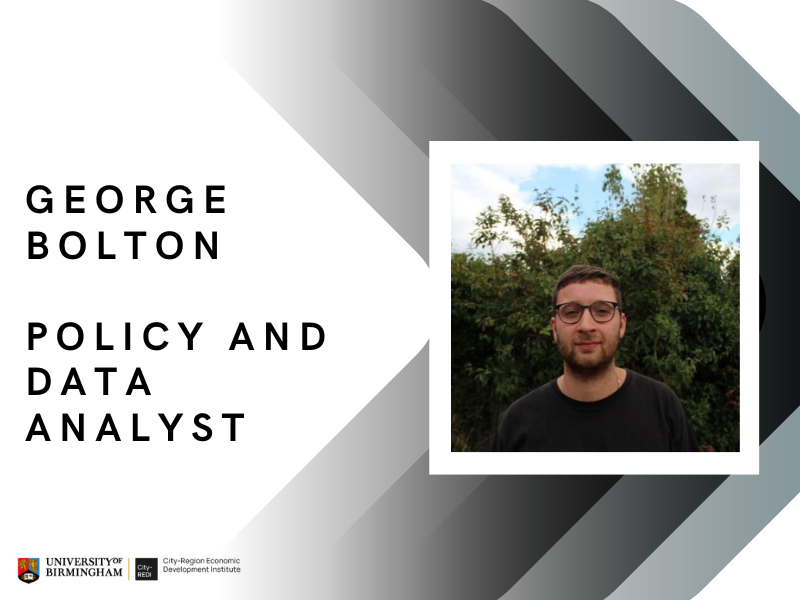
George Bolton, City-REDI’s new Policy and Data Analyst, reflects on his career so far, his motivation for joining City-REDI and what lies ahead.
Motivated by Addressing Complex Issues
My interest in City-REDI comes from a long-term commitment to use my research skills to help address the multiple, overlapping issues affecting communities across the UK. Whether it’s public health, welfare policies or unemployment support, I am passionate about producing rigorous, data-led analysis that can inform more effective public policies.
Using Data Analysis to Understand Economic Inequality
My doctoral research has equipped me with advanced quantitative skills and a strong grounding in socio-economic analysis. I have worked extensively with large datasets, combining administrative data, survey data, and spatial data to understand economic and social outcomes across population groups and levels of geography across the UK.
This research agenda has given me an intimate understanding of multiple economic pressures currently affecting harming living standards for communities across the country, from rising housing costs during the cost-of-living crisis to job-seeking requirements in the Universal Credit system.
My most relevant chapter focused on how individuals’ exposure to economic inequality in their MSOA was associated with their feelings towards the fairness of the broader economy. I found that when local areas became more economically unequal, the gap between lower and higher income groups in their feelings of economic unfairness widened.
This finding indicates that inequality can matter within relatively small areas of geography and lead to rifts among communities in whether they feel the national economy is working for the good of society. At City-REDI, I plan on building on this experience to further understand the political implications of shifting inequality in their communities.
Creative Problem Solving
Working with data to understand complex social and economic trends across the UK is not easy. The data needed to firmly understand many important issues is often patchy, imperfect and spread across multiple sources.
One of my favourite parts of my work is reflecting on this complexity and arriving at solutions that make the most of available resources, while drawing conclusions that reflect both the data’s strengths and limitations.
A key example comes from my work as a Research Consultant on a project focused on rent affordability across Greater Manchester, a critical issue for policymakers and analysts focused on urban development and inclusive growth.
Working with a large dataset of around 885,000 individuals, I used the Survey of Hours and Earnings to address limitations in the original dataset by assessing the plausibility of individual and household incomes.
No solution is perfect, so I devised a system that communicated the reliability of household income estimates to the client so that the reality of the data was clear to stakeholders making investment decisions.
This experience directly prepares me to work at City-REDI, where I will be applying the same skills to assist regional policymakers as they aim to understand the distribution of economic indicators throughout their jurisdictions. Only then can decision-makers make genuinely informed decisions, which then have the potential to be resource-efficient and deliver the best outcomes possible for local communities.
Collaboration Across Sectors
Alongside technical work, I have developed a strong interest in fostering collaboration across academia, policymaking, and the third sector. Drawing on multiple sectors’ strengths is the most effective way of solving the challenges facing our society, economy and politics.
At the Involve Foundation, for example, I worked on a co-designed research project focused on improving collaboration between academics and practitioners in the third sector. A key part of this work was working alongside experienced members of both sectors to identify mutual goals, devise approaches to mitigate risks and producing a guide that accessibly shared these insights with a diverse range of individuals and organisations.
This collaborative approach is not mutually beneficial, it is key to unlocking funding from national and regional funding bodies. City-REDI is a national leader in coordinating and maintaining impactful cross-sector partnerships, making it an ideal fit for me as I aim to build on my experience.
Looking ahead, I am prepared to contribute the full range of my skills, expertise and experience to the team at City-REDI. Most of all, I am grateful for the opportunity to learn from some of the leading figures in regional economic development and cross-sector partnerships. Whether it’s through working with policymakers, academics or community groups, I am ready to join the collective effort to ensure that opportunity, prosperity and security is enjoyed by all communities across the UK.
This blog was written by George Bolton, Policy and Data Analyst, City-REDI, University of Birmingham.
Disclaimer:
The views expressed in this analysis post are those of the author and not necessarily those of City-REDI or the University of Birmingham.