
The Birmingham Economic Review is out now!
This year’s report will provide a comprehensive analysis of the city’s economy amid the wider geopolitical landscape, and actionable measures that businesses and stakeholders from across the city-region can take to drive economic growth.
Read the full Birmingham Economic Review 2025.
Annum Rafique explores how improving the energy efficiency of UK homes—particularly in the West Midlands—can reduce fuel poverty, cut emissions, and deliver wider health and economic benefits through effective retrofit schemes.
Domestic buildings are among the UK’s most energy-intensive sectors, accounting for nearly 20% of the country’s territorial greenhouse gas (GHG) emissions. Poor energy efficiency also contributes to fuel poverty and health inequalities. In 2022, 13.1% of households in England were fuel poor , and it was estimated that 10% of winter deaths are attributable to fuel poverty and 20% to cold homes. According to the 2023–24 English Housing Survey, 13.2% of people reported being unable to keep warm during winter. Non-decent homes remain disproportionately concentrated among low-income and fuel-poor households, with 15% of all homes classified as non-decent.
To address these challenges, the government has implemented multiple retrofit schemes since the early 2010s. These programmes have helped to improve the national housing stock, though progress has been uneven across tenures and regions.
Energy Efficiency
Over the last 10 years, the proportion of homes in the highest energy efficiency bands (A to C) increased from 23% to 52%, while the proportion within the lowest bands (E to G) decreased from 26% to 9%. Social housing has the highest median EPC score (69), compared to private rented (64) and owner-occupied homes (63), suggesting that targeted retrofitting and social housing decarbonisation funding have had a positive impact.
Figure 1: Median Energy Efficiency by Region (2022)
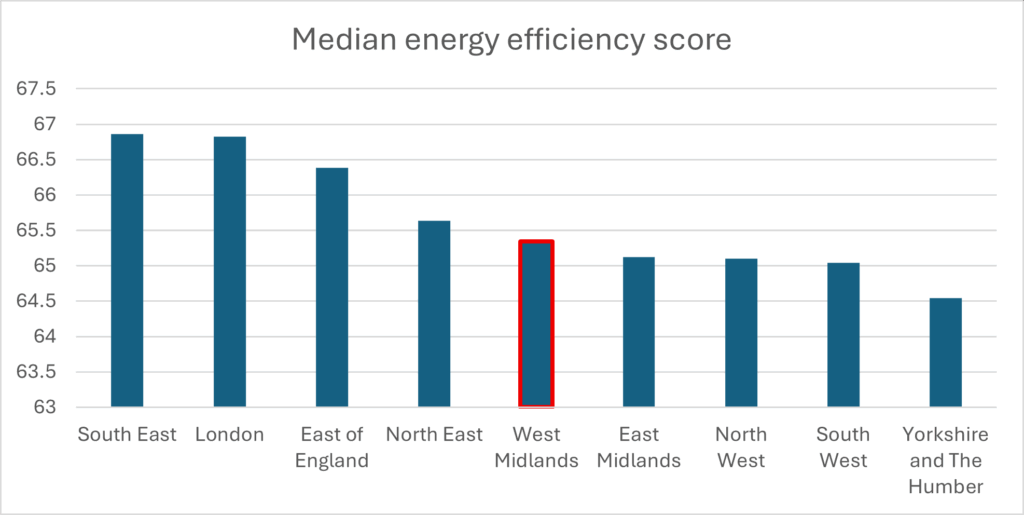
In regional terms, the West Midlands sits in the middle of the national distribution with an average score of 65.3, outperforming the East Midlands (65.1), North West (65.1), South West (65.0), and Yorkshire and the Humber (64.5). While the South East (66.9) and London (66.8) remain ahead, the West Midlands performs solidly and has avoided slipping into the lower-performing group of regions. This indicates that the West Midlands has established a strong foundation on which to build upon and expand its retrofit progress. With the greater deployment of targeted schemes, the region is well-positioned to close the gap with the top-performing areas while simultaneously addressing its higher-than-average rates of fuel poverty.
Retrofitting schemes and delivery
A wide range of retrofit schemes have been deployed across England, each targeting different household groups and energy needs. The Local Authority Delivery (LAD) scheme has focused on fabric-first measures for low-income households, while the Home Upgrade Grant (HUG) has supported efficiency improvements in fuel-poor, off-gas properties. The Social Housing Decarbonisation Fund (SHDF) has concentrated on upgrading the social housing stock, whereas the Boiler Upgrade Scheme (BUS) and the now-closed Renewable Heat Incentive (RHI) have primarily promoted renewable heat through heat pump installations. The Energy Company Obligation (ECO), funded by energy suppliers, has been the largest programme in terms of overall volume. Analysis of delivery patterns reveals a clear tenure divide: LAD and HUG have predominantly supported low-income households, while SHDF has focused on social housing. In contrast, BUS, RHI, and ECO have been dominated by private homes, accounting for more than 80% of dwellings upgraded or supported.
Figure 2: Percentage of homes retrofitted through government schemes
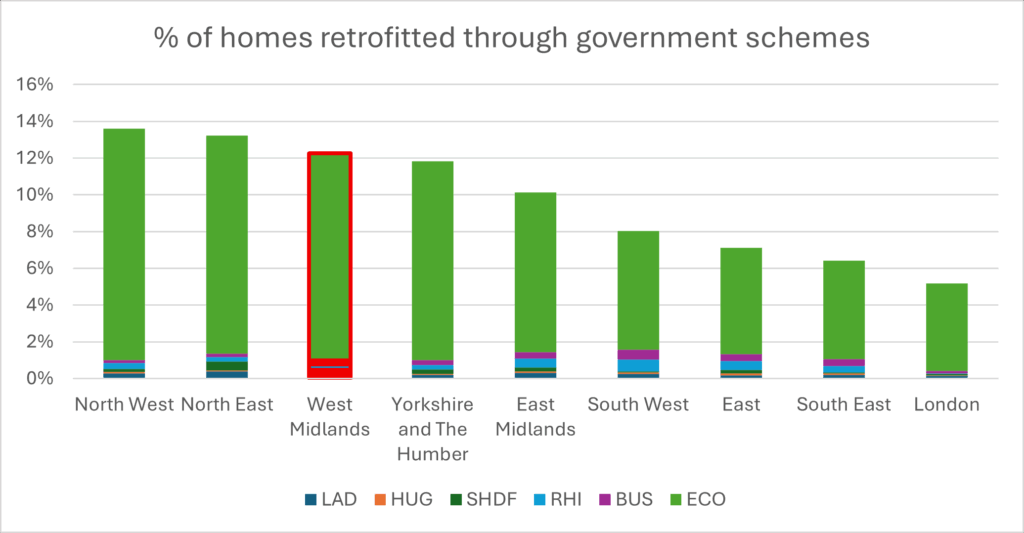
The regional distribution of retrofit schemes highlights a heavy reliance on ECO, with the northern and midland regions such as the North West (13%), North East (12%), and West Midlands (11%) capturing the largest shares. In contrast, schemes designed to target low-income or social housing households, such as the LAD, HUG, and SHDF, exhibit less activity due to shorter delivery windows of two to three years, compared to ECO, which ran for more than a decade. The West Midlands emerges as one of the strongest performers in ECO delivery, securing 11% of all installations nationally. Such performance reflects the region’s capacity to mobilise retrofit at scale, as well as effective engagement by local authorities and delivery partners. Its track record with ECO demonstrates readiness to absorb and implement retrofit funding. Building on this strong base, the region has considerable potential to expand activity into more targeted programmes. This would not only reduce fuel poverty and improve housing quality, but also unlock wider benefits in terms of public health, skills development, and supply chain growth.
Conclusion
The West Midlands illustrates both the opportunities and limitations of current approaches: strong ECO uptake demonstrates delivery capacity, but a lack of targeted scheme deployment leaves gaps for low-income and fuel-poor households. Looking forward, scaling up place-based programmes such as HUG and SHDF in the West Midlands would build on the region’s established delivery record while addressing pressing social and housing challenges.
This blog was written by Dr Annum Rafique, Research Fellow City-REDI, University of Birmingham.
Disclaimer:
The views expressed in this analysis post are those of the authors and not necessarily those of City-REDI or the University of Birmingham.